But Why?!?

Jan. 20th, 2026 10:30 am

In my previous post celebrating 100,000 miles on the bike, I promised an upcoming post about the motivations that underlie my passion for cycling. Here it is, with a shorter bonus postscript listing some things I actually dislike about cycling.

I started pedaling when I was around five years old, when my parents first plunked my ass down on a Marx Big Wheel plastic tricycle and turned me loose in our driveway. I’ve been pedaling ever since, with the only break happening during college (when I got my first car) through my first full-time job (and my first new car).

That tallies up to about 45 years where cycling has been a central part of my life.

Pæthos After PMC2025

It might seem a little late to think about this, but I’ve decided to take a look at why. What is it that motivates me to keep pedaling, after having already ridden for such a ridiculously long time?

The impetus for looking into that question came from a recent GCN video, wherein one of the presenters asked himself why he never got tired of cycling. It might be worth a watch if the question is meaningful to you. A few of the answers he shared resonated with me, and some of them absolutely did not, but the question remained…

What is it about riding a bike that still appeals to me?

But two items of business need to be mentioned before I can share my own answers.

First, after I’ve shared my motivations, I’ll share the much shorter list of things I hate about cycling, which might actually be more interesting to some.

And second: writing about my motivations is tricky. The list of factors is long and detailed, and it would be difficult to convey my depth of feeling without getting really verbose and boring my audience to death. So I’m going to keep my comments brief, and ask the reader to infer that depth of feeling. So keep that in mind while you read my summary descriptions.

That said, here’s my list. There’s a dozen of them, in single-sentence bullet-list form:

  • Cycling – especially the sensation of speed – is exciting and fun, and that’s just as true at age 60 as it was at age 6.
  • Cycling allows me to enjoy the outdoors, connecting with nature, breathing fresh air, and feeling the sunshine and wind.
  • It gets me out into the world around me, seeing the countryside and the varying contours of the land, while learning all kinds of details about the places I ride through.
  • I’ve always needed a physical outlet for expending excess energy, and cycling provides a healthy way to work myself to fatigue or exhaustion.
  • The health benefits of cycling are greater than almost any other human activity, contributing directly to cardiac, respiratory, circulatory, muscular, and digestive health (without even mentioning mental and emotional health).
  • Cycling can burn a tremendous amount of calories, which makes it great for dieting, or (as in my case) a good way to get away with eating lots and poorly.
  • I get to exercise my analytical side by tracking and comparing all the quantitive data that’s produced, such as my mileage, power, and fitness numbers.
  • With such clear ways to quantify performance, cycling makes it easy to set goals for myself, and a genuine sense of achievement upon reaching my goals.
  • Group rides offer a social element that is lacking in many of my other daily activities, and I’ve made a number of good friends as a result of this pastime.
  • Many rides wind up as treasured memories that I look back upon and will enjoy for a lifetime.
  • As everyone knows, one of the most rewarding things I’ve ever done is raising money to support cancer research at the Dana-Farber Cancer Institute, through my 26-year devotion to the Pan-Mass Challenge charity ride.
  • For all these reasons, cycling is clearly a great use of my time; among the many options I have for spending time, cycling beats nearly all other alternatives.

As far as I’m concerned, that’s an extremely compelling list of reasons to get out and ride, even – or perhaps especially – now that I’m into my sixties.

In contrast, there are certain aspects of cycling that I avoid like the plague. So, as promised, here is my much shorter list of the things that I hate about cycling.

Number one is that I only ride on the road. There are lots of other cycling disciplines, including mountain biking, gravel riding, cyclocross, track riding, bikepacking, downhill, stunt riding, and more. I don’t do those. I am a roadie, and exclusively a roadie.

I don’t race. In the U.S., most bike races are criteriums, taking place on small, technical courses with lots of turns. That kind of close-quarters racing is insanely dangerous, and I’m just not interested in courting crashes and injuries. And while I might enjoy other formats like hill climbs or time trials, I really have no desire to compete against other cyclists. I much prefer challenging myself with completing a long and/or difficult course like a century or a brevet.

I don’t do interval workouts or structured training programs. Although high intensity work is a vital part of any training regimen, I detest the self-induced extreme suffering of riding according to a spreadsheet and a stopwatch. What works best for me is the Swedish idea of “Fartlek” – or “speed-play” – where you emphasize varying your intensity based on the terrain around you, with some degree of both spontaneity and specificity.

I don’t ride a bike with motorized assist. While there might come a day when old age and feebleness force me to accept powered assistance from an e-bike, I will avoid that as long as I possibly can. Since exercise intensity is also an important part of healthy aging, I’m not going to surrender any of my fitness until I’m forced to.

And finally… I don’t mind big hills, darkness, or cold weather – I have appropriate gear for any of that stuff – but I do my best to avoid riding in wet weather. Even though it’s really only miserable at first (once you’re soaked thru, you can’t get any wetter), it wreaks havoc on the equipment and necessitates very thorough post-ride cleaning and maintenance: a messy, tedious chore I’d much rather avoid.

All this might leave you thinking that I‘m always ready and eager to ride, but that’s not always the case. In fact, there’s often times when cycling is the last thing I want to do. Usually that’s because I’m overtrained, when I’ve worked myself too hard for too long, without giving my body sufficient time to fully recover, leaving me tired and irritable. After all, it’s a fundamental cycling truth that you don’t get stronger while riding; that’s when you incur the damage that promotes muscle growth. That growth and strengthening can only happen while you’re resting, so it’s important for cyclists to rest just as diligently as they train.

That’s why I have time to contemplate and share why I’m still in love with cycling… Because I’m taking a much-needed rest day after riding for six days in a row! Now, if you’ll excuse me, I believe there’s a big ole burrito downstairs with my name on it…

The bike industry created the National Bike Challenge in 2012. It’s the gamification of cycling: you log your miles and get points (20 points per day and 1 point per mile) ranking you among other riders, plus a tiny chance at winning token prizes, including—I shit you not—a year’s supply of toilet paper. Meanwhile, the bike industry gets free marketing and all your data.

Platinum medal

I never felt any desire to participate, since the challenge offers riders absolutely nothing of value. However, they finally realized they’d get much more participation if they made data entry effortless: by simply requiring access to your Strava logs.

So this year I signed up, just to see what it was all about. The challenge formally runs for five months from May through September. In that time I rode 79 out of 153 days, or 52 percent of the days.

I was primarily interested in how I stacked up against other riders in Pittsburgh. I started out strong and consistent, but ended feebly. In May I had the 14th highest score in Pittsburgh; in June slipped to 17th; July 18th; August 19th; and then fell all the way to 41st for the month of September, when I had two bad colds, a week off the bike while traveling, no century rides, and the transition to shorter hill climbs in preparation for the Dirty Dozen.

In terms of miles, those months went: 567, 564, 567, 503, and 220, for a total of 2,421 miles. Out of 162 registered riders in Pittsburgh I ranked 18th, which made me 89th percentile.

Across the entire commonwealth of Pennsylvania, I ranked 121st out of 854 riders, or 86th percentile.

And nationally 31,543 riders registered, and my 3,305th ranking put me again at 89th percentile nationally.

Those are respectable numbers, but could have been better had I been able to ride more than 220 miles in September. Or if the century I did on October 1 had been scheduled just one day earlier!

While the challenge didn’t get me out and riding any more than usual, it did produce one consistent behavioral change: at the end of every ride, I took an extra loop up and down my street to be sure that I finished on an even number of miles. E.g. if I got home with 15.7 miles, I’d ride another third of a mile so that the odometer would just tick over 16, because the challenge doesn’t award points for fractional miles. But now that the challenge is over, I can forget doing that.

If you’re someone whose behavior can be manipulated by gamification, and don’t mind giving your personal data away for free, maybe the National Bike Challenge would be of interest to you.

For me, it was worth trying once, if only to see how I measured up against the other local participants. But going forward, it would be just one more unnecessary thing demanding my attention, while giving the bike industry unsupervised access to my personal data.

Coming back from four and a half months of forced inactivity is decidedly *not fun*. And I know from not fun.

Back on October 2nd of last year, I rode the first of this year’s Dirty Dozen group training rides. Then my mother got sick, and I had to go to Maine to care for her. Over the following 19 weeks I only managed one trivial ride, while my previous peak strength and fitness plummeted. I only resumed training on February 14th, about a week and a half ago.

Old Mill gravel road

Fortunately, my homecoming corresponded with Pittsburgh’s warmest February ever, with a record nine days in the 60s, and a couple well into the 70s.

After jonesing for the bike all winter, last week’s weather allowed me to ride five days consecutively, and in those five days I rode more often than I had in the previous five months! For the week, I rode six days out of seven, covered 167 miles, climbed more than two vertical miles, and burned a spare 7,800 kCalories.

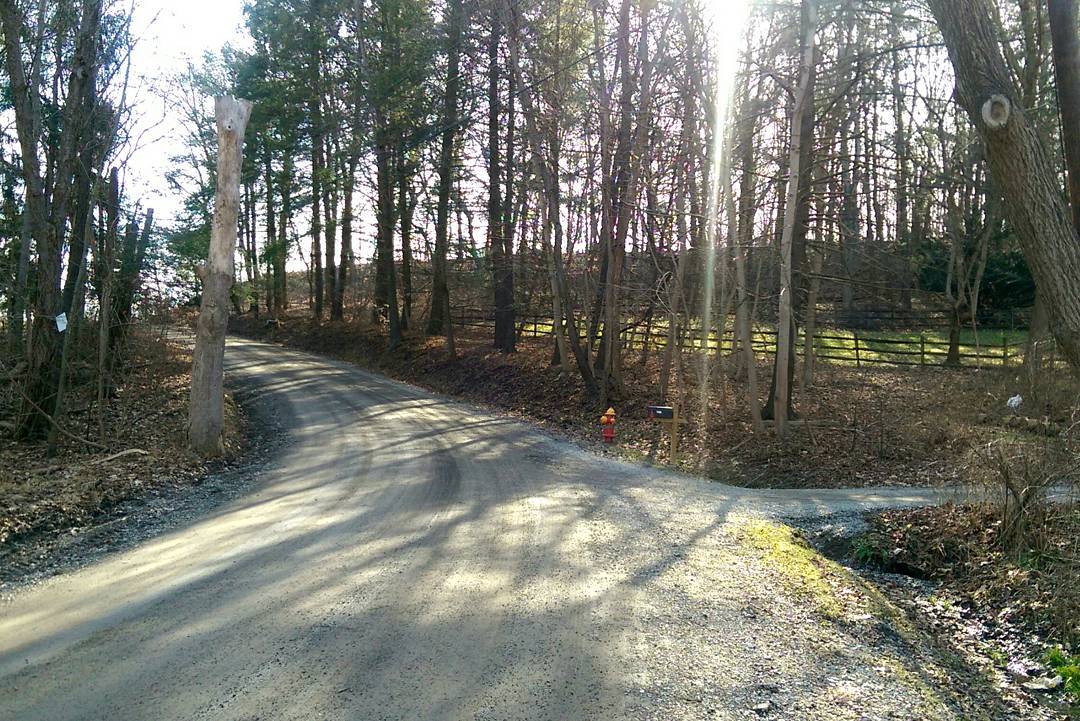
From a training perspective, I was trying to alternate between long, hilly days, and “off days” featuring short but hilly rides, to permit muscle recovery but maintain the training impulse. I hit Center Ave & Guyasuta (the first Dirty Dozen hill) twice, and took the opportunity to go exploring up a very hilly Field Club Road and the gravel outer segment of Old Mill. It felt great to finally put the body to use after endless months of inactivity!

But ironically, that intense desire to be on the bike post-layoff quickly evaporated, being overshadowed by the frustration and immense painfulness of rebuilding my fitness from nothing. It always surprises me that a short ride that I’d normally consider a mere warm-up in the summer can be so excruciatingly painful as to be almost impossible following a short winter break. And this was the longest that I’ve been off the bike in eighteen years!

Normally I’ve valued my off-season, eagerly anticipating the opportunity to relax, do something other than pedal, and eat whatever I want. I’ve always laughed at the muscle-heads who train year-round, caught in the perpetual hamster-wheel of compulsively needing to be faster than all their buddies. While I do enjoy riding fast and long, I don’t have so much ego at stake in my performance. Age and experience give you perspective beyond such adolescent traps.

But shockingly, I’m starting to appreciate the idea of training all year round. Not so much out of a vain compulsion to avoid losing competitive fitness at all costs; rather, it’s to avoid having to endure the muscle-searing pain of rebuilding the strength and endurance one loses during the off-season!

Or, to put it more succinctly: springtime riding still sucks hard! I mean, it’s beautiful and delightful… but it hurts so much that I’d consider giving up my off-season just to avoid that torture.

Thankfully, even in Pittsburgh February heatwaves must come to an end, giving weak, out-of-shape cyclists a breather, and a good reason to sit back and write about the trauma of early-season training.

Will I see you out on the road sometime?

I know a lot of cyclists here in New England whose idea of paradise is living in a place where one can ride year-round, where training rides and centuries aren’t stopped cold by winter’s ice and snow1.

Sure, it would be nice to have the choice of riding anytime one wants, but there are also advantages to having a limited riding season.

The easiest benefit to identify is that it provides one’s body a needed break. Training for endurance events is hard work2, and it puts a lot of stress on the body. By the end of the year, I’m physically drained and my muscles and joints need a couple months of rest in order to recuperate. By springtime, I’m refreshed and can attack the new season with renewed strength. Without that enforced time-out, I’d gradually lose strength and possibly cause greater damage to my joints as a result of overtraining.

What’s true of the body is also true for the mind: after months spent highly focused and motivated, one’s interest level wanes and one longs for a break. Mentally, I need that time to rest and recuperate just as much as my body does, so that when spring comes I’m eagerly looking forward to the long hours in the saddle and painful all-out efforts that training requires3. Without any break, my desire and motivation would gradually evaporate, and my performance would follow.

I find the same is true of anything I do. Whether it’s cycling, consulting, writing, travel, my meditation practice, or even relationships, I find it difficult to sustain intensely focused interest in something for years at a time without taking some kind of break.

Besides, taking a break from cycling frees up 10-20 hours a week, which I can devote to all the things I’ve been neglecting all summer (like career, writing, travel, my meditation practice, and relationships)!

But hey, why can’t you just leave the bike in the garage for a few weeks? Who says I’m obliged to ride all year ’round just because the weather’s conducive? Actually, that’s a solution that only a non-cyclist would offer.

A cyclist knows how the dynamic works. Most cyclists are competitive4. Whether it’s to put the hurt into one’s buddy on a big hill, or whether it’s simply to avoid having him put that hurt on you, no cyclist wants to lose ground (fitness- and performance-wise) to his buddies. Therefore, as long as the weather’s good, there’ll be someone out there doing hill repeats or interval workouts in an effort to get a leg up on the competition. And so long as that’s true, a cyclist trying to take an unforced break will still feel a strong obligation to ride, knowing that his buddies are out there getting stronger than him because they’re out there training5.

So although we might dream of a utopian world where it’s always sunny and warm, I’m very happy to live in a region where nature enforces an off-season. That way I don’t have to feel guilty about hanging it up for the winter, knowing that when spring comes I’ll have renewed desire to ride and my body will be ready6 for the challenges I’ll undertake.


1 Yes, one can ride year-round, even in New England. But I’ve never found true winter riding very useful endurance training. YMMV.

2 Yes, one can go into an endurance event with limited training, but one must do so with limited expectations. To thrive requires training.

3 Yes, at a certain point one’s training must focus more on intervals than mindless miles, but that’s only after one has a solid number of aerobic base miles, and distance training still has some benefits even after that.

4 Yes, most cyclists are competitive, but there are exceptions. They have wives.

5 Yes, more training volume isn’t always better. You need adequate rest, too, which a structured training program will provide.

6 Hopefully.

Frequent topics