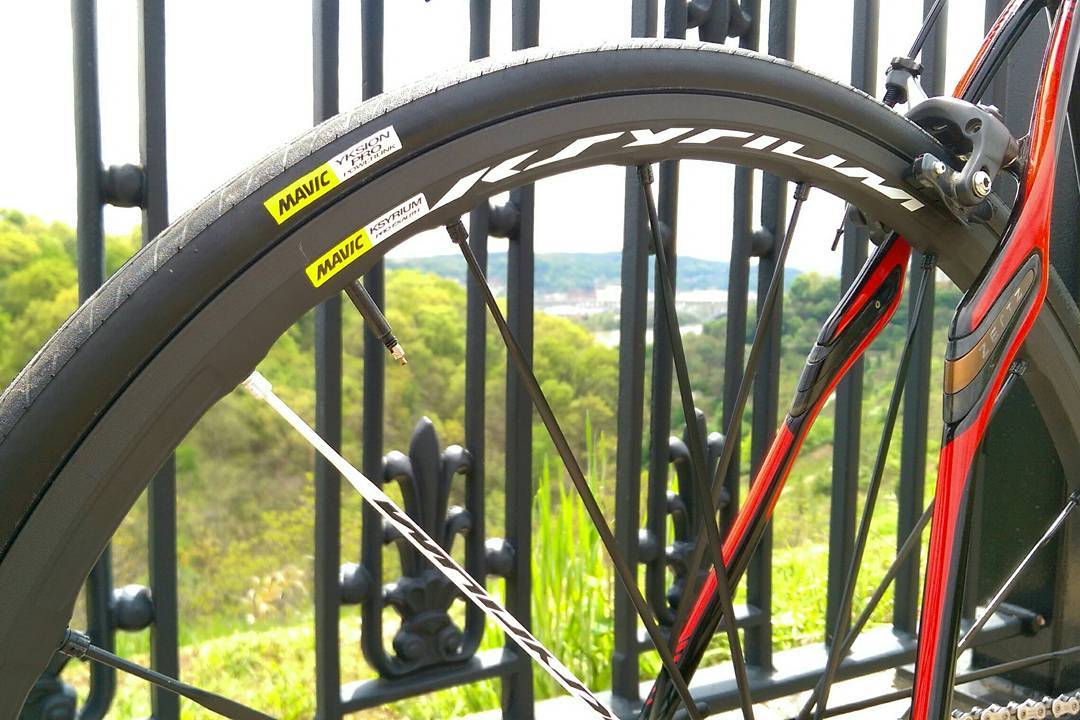
Back in June, on my third Bicycle House shop ride, I had a flat tire. Replacing my inner tube (plus a second tube and CO2 cartridge given to me by the ride leader) required a trip to the bike shop to replenish my parts inventory. In turn, that was an opportunity to finally try some changes to my wheel setup that I’d been considering for more than a year.

New other stuff

One change I made was simply making use of a new-ish tool that had been sitting in a drawer for months. I’ve struggled for years with how difficult it is to mount and dismount my tires, especially in a roadside repair. And recently moving to tighter-fitting “tubeless-ready” tires and wheels made that problem significantly worse.

The Tyre Glider is a little blue plastic device that makes both removing and installing tires considerably easier, replacing traditional tire levers and bulky tire jacks. After finally pulling mine out and putting it to the test, I can say it delivers on its promise. Not only can I get stubborn tires onto the rim, but I also don’t run the risk of puncturing brand-new inner tubes while mounting them. Two greasy thumbs-up!

Another item I’d been contemplating for years was a pocket-sized battery-powered inflator, which could replace both my frame pump and CO2 cartridges. These innovative little devices have become commoditized, and I used Amazon Prime Day to pick one up at 30% off. It’s the Fanttik X10 Ace Mini, from the same brand that makes the larger inflator I use for our car. While I haven’t used the Ace Mini a ton, my early results have been very positive.

Having struggled (as I said above) with mounting my tubeless-ready Continental GP5000 tires onto my rims, I’ve wanted to try a different brand, to see if they might go on easier. I’d heard positive things about Pirelli P-Zeros, and discovered that they still offered an expressly non-tubeless clincher version, which would be an easier fit. I picked up a pair of those and have been running them ever since. They feel great, and my only complaint is that they don’t seem quite as durable as other tires I’ve used.

New tires

At the same time, I also picked up some Pirelli TPU (plastic) inner tubes that I was eager to try. They are considerably lighter than traditional butyl rubber tubes, and are more manageable than the third alternative: latex tubes. A lot of riders keep TPU tubes as spares because they’re lighter and more compact, but I’d rather run TPUs all the time and have a reliable old butyl tube as my emergency backup.

Because I swapped tires and tubes at the same time, I can’t say whether the changes in my bike’s ride-feel were due to the P-Zeros or the TPU tubes… probably a combination. On top of that, the differences were pretty subtle, and I’m not the best at discerning minuscule differences in ride feel.

In comparison to my previous tires and tubes, it’s possible the new combination of P-Zeros and TPU tubes felt lighter, rode smoother, was a little quieter, held air a little better, and had a little less rolling resistance. But any difference was slight.

But there were two huge differences that were specific to the TPU tubes.

First was price. At around $30, each TPU tube cost three times as much as a butyl tube. We’re not talking huge dollars here, but for triple the price, I expected a vastly superior product.

And then there’s durability, which is where I’ve struggled to justify running TPU tubes at all, even though I really, really wanted to switch over to them. My first TPU tube lasted just 180 kilometers: 5 rides, or 8½ hours of ride time. The second went flat just 23 km into its first ride. The third didn’t survive 3 rides, or 86 km. That’s your three strikes; yer out.

So while running TPU tubes, I had 3 flats in 290 km; in contrast, my last butyl tube had served for more than 7,800 km! At that rate, I could run butyl tubes for $10 per year, or burn through $2,900 per year on TPU tubes!

The confounding thing is that those TPU flats were all on my rear tire, while the TPU tube I installed on the front has served flawlessly for more than 2,000 km! I guess the real test will be to move that tube to the rear wheel and see how much longer it lasts…

While I might prefer TPU tubes’ ride feel, they’re just not worth the cost, especially because TPU tubes just don’t work in real-life usage. End of experiment.

New chainring

Before I close, I’ll share three other noteworthy purchases which don’t have anything to do with tires.

One was a set of plastic inserts from Risk that increase the size of the hidden buttons underneath Di2 shifter brake hoods. The stock buttons are really tiny, making them hard to activate. These simple inserts provide a larger active surface area, increasing the usability of those buttons. At $8 for four, they’re cheap, easy to install, and effective: just the kinda thing I like!

I also had to replace my big chainring, which was damaged during one of my many TPU flat repairs (long story). After I ordered the part, it took just 15 minutes for the Trek store to perform a while-you-wait installation. That’s a big improvement over the treatment I got at the Specialized shop earlier this year, which kept my bike for 15 days to do a simple tune-up!

And if you bike in Texas, you need to learn how to manage the copious amount of sweat you generate. So I’m currently testing the efficacy of double-width wrist sweatbands. So far, so good, but I’m afraid of getting even stupider (sic) tan lines, so we’ll see how that goes.

I might not have blogged much lately, but from an “equipment” perspective, it’s been an eventful summer!

For whatever reasons, a lot of people dislike the major bicycle manufacturers. I’ve ridden Specialized bikes for two decades now, and one question I haven’t talked about is: “Why Specialized”?

So I wrote this big long essay following my progression as a cyclist over time and describing all my bikes and how much I used them and… never got around to answering the question.

So instead of a multi-volume encyclopedic life history, how about I just answer the goddamned question?

Episode One: The Plastic Bullet

The Plastic Bullet at the 2007 PMC.

The Plastic Bullet at the 2007 PMC.

I bought my first Specialized bike in 2005. At that point, I’d already ridden five Pan-Mass Challenge charity rides, and was a regular at Bobby Mac’s long group rides out of Quad Cycles. I’d transitioned into a committed endurance cyclist, after having started out as a short-distance bike commuter.

But that transition wasn’t something that suited my straight-bar hybrid commuter bike. I needed something faster, lighter, and more aerodynamic; something as zippy as the typical racing road bike but more comfortable, tailored for epically long days in the saddle. But no one sold such a thing!

Enter Specialized, who had just designed a carbon fiber bike that was fast enough for pro racing, but more reliable and forgiving in the cobblestone-strewn European spring classics races. They gave it a longer wheelbase, more front fork rake, and elastomer inserts to produce a smoother ride. In their new Specialized Roubaix, they had created the first bike in a whole new category: performance endurance bikes.

When I wanted a bike that combined top performance with all-day comfort, Specialized was the only company that could meet my needs. And the Plastic Bullet delivered on its “performance endurance” reputation, accompanying me through 7 PMCs, 30 imperial centuries, and 35,000 kilometers.

Episode Two: R2-Di2

R2-Di2 at Boston’s Charles River Esplanade

R2-Di2 at Boston’s Charles River Esplanade

Fast-forward seven years, and it was time to replace my trusty steed. Other manufacturers had introduced their endurance bikes, and I had grown into a discriminating roadie, so I took the time to test-ride eight different bikes.

However, nothing held a candle to the fourth-generation Roubaix, which was lighter, stiffer, and came with Shimano’s Di2 electronic shifting. Specialized was still the undisputed king of the performance endurance category.

Besides being my top pick, Specialized offered me a 20% manufacturer’s discount on the new Roubaix. By offering me an amazing bike at an amazing price, they ensured I’d be a loyal Specialized rider for the next chapter in my cycling career.

And R2-Di2 delivered in spades. Together over 10 years, we ticked off 45,000 kilometers, 59 imperial centuries, and another 6 PMC rides… PLUS 22,000 virtual kilometers on the indoor trainer, along with 13 Zwift centuries!

Episode Three: Pæthos

Pæthos at Austin’s Redbud Isle

Pæthos at Austin’s Redbud Isle

I was already delighted with Specialized, but when R2 finally came down with a fatal crack in the frame, they blew me away.

First, they have a discounted replacement plan for frames that break after their 2-year warranty expires. That’s pretty cool to begin with.

Unfortunately, that coverage stops after five years, and R2 was a decade old. But after they inspected my bike, they not only included me in the program, but offered me the 35% discount that you’d only get for a bike that was less than three years old! Imagine trading in a 10 year old bike and getting $2,500 toward a brand new model. Wow!

My only hesitation was that over that decade, the Roubaix had forgotten its “performance” heritage and evolved into a gimmicky, cushy family cruiser that no longer suited me. When I asked if I could apply the replacement discount to a different model… No problem! So they let me order an Æthos, their lightweight climbing race bike. Yay!

But there was a problem. This was toward the end of the Covid pandemic, when bike inventory had all been bought up, and the whole industry’s supply chain was in ruins. There was only one Æthos in my size left in the entire country, and it was in a bike shop in Denver, Colorado. But my incredibly responsive rep persuaded them to surrender it and ship it down to Austin for me.

So although I lost a very dear friend in my 2013 Roubaix, Specialized gave me an upgrade to an amazing, brand-new Æthos at an unbelievable price. I hope to put my new Pæthos through the wringer, too!

The Bottom Line

Specialized logo decal on downtube

So to finally answer the question…

I ride Specialized because their products have been excellent: well-designed, durable, and suited to my needs as a devoted endurance cyclist.

While I’ve come to expect petty greed from big corporations, Specialized has been shockingly generous with me, offering huge discounts well in excess of their corporate policies.

And beyond all that, they’ve been stunningly friendly and flexible, letting me apply my frame replacement discount to a different model, and then helping me track down and acquire the solitary bike in the country that fulfilled my needs.

Buying my first Specialized Roubaix road bike filled me with excitement and delight. That joy has stayed with me through three bike purchase cycles, over 100 imperial centuries, and more than 100,000 kilometers of riding. And Specialized’s bicycles and their treatment of me as a customer have been a significant part of the delight and enjoyment I’ve gotten throughout 20 years of cycling. Thank you, and well done!

The only area where they’ve disappointed me is in not offering more paint schemes or a custom paint program. You’d think that after 50 years in business, they would have figured that out. How about it, Spesh?

Poppies!

May. 16th, 2024 12:58 pm

Been a long time, I know. But thus far, my 2024 cycling has been uneventful but steady, as evinced by my Fitness chart, which has hovered almost unchanged since November… albeit at a level I consider reasonably active. Group rides have included ten PMC Zwift rides during the first two months of the year, which then transitioned to a dozen outdoor Friday Truancy rides as the weather improved.

Aside from just riding around, I’ve had to replace a lot of equipment due to wear and tear, including a saddle bag, gloves, three punctured inner tubes, and my heart rate monitor. My most noteworthy new purchase was a HoverAir X1 automated selfie drone, but I’ll discuss that in a separate, future blogpo.

I’d planned to undertake 2024’s first organized cycling event back in February. But as I packed the car the evening before my 2-hour drive to Hempstead, I left the interior cabin light on, and climbed into the car at 5am to discover a dead battery. Needless to say, I wound up aborting my Pedaling the Prairie ride.

With few events that early in the year, it wasn’t until this past weekend that I lined up for my first century of 2024: the Red Poppy Ride in Georgetown, 30 minutes north of Austin.

I approached it with a bit of trepidation. I’ve done no long rides this year, and an imperial century (at 161 KM) would be twice the distance of my longest indoor (82 KM) and outdoor (72 KM) rides thus far. I’ve also only done one century in the past 18 months; that was last September’s Livestrong Challenge, which pushed me beyond my limit and resulted in ignominiously puking my guts out into a trash bin at the finish line. That left me wondering if I am still physically suited to riding 100 miles now that I’m 60 years old.

Ride start: not a small ride!

Ride start: not a small ride!

After the half-hour drive to the start, I picked up my bib number (a grossly inappropriate #357) and joined a large field of several hundred riders, although most were doing shorter routes. Typical of Hill Country mornings, the sky was about 70 percent obscured by thin clouds, and the temperature hovered around 20°. You couldn’t ask for a better forecast for a long ride.

Having suffered three flats in recent months, I imagined that my rear tire wasn’t holding air pressure well and chose ask the mechanical support tent to replace my inner tube at the last minute. That work left me with just enough time to line up at the start with my buddy Jordan and his friends John, John, and Bob.

While swapping my tube, I heard snippets of the organizer’s pre-ride announcements, which mentioned some rough gravel sections of the route, a detour, and route markings. He said something about the 100-mile route coming back the to the start and then going out again on a second route to complete the full distance. I was already confused about the route because the organizer hadn’t provided a downloadable GPS course, while the cue sheet and two maps on the event website all disagreed with one another. And none of them had shown a mid-ride return to the start.

So as we rolled out at 8am, I wasn’t just worried about aging and my fitness, but also my tire, the route and any detours, the gravel sections, and the route arrows.

The first 22 km of the ride included a couple small hills before the course flattened out. More taxing was the 20 km/h headwind, which would persist through the north- and east-ward first third of the ride. We were quickly onto empty country roads through endless farmland and cornfields already showing ears with silks… in mid-May!

Fields and fields and fields and fields and...

Fields and fields and fields and fields and...

I was taking it easy, but keeping up with the pack. My friend Jordan disappeared down the road, but his outgoing buddy Bob and I chatted off and on as the miles ticked away. I zipped past the first two water stops before finally pulling off at rest stop #3 for a 5-minute break. It was 9:20am, and I’d covered 37 km.

Having finished the northeast-bound part of the course, we turned south. The change put the wind behind us, which was a delightful benefit on the endless false flats we covered. At 10:30am I pulled into water stop #4 for another quick refill. With 65 km down, I was on pace to complete my century in 6:10!

This was where things got frustrating. First my GoPro battery died after just 17 still photos. And 30 minutes on I felt the tell-tale squishiness of my rear tire going flat: the very misfortune that I’d hoped to avoid by installing a new inner tube. Ironically, it wasn’t due to a puncture; the leak was at the valve stem, indicating a manufacturing defect in the brand-new tube I’d gotten at the support tent.

Somehow, one of the few support vehicles pulled up almost immediately, followed – equally improbably – by the aforementioned Bob, John, and John trio. After installing my remaining spare tube, it took two of us to manhandle the tire back onto the rim, and we’d lost 20 minutes by the time we set out again. With 85 km still to go, no spare tubes, and gun-shy after my recent spate of flats, I decided it would be safest to continue riding with these guys, who were doing a more relaxed pace than I had been.

Having just had a long break, we skipped nearby stop #5 and rode on to stop #6, where we arrived just after noontime with 99 km on the odo. There was still some high overcast, but much of the fog had burned off, and temperatures had climbed moderately toward 26°.

Along the way, one of the Johns and I discussed the route, because none of the riders or support staff had any idea which of the several conflicting routes was the “real” one. Fortunately, John’s plan and my route gleaned from the cue sheet were in agreement, so we committed to that option, and to hell with the official route, whatever it was.

Texas: not unlike Ohio, Penna, or Mass

Texas: not unlike Ohio, Penna, or Mass

On the following segment, we endured about a mile of gravel road (where I fretted about my tire), followed by a gulley where Opossum Creek was just high enough to spill over the roadway, forcing a ginger water crossing. Along the way, Bob and the other John peeled off to complete shorter routes; but the remaining John and I were joined by another century rider named Dodge.

We rolled into rest stop #8 at 1:26pm, having completed 125 km. I was starting to feel the effort in my legs and traps. The whole day my Garmin bike computer had steadily predicted – based on my previous training – that I’d run out of stamina after 115 to 120 km, and it was eerily accurate.

This was actually the same location as stop #1, so we were pretty close to the start. But in order to complete the full century route, we needed another 35 km. This was the dubious part of the route, but the three of us agreed to follow the cue sheet, which did a 28 km loop by doubling back and rejoining the roads we’d already ridden. That included a second passage of the short gravel section and the Opossum Creek crossing, where I dunked my cycling sandal-clad feet in the stream to cool off.

And in no time (about 70 minutes, akshually) we rolled right back into the same rest stop, arriving at 2:50pm, now with just 9 km left to go.

After a minimal rest we knocked out the final segment back to the start/finish, hitting 100 miles (161 km) just before the end, celebrating Dodge’s first-ever 100-mile ride – and my 109th!

Reflections

While I can’t say this ride was spectacularly special, it did provide some memorable elements.

Most importantly, it gave me back my mojo, after such a difficult experience on my last century, eight months ago. It proved that – despite my age – I still have the strength to complete a 100-mile ride, even early in the year and in the absence of adequate training rides.

One of the reasons why it wasn’t a more painful experience is that riding with Bob and John forced me to pace myself. Although I thought I was being conservative at the start, my average power riding solo before I flatted was 152W, while after I flatted and joined them it was 112W.

My only physical complaints were growing pain in my traps toward the end of the ride, and saddle irritation in the days following.

One mistake was that I forgot to take the electrolyte caplets I’d brought along. That wasn’t an issue thanks to the temperate weather, but I don’t want to overlook that in future, more challenging (i.e. hotter) events.

In terms of equipment, the obvious issue was riding on an untested inner tube and worn tire. The entire second half of the ride was tinged with fear that I might have a second flat, but my backup tube performed flawlessly. But I do need to practice re-seating my tire on the rim, and am considering trying out a set of Pirelli P-Zeros over the tight-fitting Conti GP5000s.

And I can’t let it pass that I finished the 7½-hour ride with 56% battery charge left on my Garmin cycling computer, thanks in part to the 45 minutes of charge gained from its built-in solar panel. It’s nice no longer needing to carry a USB power bank and plug it in halfway through a long ride. And the unit’s stamina estimates again proved surprisingly accurate.

But the biggest worry and inconvenience was the organizer’s poor communication of the ride route. The overview map depicting all half-dozen courses was unclear. The 100-mile route map was incorrect, only showing an 86-mile route with no inner loop. The cue sheet included that inner loop, but that contradicted the other two maps. And the verbal announcement at the start said something about returning to the start, which wasn’t on the cue sheet or any map!

Out on the road, the half dozen routes were marked by colored arrows, but no one had labeled which color arrows went with which distance, so when they diverged, riders had to guess which arrow to follow. At every rest stop, riders were asking which route was correct, and the volunteers couldn’t do anything but point at the map. And after all that, the arrows painted on the road veered off and went in yet another direction altogether!

Of course, all this would have been avoided if the organizer did what every other event does: provide GPS route files that can be downloaded to one’s bike computer. I have no idea why the organizer neglected to offer this basic service, especially when their vague maps and cue sheets and arrows all contradicted each another. But setting that frustration aside, in the same way as I did during the ride…

I did enjoy the event. It had been nearly two years since I had a satisfying century ride, and I really needed the confidence boost that this one provided. I’m glad I did it, and glad to have my first century of 2024 under my belt. And I expect to return to the Red Poppy Ride, albeit after taking extra precautions to clarify the intended route.

… the season for a rambling update, because I haven’t shared anything since early September other than turning sixty, which you can read about here. So what has been going on? Let’s see…

As alluded to in my Livestrong Challenge blogpo, Specialized warranty replaced my rear wheel’s carbon rim after a nasty rock strike in the aforementioned ride. Summarizing my feelings about that:

Feeling ballsy

Feeling ballsy

Friday Truancy ride

Friday Truancy ride

Tour of Watopia celebration

Tour of Watopia celebration

Zwift PMC group rides resume!

Zwift PMC group rides resume!

Zwift fondo series returns

Zwift fondo series returns

  • Boy, am I glad I wasn’t running a tubeless setup, because my day would have irrecoverably ended right there. Thanks to my butyl inner tube, I continued riding without getting a flat. I didn’t even notice the break until I got home!
  • My first carbon wheel lasted just six months, or about 4,000 KM. That’s disappointing, unacceptable, and bullshit.
  • It took Spesh four weeks to replace the rim, which meant I was off the bike for a whole month during peak riding season. I need to remember that I have recourse to my indoor trainer and my folding clown bike.

In other news, I’ve purchased a couple new goodies. First is a cycling jersey from the Buddhist Bicycle Pilgrimage: a two-day northern California ride that I rode back in 2012. Read about that whole trip here.

Of greater impact (pun intended) is my one noteworthy birthday present: an Ekrin Bantam cordless vibrating mini massage gun, nicknamed my “Fun Gun”. I’ve long had lingering calf pain during training season, and addressed it by doing tapotement, a Swedish massage technique that involves rhythmically rapping on the muscle with one’s knuckles. Now I’ve got a portable device that can do that work for me, and so far I adore it.

If nothing else, this has been an excellent year for cycling purchases, as I’ll detail in my usual year-in-review at the end of the month.

On a less satisfactory note, the name decals I crowed about in this post failed miserably by de-laminating. I suspect the Texas heat got ‘em, but the manufacturer asserted that my carbon frame’s coating was still “off-gassing”. We’ll see, as I have reapplied a second set of decals.

And speaking of the heat, it got cold fast! We were in full-on summer mode until October 29th, when a strong cold front blew in and dropped temps from about 22°C to 13°C in about an hour, ushering in certifiably cold nights and cool days. Not ideal for riding the stationary trainer in an unheated garage! But other than that cold snap, the weather’s been pleasantly seasonable.

But that brings us reluctantly back to Zwift and the indoor trainer. Anticipating a warmish Texas autumn, I wanted to avoid the trainer and ride outside as much as possible. But then temperatures dropped, Zwift released some nice new roads, the Pan-Mass Challenge’s online group rides started up again, and Zwift moved the always-tempting “double XP” Tour of Watopia from March to October. So even though the weather was often fine for riding outdoors, I put the bike up on the trainer and started riding indoors again.

This year I rode 19 Tour of Watopia stages (plus two half-stages) totaling 950 KM. In the process I hit XP Levels 57 and 58, with new route badges giving me a head start on the road toward Level 59, which I will achieve this month. This year Zwift only awarded double XP the first time you completed a Tour of Watopia stage, but no one stopped you from almost completing one multiple times! In addition to the usual, regularly-scheduled group rides, this year you could also complete stages on your own schedule as free rides.

Then today – December 3th – I celebrated five years and 25,000 KM on Zwift by repeating one of my very first Zwift rides: their December fondo.

Thanks to my recent riding, I’m feeling strong and have regained all the fitness I lost during that month-long break due to my broken rim.

For the remainder of the year, I’ll be focused on reaching my 8,000 KM distance goal, trying to decide what I’ll do for the 2024 Pan-Mass Challenge, and putting the final touches on my inescapable annual year-in-review blogpo.

Back on September 10th, I completed the 100-mile Livestrong Challenge Austin ride and raised $875 for the Livestrong Foundation.

Rather than give you the usual chronological ride report, I’m gonna organize this mostly by themes, in hopes that it will be both more effective and readable. Are you with me here? Let’s start with the elephant in the peloton

The Decision

My decision to participate will surprise those of you who know my feelings about Lance Armstrong, the Livestrong Foundation’s disgraced founder. I don’t ever want to contribute in any way to the fame or fortune he has amassed from lying to the public and terrorizing the people around him.

So what convinced me to do the Livestrong ride? Here are the factors that went into my choice:

  • Lance has left the organization and is no longer involved in any official way. After suffering due to their association, Livestrong have wisely distanced themselves from him, although he remains their largest financial backer.
  • There are surprisingly few century rides here in Austin, and it’s been a long eleven months since my last one (back in Pittsburgh).
  • I hate cancer even more than I hate Lance, and Livestrong does admirable work for cancer survivors.
  • I have two friends who are Livestrong bigwigs, and their vocal support of the foundation earns it a degree of approval. My childhood friend Scott is on their Board of Directors and is a survivor of testicular cancer; and Steven, the leader of the Pan-Mass Challenge’s popular Team Kermit, is a Livestrong Ambassador (i.e. a distinguished volunteer).
  • Along with Steven, several other PMC friends from Boston come down to Austin for the Livestrong ride.

So while I hate the idea of being associated with Lance Armstrong, I don’t think it’s unreasonable for me to take part in this ride. But I took perverse pride in wearing my 2011 PMC jersey during the event.

Poor Training and Lead-Up

Ornoth with Scott & MJ

Ornoth with Scott & MJ

Scott, Ornoth, & Steven before the start

Scott, Ornoth, & Steven before the start

Ornoth lined up in the VIP starting area

Ornoth lined up in the VIP starting area

MJ & Scott, Steven & Ornoth ready for the start

MJ & Scott, Steven & Ornoth ready for the start

Ornoth rolling out with Team Kermit

Ornoth rolling out with Team Kermit

Rolling through the ranchland in Driftwood

Rolling through the ranchland in Driftwood

Scenic level crossing on the Blanco River

Scenic level crossing on the Blanco River

ClimbPro showing Fulton Ranch hill

ClimbPro showing Fulton Ranch hill

Team Kermit's Ornoth, Christophe, and Steve after conquering Fulton Ranch hill

Team Kermit's Ornoth, Christophe, and Steve after conquering Fulton Ranch hill

Real-Time Stamina, estimating 21% or 17km remaining before bonking

Real-Time Stamina, estimating 21% or 17km remaining before bonking

Ornoth dragging himself toward the finish

Ornoth dragging himself toward the finish

Ornoth crossing the finish line

Ornoth crossing the finish line

And having finished, collapsing

And having finished, collapsing

Not looking good post vomiting after the finish

Not looking good post vomiting after the finish

Solar power gain, showing 71 minutes gained over a 9-hour ride

Solar power gain, showing 71 minutes gained over a 9-hour ride

May, June, and July were filled with short rides focused on becoming Local Legend on the Ladera Norte hill. So I didn’t begin training for distance until August. And August’s training was cut short after badly throwing my back out. Right when my training should have been peaking, I was off the bike for ten days, while the small training effect I’d gained atrophied away.

Four days before the event, I was just getting back onto the bike when Team Kermit members started assembling in Austin. They were looking to meet up and ride every day, right when I would normally be tapering my training in order to be well-rested for the event.

Instead, on Thursday before the (Sunday) event, local Austin Kermit member Scott led a group of five of us up the Walnut Creek Trail, then back to 51th Street for lunch at Jewboy Burgers. Then on Friday I led a sightseeing ride up the Shoal Creek bikeway and back down Scenic Drive. We finished at event packet pickup, where I received a Livestrong Challenge cycling jersey and VIP rider bib tag #28.

I took Saturday off while the Kermiteers spent the day doing another long ride down to the Veloway park. I’d ridden 150 km in two days and was suffering for it. My back was still iffy, my ass was abraded, and my legs were too tired to tackle a hundred-mile ride without rest. At the same time, I hadn’t eaten or slept well, was already dehydrated, and down 1.8 kilos of body weight in a week. For the first time, my final ride prep included zip-tying a stuffed Kermit doll to my helmet, complete with white cowboy hat and rodeo bull-riding pose.

Quick Ride Summary

My Strava activity’s description summed my Livestrong Challenge up best: it was very good until it wasn’t.

After about five hours of sleep, I got up at 4:30am and set out in darkness at 5:45 on the 15 km ride downtown. I rode with Team Kermit from their hotel to the start, where we lined up in the VIP section before being set loose on the streets of Austin at 7:30am.

At the tail end of a brutally hot summer, the ride began under pleasant temperatures that warmed considerably, but not to the extremes that we’ve lived under for the past three months. South from Austin to Buda, then west and south through Driftwood.

Enjoying the freedom of having two water bottles rather than one, I skipped the first three rest stops out of a desire to stay ahead of the pack and beat the time limits for the 100-mile route, which the organizers had shortened by 30 minutes. So my first break came two hours in, after 57 km, (or 72 km if you include my 15 km commute to the start). As you might guess by such a long stretch without a break, I had been feeling good thus far.

I refilled my bottles and marshaled some strength for the long, steep hill at the end of the next segment. I enjoyed the pleasant tree-lined streets near Wimberley, and a stunning level crossing of the Blanco River. Then came the 15% grade climb up Fulton Ranch hill, which is essentially the halfway point of the course. It was quite manageable for a cyclist used to the much lumpier terrain back in Pittsburgh. At the top, a water stop beckoned; I pulled in at 10:30am, having taken three hours to knock out 77 km (or 92 km).

While resting here, Team Kermit members Christophe and Steve rolled in, and we would leapfrog each other for the rest of the 110 km trek back to Austin. But this would be the point when things slowly started going to hell. The temps climbed through the 30s, and I was feeling the effort in my feet, legs, lower back, traps, and hands.

As my reserves dwindled, my speed and power dropped, and my horizon shrank to simply reaching the next rest stop. I hadn’t eaten any solid food during the whole ride, and was pounding fluid in an attempt to address both heat and thirst. Extended 15-minute rest stops and hand towels soaked in ice water were just enough to keep me from blowing up.

I stopped twice to battle fatigue and nausea during the last segment to the finish, but completed the final loop around Auditorium Shores. The event photographers captured my grim visage as I crossed the finish line at 3:07pm. I’d completed the official 158 km official course in 7h 37m, but had fulfilled my 108th imperial century by riding 15 extra km to the start.

I collapsed in exhaustion underneath the Team Kermit tent and waved off others’ attempts at congratulations, accepting only a folding chair and an ice-water towel. And then came that feeling we’re all familiar with: a particular certainty that it’s time to find a convenient but discreet place to deposit some biological material. So I staggered nonchalantly over to a nearby trash can and retched about three gallons of undigested fluid that I’d carried with me over the preceding few dozen kilometers.

So my Livestrong Challenge ended successfully but ignobly. I managed to recuperate enough to stand for a team picture before I said goodbye, then met up with my partner Inna, who mercifully drove me those extra 15 km back home.

My First Century in Eleven Months

This was my first 100-mile ride since October 2022. Eleven months is a long layoff; I haven’t gone that long between centuries in fifteen years (since 2007-2008)! You ask me how it went? Go back and read the summary: it was very good until it wasn’t.

Mistakes were made. Looking back on it, nearly all of them were about my personal physical fitness and decisionmaking, not my equipment or the location or the event. So I guess that would be the logical place to start…

My Fitness and Decisionmaking

A century always demands a lot of stamina and will power from me, but this was an exceptional case. Despite being one of the first dozen riders out of the gate, then skipping three rest stops, I only marginally beat the last finishers on the course.

I could blame the Texas heat, but even at 37°C (98°C) it was mercifully moderate in comparison to the seventy days above 38°C (100°F) that Austin experienced over the summer.

Or I could blame my age. After all, I’m only weeks away from my sixtieth birthday, and that’s the kind of thing that can slow a guy down.

While those are valid considerations, there was a whole panoply of other factors that impaired my performance, leaving me with weak legs and zero stamina toward the end of the ride.

Despite not doing any long rides in nearly a year, I barely did any lengthy training rides prior to the event. I went into it fatigued and dehydrated from too little sleep and too much riding just before the event. I was insufficiently fueled due to an irregular eating schedule and not eating any solid food during the ride. And I still had lingering injuries to my lower back and my backside (the latter attributable to insufficient time in the saddle).

But the biggest wildcard was hydration. Consuming two bottles over the first five segments of my ride – especially since the first segment was a casual commute – doesn’t seem like an especially egregious error. But it set me up poorly for the second half of the ride, where my perceptions of thirst and heat were clearly malfunctioning, causing me to take in more fluid than I could digest. This is the biggest thing I’ll have to monitor on future long rides.

There were lots of physical niggles along the road, of course. Early on, I had to make a quick roadside stop to flush some stinging sunblock out of my eyes. In my cycling sandals, some pain developed in my big toes, but I got away without a repeat of the abrasions I’d gotten on top of my feet a couple weeks earlier.

And I’d expected pain in my hands due to a slight change in my position on the new bike. I did have some discomfort, but not the severe palsy that I’d feared. It would be prudent to address this soon by buying new cycling gloves and plush handlebar tape.

The New Bike

Like its owner’s ride, my new Specialized Æthos was very good until it wasn’t.

It looked like Pæthos came through its first century in flying colors, to the extent that I had very little to say about it, other than that it suited me well and earned my full confidence.

Two weeks before the event, I’d gotten a flat on a pair of brand new tires. That got me so worried about the rough chipseal of Texas back roads that I’d carried two spare inner tubes, in addition to a pump, a CO2 dispenser, and a Shrader-to-Presta adapter in case I needed an automotive air compressor. That was all overkill; Pæthos appeared to handle everything that was thrown at it.

Just before the ride, I’d also converted from one water bottle cage to two, which was a big win. That gives me the flexibility to ride farther unsupported or without stopping (e.g. skipping three water stops). But it also gave me the option of carrying both sport drink for hydration and clear water to pour over my head and body when the heat was at its worst. And I did lots of that on the Livestrong ride!

But those Texas roads did get me in the end. After I got home, I noticed a break in the carbon rim of my rear wheel, which most likely happened due to a rock strike somewhere along the Livestrong route. I took it in to Specialized to see if it was rideable or a case for a warranty replacement, and they chose to replace the rim. Pretty ridiculous that my first set of carbon wheels lasted a mere 4,000 km.

The New GPS Bike Computer

This was also the first century-length test for the Garmin Edge 840 Solar that I picked up last month, which delighted me in nearly every way. On top of flawlessly handling mapping and turn-by-turn navigation, it now sports graphical data fields (e.g. power and heart rate charts), and the new ClimbPro feature, which tracks your location on an elevation profile of the current climb.

While cool, I had already tested that stuff; I was more eager to try out some other features that could only be done on a century-length ride. After all, I couldn’t finish my full review until I’ve put it through all my typical use cases.

Top of the list was battery life. The battery on my old Edge 820 had deteriorated to the point where I had to plug it into a portable USB battery for any rides longer than 90 minutes. The new unit claimed 26 to 32 hours, and I finished my 10-hour day with a whopping 72% charge remaining. I think I can finally leave my USB charger at home for good!

Of course, that includes the benefit I derived from the unit’s solar charging feature, which in Texas is a painless way to give the battery slight boost. Over 9h 15m the unit gained about 72 minutes worth of solar power, or about 8 minutes per hour. Not revolutionary, but not trivial either!

The other major feature I wanted to test was Garmin’s new “real-time stamina” estimate, which supposedly learns your physiology and provides a real-time guess about how long you can go until exhaustion. At my first rest stop, it estimated that I had 55% stamina remaining, and – ominously – that my reserves would run out 40 km before the end. I monitored that number all afternoon as it fluctuated, but it consistently told me that I’d have nothing left in the tank for the last 25-35 km of the ride, which is exactly how things played out. It was surprisingly accurate, given the variables that it didn’t know about, like fueling and hydration.

One feature came as a complete surprise to me. When Kermit team leader Steven texted us to ask where we were on the course, I deliriously scrolled down through the usual canned, stock responses for something appropriate as I continued pedaling. At the bottom of the list was something my old unit had lacked: the ability to actually type a freehand text response right there on the head unit! So I was able to pound out a response that truly captured my feelings in the moment. In response to his “How far out are you??”, I answered “Lifetimes”.

The only glitch I had was a minor one. I’ve always had an alert set to pop up when I reached the 100 mile threshold, but it never showed up on the new computer. I’ll have to re-test that, the next time I get the opportunity to pound out a hundred-mile ride.

My Friend Scott

As I mentioned above, my childhood friend Scott is on the Livestrong Board of Directors and is a survivor of testicular cancer.

Our friendship goes back fifty years to 1972: 3rd grade back in Maine, Cub Scouts, then French and several other classes through middle and high school. After going separate ways for college, 25 years later we rediscovered each other and our common commitment to cycling to combat cancer. In 2008 he rode the Pan-Mass Challenge, so it seemed appropriate for me to take part in his preferred event, especially since I’m now based in Austin.

I ran into him and his partner MJ outside the hotel as we were both heading to the start, and got to chat with them a little more just before we lined up for the depart. It was the first time I’d seen him in ten years, and it was wonderful to touch base, although it was much briefer than it deserved… Hopefully another time.

Steven and Team Kermit

My friend Steven is both a Livestrong Ambassador and the captain of the Pan-Mass Challenge’s very popular Team Kermit, founded in honor of – and continuing in memory of – his son Jared. I have several connections in the group and have ridden alongside numerous Team Kermit riders in the PMC all the way back to their founding in 2005. Most recently, I’ve nurtured friendships with several Kermiteers by riding with them virtually on the weekly PMC Zwift indoor trainer rides.

While I’ve never ridden the PMC as part of a team, I thought it would be fun to bolster Team Kermit’s numbers on the Livestrong ride, so I registered as an official team member. The days preceding the ride were spent tagging along – and even leading – some fun local sightseeing rides for our traveling visitors. Taking charge was local Austinite and Team Kermit member Scott.

Riders Christophe and Steve I only knew from the Zwift group rides, so it was nice to put names with their faces. They rode with me for the second half of the century route, and their companionship was absolutely invaluable.

I’m very much a lone wolf, so there were several times when I felt awkward as a member of a team, especially a team who decorates our helmets with large, stuffed Kermit toy dolls, which gets a ton of attention and comments! But they’re truly good people, and I was happy to be allowed to represent them.

Riding in Texas

This was my first century-length ride in the Lone Star State, which I view as a milestone, since it’s such a vastly different environment from my familiar riding in the Northeast.

My top concern was the Texas heat, especially after months of temperatures hovering at or above 40°C. Riding in that kind of heat is seriously dangerous, and I wanted to be sure my first long ride offered the kind of generous support you get on large charity rides. Wisely, most centuries down here take place in the spring and fall, and we were lucky that event day hovered just below 40°C. But temperature concerns will always be present for every ride I do down here.

My second concern was the roads, not knowing quite what to expect in terms of traffic, surface quality, and space to ride. In the end, those things all vary. There were trafficky bits and quiet bits; there was smooth tarmac and ample rough chipseal; broad roads with dedicated bike lanes and narrow, single-lane roads without even a shoulder. Finding quiet, comfortable roads for long, solo rides is just going to require some investigation.

Once outside of the city and its immediate suburbs, the terrain was mostly what I’ll call scrubland. Plots of large ranches with low, hardy, weatherbeaten vegetation like juniper (which Texans call “cedar”) and live oak. There aren’t a ton of rivers and creeks – and those are nearly all dry after the summer’s heatwave – where you often see dramatic exposed limestone. It has a lot of character, without being entirely desert or prairie. The Blanco River crossing was really interesting, and I even shared the road with a roadrunner while climbing out of it.

At a macro level, riding in Texas is going to take some adjustment, but it should be amply doable, with careful scouting and route selection, and more experience managing my hydration.

Livestrong: the Event

This was also my first Livestrong ride. How was that?

The route was mostly fine. My only complaint was is that because the start/finish is downtown, a large percentage of the ride was urban and suburban strip mall hell, leaving less than a third of the route for scenic rural country roads. The entire second half of the ride paralleled ugly Interstate 35 on the run back to Austin. But the scenic bits we did get were thoroughly pleasant.

Ride support was generally great, with no less than nine water stops spaced about 16 km apart, well-stocked with ample ice and wet towels, although no cola was available until the end.

As a rider, the cutoff times for the century route were not especially generous, particularly after they were shortened an extra 30 minutes. Fortunately they weren’t an issue for me, though.

The fundraising minimum (ZERO!) was surprisingly welcoming, with premiums offered at varying – and entirely voluntary – fundraising thresholds. By raising $875, I earned an on-course tribute sign, a tote bag, a tee shirt, a cheap mini Bluetooth speaker, the ubiquitous water bottle, an event cycling jersey, and a finisher’s medal, plus the right to line up in the VIP section at the head of the ride. That’s a much friendlier model when compared to the PMC’s $2,000 to $6,000 fundraising requirement just to participate!

Unlike the PMC, where thousands of spectators — often former patients and their families – line the entire route and thank you for riding, community support was mostly non-existent on the Livestrong ride. Other than the crowd at the start/finish, a few bystanders waving from nearby bus stops, and water stop volunteers, during the entire ride I only encountered one couple sitting at the side of the road in the middle of nowhere, cheering their hearts out. The two events couldn’t be more different in that respect.

It all adds up to a mixed picture: a well-run and rider-friendly event for an organization that has wisely distanced itself from its shameful founder, and which Scott and Steven have convinced me does admirable work helping cancer patients and their families. And even if it’s no Pan-Mass Challenge or Dana-Farber Cancer Institute, I’m very likely to participate again in the future, for the same reasons I outlined above.

Epilogue

So there you have it; it was a landmark ride. To encapsulate, it was:

  • My first Livestrong ride
  • My first imperial century in 11 months
  • My first century of 2023
  • My first century in Texas
  • My first century on Pæthos, my new bike
  • My first century with my new Garmin bike GPS
  • My first event as an official member of Team Kermit (or any team, for that matter)

While this century included a grim struggle and an ignoble footnote, I hold to my words that it was very good until it wasn’t. Troubles aside, I completed the course safely and enjoyed the overwhelming majority of it, and gained lots of lessons to bring forward for future rides. I enjoyed it immensely and am glad to have done it.

Sunday was my third century of the year – the PMTCC 3-State Century – and for the first time in five tries, it wasn’t boiling hot. My previous editions were in 2016, 2017, 2019, and 2021.

I left the house at 5:45 to get to Neville Island for check-in and a planned 7am depart. It was a pleasant 17° and overcast, and I chatted with riding buddies Phil and Gary and Oscar as we waited for the group to roll out.

Ornoth & Phil at Tomlinson Run SP

Ornoth & Phil at Tomlinson Run SP

Phil, Ornoth, & Gary at the start

Phil, Ornoth, & Gary at the start

Phil on Longs Run Rd

Phil on Longs Run Rd

Ornoth & Phil receive their finishers' medals!

Ornoth & Phil receive their finishers' medals!

Immediately after crossing the Ohio River backchannel into Coraopolis, the shorter metric century riders split off from the few of us who were doing the full imperial century. Although the organizers said there were fourteen registered, our initial group numbered just seven – including Phil and I – and that was reduced by one when the sole woman in our group fell off the pace on the first climb.

The first leg was identical to last year’s route, featuring a stupidly hilly 22 KM loop up the ridge into Moon and back down a screaming descent back to Coraopolis before going downriver a bit and climbing right back up and over the ridge to the first rest stop.

We pulled in with 40 KM complete in 2¼ hours. I shed my arm warmers, hit the porta-potty, downed some chips, and the only sport drink they had on hand: Gatorade Zero. Why the hell would you offer a zero-calorie sport drink on a hundred mile bike ride?

After the rest stop came the first of two route changes for this year. Instead of staying on Route 151 / Bocktown Road, the route took Longs Run Road, a back road that paralleled it for about 6 KM. It was heavily wooded and scenic, with huge imposing cliffs looming over the road at one point, but much of it had degraded into loose gravel, so it was slow going on a road bike.

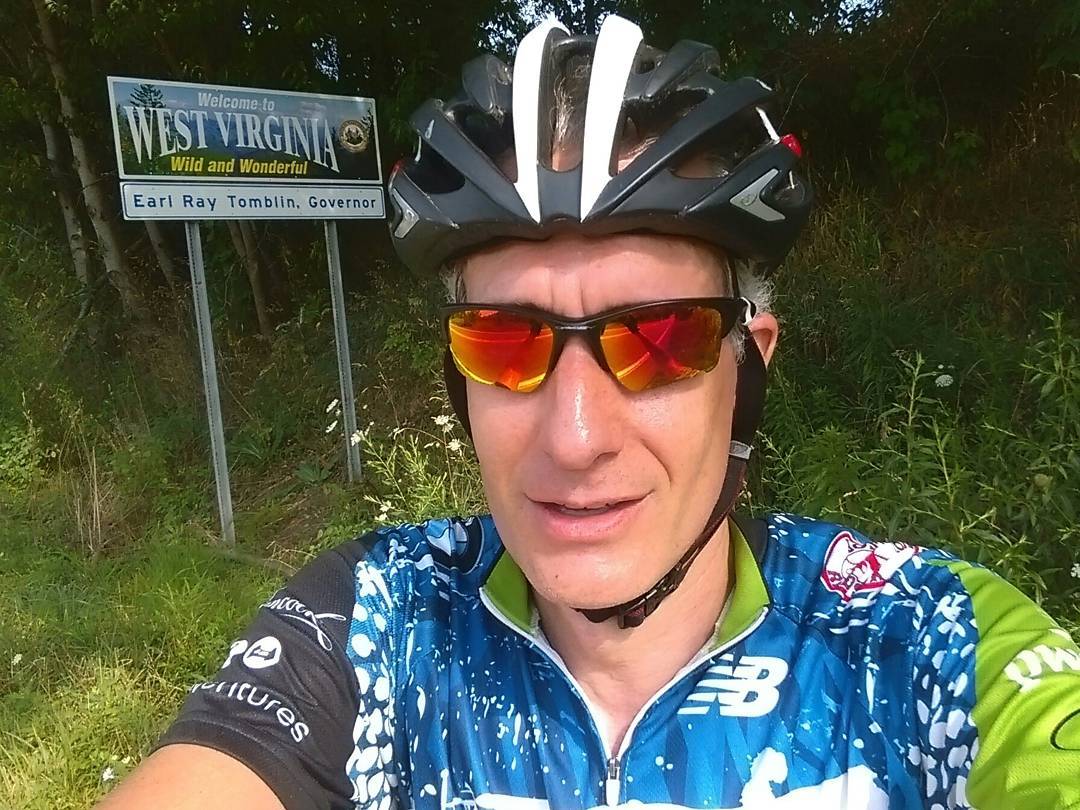
We returned to Bocktown Road briefly before turning onto busy Route 30 and passing the highest point on the route, which was followed by the second, larger change from last year. Last year we left Route 30 and cut across West Virginia to New Cumberland and then up the Ohio River; this year we didn’t quite go that far, instead riding down Gas Valley Road to Tomlinson Run State Park, then riding back up to Route 30.

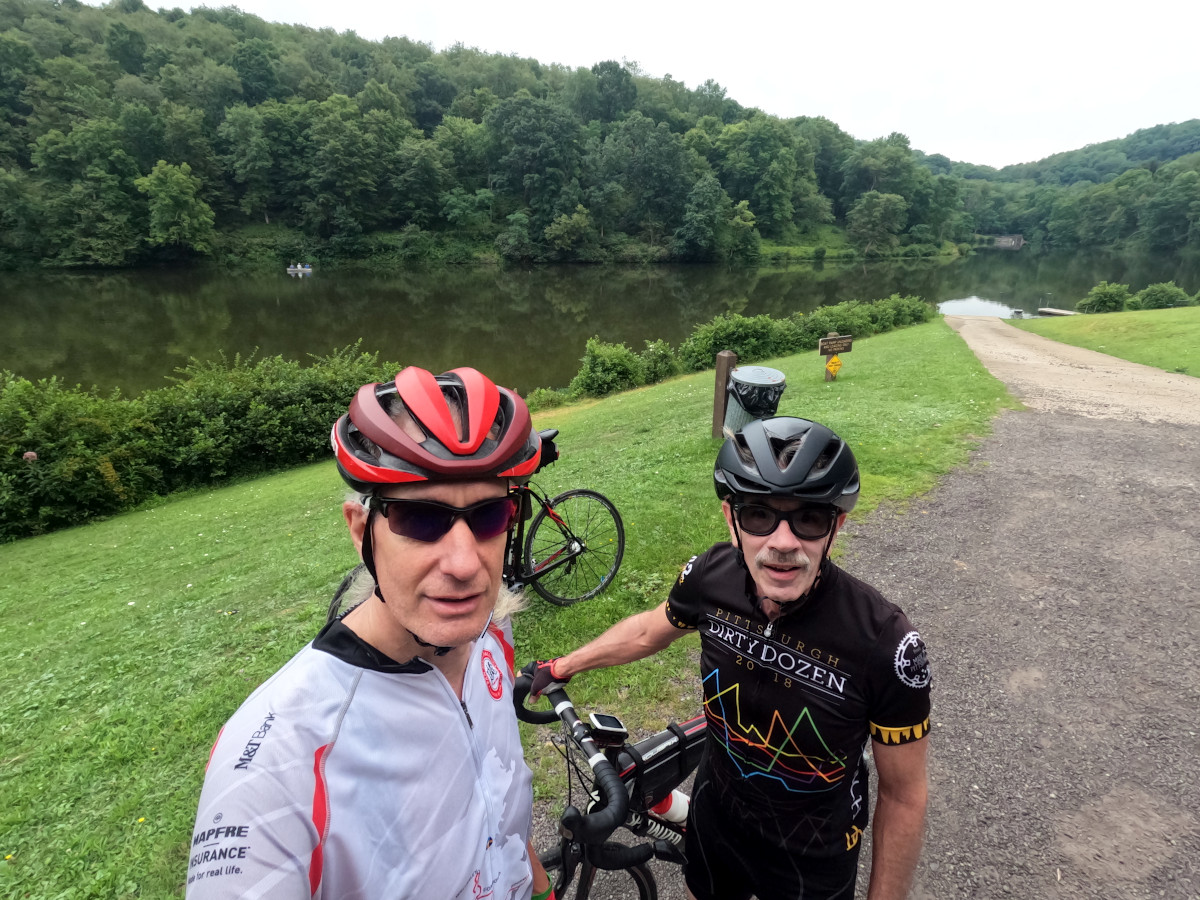
The transition from Pennsylvania’s terrible roads into West Virginia was just as noticeable as last year, although the roads inside the state park were still pretty bad. We circumnavigated the pond that was the park’s central feature and I got a selfie with Phil (top), whom I’d been riding with all morning. We made our way back up to Route 30 and had just started down to screaming descent into Chester WV when I took a big, black bug right on the bridge of the nose.

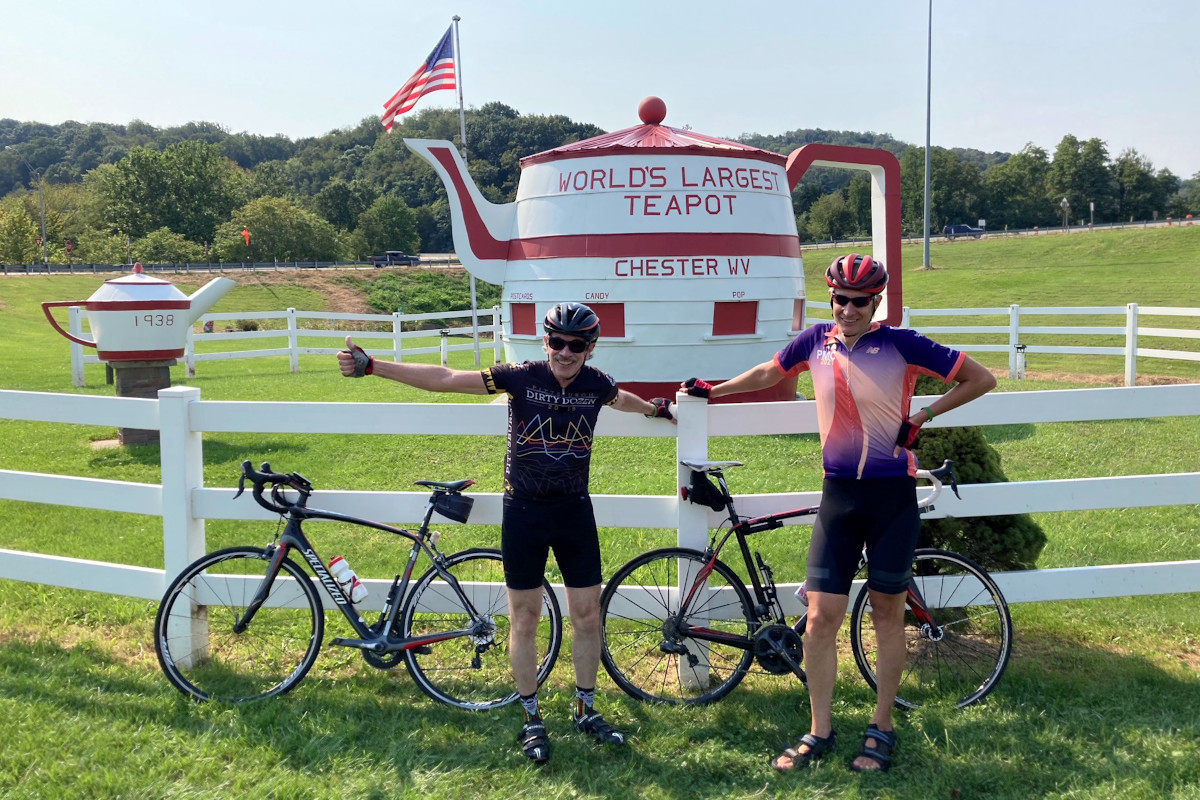
We pulled into the “World’s Largest Teapot” rest stop at 10:47am with 82 KM complete. We were making good time and it was still only 22° and windless, making for ideal riding, even if the lack of sun made it less than spectacular visually. Like last year, all the climbing came in the first half of the ride, so it would all be flat and easy on the back half as we made our way upstream along the Ohio River. We had leapfrogged the other four century riders from time to time, and since the metric riders had passed through earlier, there weren’t many other riders behind us. Unfortunately, the rest stop was out of everything but water, which is just about the only thing that could be worse than Gatorade Zero!

The third segment featured the same terrifying crossing high over the Ohio River on the decrepit Newell Toll Bridge as last year. The less said about that the better; if you’re curious, go back and read last year’s ride report. I want to block it out of my memory as quickly as humanly possible. Then 8 KM of lousy Ohio roads were followed by 7 KM of terrible Pennsylvania roads before we pulled into the Subway lunch stop in Midland PA. It was 11:50am and I felt it could begin sprinkling at any minute. I dumped the water out of my bidon and replaced it with cola, downed a small meatball sub, and wistfully deferred getting a Dilly Bar from the Dairy Queen that shared the building.

From there it was up along River Ave in Beaver and back across the river into Monaca. After a two-minute rest we headed down the high-speed Route 51 highway, where Phil did a good portion of the pulling. I was just starting to feel the effort in my knees and neck, but was only just starting to tire. Then back across the river into Ambridge and our final rest stop at Sweetwater Bikes. We’d covered 133 KM in 6½ hours, and it was still a pleasant 25°, although we’d felt the first sprinkles as we were crossing the bridge. A mini cinnamon bite and more pointless Gatorade Zero, and we were back on the road.

The drizzle kept coming off and on as we made our way through Sewickley, across the Ohio once more into Coraopolis, then back across the backchannel to Neville Island and our starting point. But we were far from done. In order to add mileage, the official route did a big extra 9 KM loop around the heavily-industrialized island. But even then, we’d still be short of the official 100-mile mark, so Phil and I planned to keep going until we could claim an official century, even if the rain had picked up and we were both wet and dirty.

And so, with just 8 KM left to go, I found myself rolling along at speed, crossing the fourth or fifth set of train tracks on the island. But this one crossing featured big, wide, deep rail beds. I tried to jump the gaping holes, but you can’t jump three sets of rails, and I came down and hit the edge of one of the cement rail beds hard, causing a slowly-leaking pinch flat.

Fifteen minutes of wet, grimy work later, Phil and I had replaced and re-inflated my rear inner tube, after discovering that my spare tube was defective. Between the rain and my flat, it was a frustrating end to what had otherwise been a good day. We finished the “official” route by going back to the start, where I pulled my floor pump out of the car and topped up my tire while Phil got our finishers’ medals from the organizers.

Then we set off for a second loop around the island to complete our century. The sprinkles had stopped and the roads were drying out. We ticked over 100 miles almost exactly at the place I’d flatted on our previous circuit, then rolled back to the cars to pack up and head home. 164 KM at a 24.4 KM moving average and 1,524 meters of climbing. Although we’d completed the ride in 6:43 moving time, it was 3:15pm, so we’d been gone nearly 8¼ hours of clock time thanks to my flat, the long stops, the climbing, and the rain.

Thanks to the moderate temperatures, I finished feeling very comfortable and strong, which bodes well for next weekend’s remote Pan-Mass Challenge rides. My only physical complaint is a blister I gained on top of my left foot, which was probably due to irritation from my cycling sandals combined with rain and road grit. I’ll have to care for that over the coming week.

I will say that I’m noticeably slower this year, especially while ascending, which is understandably frustrating, but not the end of the world, considering how scarily the year started. There was always going to come a time when I stopped being able to keep up with the pack, and it’s probably good to accept that as I approach 60 years of age.

And with that, the stage is set for next weekend’s “remote” Pan-Mass Challenge. Even at this late date – the ride is in four days – I’m still trying to work out what my ride will look like. This is a very busy week, and I’m nervous about both the weather and the course. Hopefully I’ll be able to relax and be flexible enough to let the ride be a positive experience.

And, of course, if you have not yet supported my ride by making a donation to the Dana-Farber Cancer Institute, I’d be delighted if you could contribute something. While the actual ride looms large in my mind right now, the most important thing is advancing cancer research and treatment: a cause I’ve been riding for since 2001. Please give here.

Last Sunday was the Akron Bike Club’s Absolutely Beautiful Country ride: my second century of the year, my first major organized ride in ten months, and only my second big event since pre-Covid days. And it was pretty stellar…

It was especially rewarding after a disappointing June, which warrants a short summary. I skipped the two-day Escape to the Lake MS ride because I just wasn’t ready for that kind of distance. I hoped to drive to Ohio to ride my first Sunday in June event, but I punted when the forecast gave a 70% chance of rain (which infuriatingly never transpired). Then came the Tour of Mercer County, where the organizers withdrew the 100-mile ride at the last minute due to insufficient riders. On top of all that, I learned that the Mon Valley Century – scheduled for August – had also been cancelled. So by the end of June, I was feeling pretty dispirited.

2022 Akron Bike Club's ABC Century ride

2022 Akron Bike Club's ABC Century ride

Long shadows in the early morning

Long shadows in the early morning

Ornoth rides the endless farmland of Ohio

Ornoth rides the endless farmland of Ohio

I had hoped to get one more century under my belt before deciding whether to register for this year’s Pan-Mass Challenge as a remote rider, but finally gave in and signed up, just two days before registration closed. So if you want to support my riding – as well as the amazing research and treatment that takes place at the Dana-Farber Cancer Institute – please take the time to sponsor my 17th PMC ride!

After all those problems in June, I watched the forecast for the ABC ride like a hawk. But despite my fears, the National Weather Service promised a perfect weekend. So I registered and picked up the Nissan Rogue SUV I had rented, since Inna had taken our car on a two-week road trip to New York and Vermont.

I’ve ridden the ABC three times previously – in 2017, 2018, and 2019 – and have always gotten up early to drive two hours to Akron, complete the ride, then drive home on the same day. That usually works well, but this year I couldn’t sleep, and wound up getting up at 2:45am with less than three hours’ rest. Luckily, that lack of sleep didn’t effect me much over the rest of the day.

At 4am I stuffed my bike and gear into the SUV and headed northwest outta town, only stopping at Sheetz in Cranberry for gas, a glazed donut, OJ, ice, and a sports drink. Rolling into Ohio, the dark sky slowly revealed the black silhouettes of the trees on the horizon, then the rich colors of a dawn sky, and eventually added color to the trees and farm fields.

Once parked at the Copley High School start, I checked into the ride, despite the organizers being unable to find my registration packet. Then I changed into riding kit, sprayed myself with sunblock, and made sure all my ride and post-ride gear was set. It was nice to pull my bike out of the SUV all ready to go; I would normally have to take off my front and rear wheels to fit it into the trunk of our sedan; so reassembling it was one less thing to worry about before setting off. The sky was brilliant, with a few clouds decorating the distant southern horizon, where they would hover all day. As it was a cool 13°C, I donned arm warmers and rolled off minutes before 7am.

Fifteen minutes later I stopped to quickly re-calibrate my new power meter pedals, which has now become standard procedure. Another 15 minutes of riding brought me to the semi-formal Windfall rest stop at Dunkin’ which has become the ride’s highlight since the unfortunate route change away from Dalton removed the popular free ice cream stop there. I quickly thanked the friendly ride volunteers, grabbed half a blueberry donut, and rolled on.

Riders were provided with a spectacular blue sky, no wind whatsoever, and a brilliant sun that quickly warmed me up enough to shed my arm warmers. I rolled along steadily but easily, conserving my strength for the long hours of riding still to come. On the first noticeable hill out of the ominously-named town of River Styx, I found myself unable to put much torque down without my chain skipping and falling off my worn front chainring, a worsening of a longstanding problem I’ve been unable to fix due to pandemic-related supply chain issues.

At 8:35am I pulled into the first rest stop in Seville with 43 km complete, having averaged 151W and 27.3 km/h; it was 16°C. After a pickle and refilling with ice and sports drink, I was back on the road in seven minutes.

Although only a couple hours away, riding in Ohio is immensely different than Pittsburgh’s challenging, lumpy terrain. It’s a wonderful opportunity to ride on mostly flat roads. Ohio features long, straight, sparsely-traveled roads running between endless fields of farmland, their borders marked by lines of trees. The only drawback is that those trees rarely line the roads, meaning there’s almost no shade to protect you from the heat of the sun, which featured in my previous editions of the ABC ride. Hence my liberal application of sunblock at the start.

Due to that heat, the asphalt roads melt into a smooth, featureless patina that lacks potholes and is a delight to ride on. Just when you are ready to pronounce Ohio a cycling paradise, you turn onto one of the innumerable secondary roads that isn’t surfaced with asphalt, but with “tar and chips”. In brief, a truck comes through and pours petroleum by-products onto the ground, and then dumps loose, coarse gravel on top of it. It’s not even tamped down; they rely on the hot summer sun and passing cars to eventually smush that slurry down into a “passable” road surface. But for cyclists, it’s a hellacious, dirty, dangerous, slow, and strength-sapping moonscape that will make you want to commit suicide right there.

In contrast to the open fields, this year’s route spent about 16 km on Overton Road, which is an atypically winding corridor paralleling Killbuck Creek. It provided a nice, scenic, tree-lined respite from the sun, but also a bit of a puzzle. The “creek” appeared to be made up of consecutive big, square farm fields that had been given over to swamp or open water rather than a crop. It was as if someone was playing a grid-based farm game, where they decided to develop one square as corn, another as soybeans, and then devoted a few consecutive plots to hold water. It was kinda surreal.

From there, we entered the picturesque downtown of Wooster (not Worcester), and the Ride On bike shop that was our halfway rest stop. I arrived at 10:35am with 92 km done, having averaged 136W on that segment; the temp had climbed to 22°. Over the course of a 20-minute stop, I downed a ham-and-gouda sandwich and filled my bidon with cola and ice for the challenging next leg.

I was still enjoying riding on such a nice day, but it was getting hotter, there were more hills and a bit of a headwind, and my stamina was starting to flag. The kilometers were ticking over more slowly than they had before, and I was riding almost exclusively alone. After being steady all day, my heart rate drifted higher, a sure indicator of fatigue. In the midday heat, the second half of the ride wasn’t going to be as easy as the first.

After a long trudge, I pulled into the final rest stop in Marshallville at 12:27pm. My bike computer reported 127 km done, a temp of 24°, and that my power had dropped to 125W on that segment. While recharging with cola and ice, my bike, which I’d rested against a picnic table, fell over onto the ground, but I didn’t pay much attention. Through the brain-fog of being late in a long ride, I realized I was really close to completing a seven-hour century, which is a solid accomplishment for me. I was suffering, but the final segment was a good time to use up what stamina I had left, in pursuit of a decent finishing time.

However, leaving the rest stop, my attention was sidetracked by the lack of power data coming from my new pedals. Repeated attempts to reconnect to them from my bike computer failed, and I eventually gave up. They could have been permanently broken when the bike fell over; they might have gone into some kind of “safe mode” due to their internal “incident detection” mechanism which would necessitate a reset; or the coin-cell batteries could have just gone dead. But I’d have to wait until after the ride to fix them.

Although I felt strong after that 10-minute rest, it didn’t last, and the final segment was slow and tough. My feet and knees were complaining, but I’d completed most of the climbing, I was keeping pace with the riders ahead of me, and the end was in sight.

I finally pulled into the high school parking lot at 2:03pm, exceeding that 7-hour century by about six minutes. 162 km done at an average speed of 25.4 km/h, with 1,264m of climbing; it was now a warm 28°C. I downed a quick lemonade at the finishing tent before changing back into street clothes and driving to the local Sheetz for postride drinks and snacks.

Then it was a two-hour drive home, a welcome from a persistent cat, a quick shower, and going to pick up four meals’ worth of Thai food.

Looking back, I have only two minor disappointments. One is not having power data for the last quarter of the ride. Fortunately, my power meter pedals recovered after I gave them a hard reset and fresh batteries. My other regret is that the nearly all of my photos are of the same undecorated blue sky, brilliant sun, and farmland; but that’s representative of summer in Ohio and the Absolutely Beautiful Country ride in particular.

Other than those nitpicks, I’m delighted. I’m pleased with my finishing time and stamina level, and happy with how the bike performed. I’m glad I made the drive, glad I could do the century route and complete my second 100-mile ride of the year, and delighted by the spectacular weather. And most importantly, I’m pleased at finally getting back to – and completing – another normal major event like the ABC ride.

If my luck holds out, over the next month I’ll be able to report out on my participation in the PMTCC’s 3-State Century, followed by the WPW’s Rough Diamond Century, which will constitute Day 1 of my remote ride for my 2022 Pan-Mass Challenge, a charity ride that I hope you’ll choose to sponsor me in.

Measuring power is the gold standard of performance management on the bike. I’ve waited years for the industry to provide a pedal-based power meter that is accurate, uses mountain bike-style SPD cleats, is reasonably easy to use, and “affordable”.

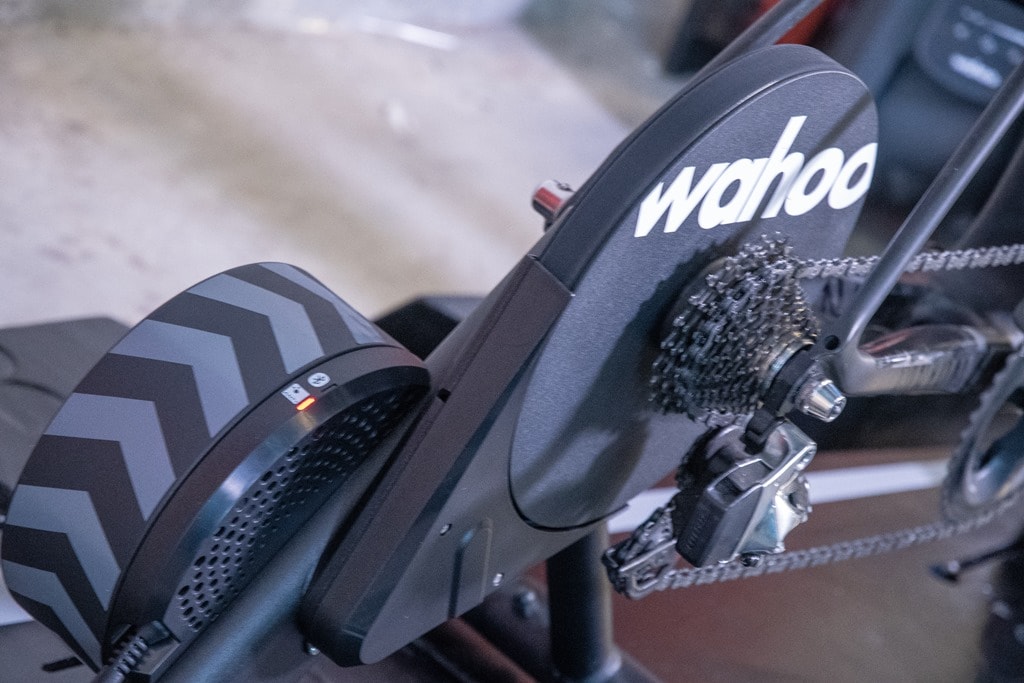
In 2018 I bought a Wahoo Kickr Core indoor trainer, which allowed me to finally measure my power output over the winter. But when I took the bike off the trainer for the summer, I had to give up measuring power, and go back to estimating power (and thus fitness and fatigue) indirectly based on heart rate data.

Garmin Rally XC200 power meter pedals

However, after over a decade of waiting, last month I opened my wallet and acquired a set of Garmin Rally XC200 power meter pedals. Here’s some background and insight into how it’s been for me so far…

Why pedal-based? These days, you can throw a power meter on a bike in several places: pedals, crankarms, chainring spider, rear hub… A pedal-based system made sense for me because it’s the easiest to install, and the easiest to move from one bike to another. And unlike a hub or indoor trainer, it measures your power output earlier in the process, because some power is lost to friction and inefficiency in the drive train (as we’ll see in detail below).

Why the Garmin ones? One other option, the SRM X-Power, was about the same price, but they have a bad rep with pedals, and just didn’t seem able to manufacture them very quickly.

The only other option would be to buy a pair of non-SPD Favero Assioma pedals, rip out the internals, and plug that into a pair of Favero SPD pedal bodies. That would have been a couple hundred bucks cheaper, but would have voided their warranty, which is meaningful on a nearly $1,000 purchase.

Another argument in favor of the Garmins is that they have 2 to 4 times better battery life than the others.

A lot of this gets covered in exhaustive detail by the incomparable DC Rainmaker in his exhaustive Garmin Rally review from last year, as well as this year’s power meter pedal buyer’s guide.

Some miscellaneous notes: All these pedal-based units are double-sided (a necessary convenience), and also transmit your cadence to your bike computer, eliminating the need for a separate cadence monitor.

Like the Assiomas, the Garmin power meter is housed in the pedal spindle, and can be moved between pedal bodies of different styles. So if I ever decided to switch from SPD pedals to SPD-SL or Look Keo style cleats, I could just buy some empty pedal bodies and plug the power meter spindle right in.

Also, although the Garmins were very expensive, I got a tasty $240 discount thanks to REI’s spring members’ sale. Plus forthcoming reward bucks that could be applied to a new Garmin bike computer, if they were to ever release a new model…

Some usage notes: You need to keep a couple things in mind in addition to your battery life. One is that you need to let the unit acclimate to the outdoor temperature in order to get accurate readings, and that can take about ten minutes if you store and ride your bike in very different temperatures. And then you also need to do a zero-offset calibration about 10 or 15 minutes into every ride. It’s a bit of a bother, but it’s much better than we used to do with older power meters.

One big difference is the weight of the pedals. These pedals weigh 443g; they are replacing my current pedals, which weigh in at 306g. Although I’ll also be removing my dedicated cadence sensor from the bike, which is an additional 10g.

So what data do I get? I’ve already mentioned power (in Watts) and cadence, but there’s a shitton more. You get the power balance between your left and right legs. You get how much time you rode seated versus standing. You get measurements of how much power you produce at all points throughout the pedaling circle (even if that’s not of any practical value to anyone). You get measurements of whether your power is being delivered at the center of the pedal, or off to one side, which might indicate a bit of a fitting problem. And all of these are logged second-by-second for later analysis.

Can this get any geekier? I’m glad you asked!

So one of the biggest questions to ask of any power meter is its accuracy. The first units claimed to be accurate to ±5%, and up til now I’ve been assuming my Kickr is performing up to its ±2% claim. Most power meters these days (including my pedals) advertise ±1% accuracy, but how do I know? Well, let’s compare them against one another!

I’m going to look at two indoor trainer rides. The first is a March 31th 50-minute ride of Zwift’s Tour of Watopia Stage 3 on the hilly Downtown Titans route. The second, longer ride is ToW Stage 2’s flatter Watopia’s Waistband route on April 2th.

For each ride, I simultaneously recorded the power data coming from my Wahoo Kickr Core, and also that coming from my Garmin Rally XC200 pedals. So if things are working correctly, the measurements coming from each ride should be almost identical.

First, the numbers: As expected, cadence was virtually identical between the pedals and the crank-mounted dedicated cadence sensor (I did not take cadence from the Kickr, as trainers aren’t reliable for cadence data).

In contrast, the pedals registered an average power that was 2.7 to 4.1% higher than the trainer. Similarly, average weighted power came in 3.0 to 4.5% higher. Does that mean one power meter is slightly off, and how do we know which one?

No, everything’s fine. That small difference is eminently explainable by that thing I mentioned way back in paragraph four: power numbers coming from a trainer will be lower due to drive train losses that occur due to friction and flexion somewhere between the pedals, crankarms, chainrings, chain, cogset, and trainer. So they’ll naturally report a little lower numbers than pedals, which measure power transfer much earlier in the process. That would easily explain the 2.7 to 4.5% variation I saw.

But interestingly, when you look at maximum power (e.g. sprinting), the difference between the pedals and trainer falls to 0.6 to 1.0%. I haven’t got a good explanation for that yet.

But that’s all just summary data, and averages aren’t a great way to validate data over time. Much more revealing (and interesting) is the second-by-second detailed data. For that, we need some charts!

Next, the charts: So let’s compare the power data for each ride in the DC Rainmaker Analyzer Tool, overlaying the numbers for each ride from our two data sources to see how closely they match up. In all these charts, the red line is my Kickr Core trainer’s data, and the Garmin pedals are in green, and hopefully those lines will be almost identical.

First, let’s look at the power charts for the whole duration of both rides.

Chart: 3/31 power over 50 minutes Chart: 4/2 power over 90 minutes

It’s a little easier to see on the first chart, since it’s less busy, but in general the numbers reported by my pedals and my trainer line up really well, with the pedals giving slightly higher numbers, as expected.

Remember tho that the first chart is 50 minutes long, and the second is 90 minutes. So although things look pretty good (yay!), this is at an extremely coarse level. For a better comparison, we really need to zoom in a little closer. Let’s find a couple representative chunks in the 7- to 10-minute range.

Chart: 3/31 power over 7 minutes Chart: 4/2 power over 10 minutes

And there you go. Aside from the pedals’ slightly higher readings, the ups and downs of the charts are almost identical, close enough that the difference could easily be put down by the devices’ different sampling rates. No dropouts, no crazy spikes, or big differences between the curves.

In addition to a simple time-series comparison, there’s another way athletes look at power that might confirm our conclusion. For a sprinter, your overall power doesn’t matter so much as the maximum power you can put out and sustain over five, ten, maybe thirty seconds. So the critical power curve shows the maximum power you sustained over a particular duration. Obviously, the human body can generate a lot of power in short bursts, but can only sustain a more moderate power over durations measured in minutes and hours.

Unfortunately, as I’ve noted before, I’m keeping an eye on some cardiac issues and my chainrings are so worn that I can’t really sprint without dropping my chain, so my numbers are very pedestrian. Still, we can still draw some conclusions from my critical power curves for those two rides.

Chart: 3/31 critical power Chart: 4/2 critical power

And this perfectly confirms everything we’ve seen so far. At just about every duration, the pedals consistently read 3 to 5% higher than the trainer, as expected. The only variance is at durations shorter than 15 seconds, where the devices’ sampling rates might impact the numbers.

So my overall conclusion is that I can definitely rely on these pedals to produce accurate power data that is very consistent with my indoor trainer, keeping drive train losses in mind.

Unless you’re a cyclist, it’s hard to convey how exciting and interesting it is to finally have a power meter on the bike year-round. At the big-picture level, this means my power data will finally be consistent between indoor and outdoor seasons, thus giving me more reliable fitness and fatigue numbers.

This means I can not only monitor my fitness and fatigue month-by-month and year-over-year, but also precisely quantify and properly pace my level of effort and reserves on a minute-by-minute basis during an individual ride of whatever duration.

A rider only touches his bicycle in five places: two hands, two feet, and the most sensitive place of all: the saddle.

People are very finicky about their saddles – for good reason – and it can be difficult to predict what will work for any given rider. I have been fortunate that the stock saddles that came with my bicycles worked well for my physiology… until recently.

And this may be where we get into what might be too much information for the sensitive reader. Viewer discretion is advised. You have been warned!

Over the past year or so, after long rides – especially centuries – I’ve experienced an abnormal amount chafing around the sit bones. It’s painful, but heals over a couple days. What’s odd is that I’ve never had this problem in the past.

I was slow to look into specific causes or solutions, mostly because it took a while for me to see the pattern, since it only happened on my (comparatively infrequent) longer rides. But when I finally decided that something had to be done, the obvious places to look were my cycling bib shorts and saddle… and my shorts are fine.

But the saddle… As I said, this is the stock saddle that came with the bike. And looking back on it, I’ve put that bike through more than 24,000 outdoor miles, plus another 11,000 miles on the indoor trainer. The saddle still works fine for me, but it does show signs of wear after nine years and 35,000+ miles of use!

Specifically, the saddle’s cover is worn, with the underlying material showing through in places, as you can see in the following two photos. But that shouldn’t have any impact on its functionality, should it?

Saddle facing right
Saddle facing left

In those photos (as always, click for bigness), there are at least four different layers of saddle material showing.

The outermost layer is glossy, ivory colored, and near the saddle’s centerline. This is the original outer layer of the saddle, and probably is some plasticky protective outer coating. The second, whiter layer is the textured cover material itself, probably leather, that shows through where the clear overcoat has peeled off.

Where I’ve worn through the white leather surface is third layer that probably started as light tan, but turns a dark grey over time. And finally, beneath that are a couple rough, black, patches of hard foam-like material.

The glossy outermost protective layer is quite smooth, but each subsequent layer becomes more tacky and sticky than the last. While Lyrca bike shorts would move and slide easily on the whiter surfaces, they would adhere to the softer, worn dark patches.

And I think that’s where my problem is. While riding, as you pump your legs and move around on the saddle, your bike shorts should stay in one place on your body, but freely slide around on top of the saddle.

But if your shorts stick to the saddle then they can’t slide around, and all that movement between your saddle and your shorts turns into movement between the shorts and your skin! It’s no wonder my ass was raw after a ride of seven hours and 30,000 pedal strokes!

Testing this hypothesis was easy, because I have two other (older) bikes with saddles that are in better condition. I could just swap out the saddle and see if the problem went away.

But the timing of this revelation wasn’t great, because it was just before my planned PMTCC 3-State century (ride report), and if there’s one single inviolable canonical rule in cycling, it’s this: never change your equipment just before a major ride. So I rode the century on the old saddle; at least the resulting sores would give me something to judge the replacement saddle’s performance against!

But after the century, I made the swap, and results so far have been promising on rides of 20, 35, and 50 miles.

Kinda weird to think that I’ve actually worn out a saddle!

Of course, the replacement saddle is black, while the old one was white, which matched my handlebar tape. So I’ll have to spend some time trying to procure my preferred saddle in white, which was a rarity even before the Covid-19 pandemic obliterated the bicycle industry’s supply chain. But having a spare saddle lying around has bought me time to make that happen.

Or I could just change to black bar tape. Or red, which would also match by bike frame.

But either way, thanks to how difficult it has become to get bike parts, my steed has started looking like a bit of a Frankenbike.

It’s been two years since I last participated in an organized century event. But with the 2021 season starting to wind down, last Sunday I completed my fourth PMTCC 3-State Century.

The headline leading into the event had to be the weather. Hurricane Ida swept away the last humid heat of summer, and left Pittsburgh enjoying a delightful string of sunny days with lows in the upper 50s and highs in the 70s. You couldn’t ask for better conditions!

Phil & Ornoth at the Crestview Park overlook in New Cumberland WV

Phil & Ornoth at the Crestview Park overlook in New Cumberland WV

At the teapot rest stop in Chester WV

At the teapot rest stop in Chester WV

Leaving WV on the Newell Toll Bridge

Leaving WV on the Newell Toll Bridge

1/3 mile of very sketchy boardwalk

1/3 mile of very sketchy boardwalk

On the other hand, one could ask for a more reasonable starting time! Riders choosing the 100-mile route had to hit the road at 6:30am to avoid road closures for a 5k run.

With the event beginning on Neville Island – eight miles down the Ohio River from Pittsburgh – that meant an early wake-up call. I staggered awake at 4:15am, downed half a bagel, and drove to the start.

In the pre-dawn darkness, I found I’d parked next to Phil, a longtime riding buddy I hadn’t seen in years. I checked in for the ride, put my bike together, and decided to keep my arm warmers on for a while. We rolled out at 6:40am at 63° with just enough light to see.

This year’s updated route split into two completely different halves. 71% of the climbing (3,850 feet) came in the first 50 miles, while the second half only climbed 1,550 feet, less than 30% of the total. The first half averaged 80 feet per mile of climbing, while the second half averaged a mere 30 (that’s considered pan-flat in Pittsburgh). If you exhausted yourself on the lumpy first half, it would be a long and painful slog home.

The new route began with a pointless 14-mile loop up two major climbs into the Montour Heights, followed by a screaming descent right back down again. I took it casually, mostly riding with Phil and a couple other guys. Then a minor climb along busy Route 51 before I stopped at a construction site’s porta-john while the others rode on. Then another major climb on PA 151 back up the escarpment where Phil was waiting for me for the run into the first rest stop, 25 miles and about two hours in.

The rest stop spit us out directly onto the fourth and final major climb of the day before turning onto a slightly busier US Route 30 for a smaller climb up to the West Virginia border. Just a couple miles later, the route took a new left turn onto WV Route 8 toward New Cumberland. Another change from prior rides, this would give us more time along the Ohio River and increase our riding in West Virginia from 4 miles to 24. We noticed how much the road quality improved over that in Pennsylvania, while the buildings looked shabbier. We crawled along, slowly overcoming a gusty 25 MPH headwind and two more short but steep hills.

When we descended into New Cumberland and met the Ohio River, we took a quick turn onto WV Route 2, then climbed the final hill of the day. I pulled Phil aside for selfies in a small park with a platform overlooking the river, the Stratton flood control dam and locks, and the Sammis coal-fired power plant on the opposite shore. Having ridden 50 miles in three and a half hours with only one break, I had heavy legs and a stiff back, and Phil was hungry. Importantly, this marked the halfway point of the ride, the end of the climbing, and now we had the wind at our backs; we would make much better speed on the homeward leg of the ride.

We quickly covered the 10 miles to the next rest stop, arriving at the World’s Largest Teapot in Chester WV at 11am. This is beneath the Jennings Randolph Bridge where US Route 30 crosses the Ohio, which the normal ride route would take, but is closed this year for construction. So after a short rest and a photo with the “teapot” we backtracked a couple miles to our alternative: the Newell Toll Bridge.

The Newell Toll Bridge is about as small and rickety as you might imagine a bridge built in 1905 would be, although it was rehabbed just 67 years ago! It’s just wide enough for two cars to pass on its metal grate open deck, and pedestrian access is provided by a single run of aging wooden planking hung off the side, with a rusting token railing. Did I mention it’s a suspension bridge? That means the entire bridge deforms, dips, and sways under the weight of passing traffic. In between taking photos at either end, we gingerly rode a third of a mile across the creaking wooden walkway fifty feet above the Ohio River, where I discovered my long-dormant faith in God. The friendly attendants waved us on rather than collect the five-cent pedestrian toll.

Thus began our 5 miles of riding in Ohio (this year’s new route having added two extra miles!) which quickly saw us back across the border into Pennsylvania. We were delighted not to turn left for more inland climbing this year. This whole segment was only 12 miles, so it soon ended at a Subway sandwich shop in Midland PA. It was exactly noon, and we’d covered 70 miles. I was intrigued to see they’d expanded the Subway shop, adding a Dairy Queen counter, but I was heartbroken that it wasn’t open.

After ingesting a meatball sub (after defending it from some insanely persistent hornets) and filling my bottle with ice and cola, we continued up the riverside to Beaver PA, then across the bridge over the Ohio into Monaca (pronounced m’NACK-a, not MON-a-ka). We pulled aside for a quick rest to freshen our legs for a 7-mile all-out sprint down Route 51 to the Ambridge Bridge. Route 51 would be considered a four-lane superhighway if it met state or federal safety requirements, and it’s one of the most dangerous roads in Western PA. However, we survived our passage, crossed the Ohio (again!), and pulled into the final rest stop of the day: Sweetwater Bikes in Ambridge, where I filled up with ice and water. It was 1:50pm and we’d covered 91 miles, with just 7 miles to go!

Having stayed on my tail all day long, Phil was starting to flag, so we continued on at a much more casual pace, proceeding down Beaver Street into the more familiar roads in Sewickley PA. We crossed the Ohio (again!) on the Sewickley Bridge, ambled through Coraopolis, and crossed the backchannel onto Neville Island, where we’d started out eight hours before. We did a quick couple miles up and down Grand Ave to round our ride up to an even 100 miles, with 5,400 feet of climbing.

After putting my bike back in the car, I joined other finishers, where I enjoyed a cola and some pizza after claiming my finisher’s medal, tipping the group’s bartender the $5 bill I had found in the street on a June ride that coincidentally had also gone through Neville Island to Sewickley.

So that’s the ride. Now for some final observations.

As mentioned earlier, this was my first organized century since my Michigan trip back in October 2019, my fourth century of the year, and my 101th century overall. It definitely felt good to be back doing a big, supported group event, and the weather was absolutely perfect.

And it felt good to really thrash my legs on another serious day’s effort. I seem to have escaped without any of the severe night calf cramps that hit me after last month’s PMC.

Phil’s presence made it better, too. He was strong and stayed with me the whole day, even if I did the lion’s share of the pulling. He and I seem to have a similar pace and riding style, dating back even beyond our mutual support leading up to the challenging 2017 Dirty Dozen ride.

The changes to the route were mostly successful. The bonus climbing loop at the start was begrudgingly tolerable, even though I’d rather do something with more value than a pointless loop. The cut across West Virginia Route 8 to New Cumberland and along the river up Route 2 were excellent additions. But I’d rather cross the Ohio on Route 30 and avoid risking my life and emotional well-being on the 116 year old Newell Toll Bridge!

For the bike, this might well be the last big ride for its stock saddle. One of this year’s major themes has been chafing around the sit bones, and I think I’ve finally figured out that it’s because of how worn my saddle is; understandable, since it’s seen 24,000 road miles plus another 11,000 on the indoor trainer. I thought about swapping it out before this ride, but was stopped by the age-old cardinal rule: never change your equipment just before a big ride! Fortunately, my butt (mostly) survived this saddle’s last hurrah. But there’ll be a whole followup post about my saddle woes shortly.

Sadly, with September halfway gone and the season winding down, there won’t be many other organized events this year. There’s the Western PA Wheelmen’s fall picnic, which includes some short rides, and Tour the Montour. And the Dirty Dozen, which I’m in no shape to tackle, so I’ll probably play photographer again. And I suppose I ought to do another FTP test while I’m still in good form, since I haven’t done one in 10 months…

It was a wonderful day in the saddle, and one more big step to celebrate in the post-Covid return to normalcy.

When a product sucks, I‘ll tell you; and the new revision of the Wahoo TICKR sucks.

For the past two years, I’ve used a first-generation TICKR heart rate monitor chest strap. And it worked flawlessly until the snaps corroded and fell apart at the end of June.

And before that, I used two Garmin HRM straps and then one branded by Bontrager (although I have no idea who actually manufactured it for them). So I’ve had HRMs for around 15 years and know how to care for them and what kind of data to expect.

Shortly before my old TICKR died, Wahoo Fitness had conveniently announced a second-gen version of the TICKR, which I promptly ordered.

That was back in June, and the subsequent two months have been a litany of disappointments. Despite my updating the firmware and other troubleshooting tasks, the data coming out of the new unit was unusably bad, when it produced any data at all.

In feeble hopes that they’d sent me a defective unit, Wahoo shipped me a second unit, which was just as worthless as the first… Then offered me a third.

After giving Wahoo two months and testing multiple devices, I gave up on them and bought an HRM from their competitor Garmin, which was nice, reliable, and accurate straight out of the box.

To give you an idea how bad the new TICKR was, look at the following chart. It shows measured heart rate over the same 5-mile route for those three brand-new HRM straps, alongside estimated power to give you a level of effort to compare against.

Heart Rate Chart

What should you see here? What the Garmin HRM shows: a smooth, undulating curve that responds to and follows the contours of the user's power output, ranging all the way up to the user’s max heart rate.

Instead, both TICKRs spend long periods completely flatlined, when the unit isn’t registering or updating the user’s heart rate, often not responding at all through entire high-intensity efforts. Obviously incorrect, the TICKRs would report a sudden increase in pulse in the middle of a resting period, or a sudden drop in heart rate smack in the middle of a high-intensity interval. And the TICKRs never measured more than 75-85% max heart rate, despite intervals where I put out one-and-a-half times the power of the Garmin run! Hence the unbelievably low average heart rates. Based on my observations, the TICKR has a promising future… not as a heart rate monitor, but as a random number generator!

I saw the same consistent behavior irrespective of which unit I used, and whether I used it outdoors connected to my bike computer or indoors connected through my laptop to Zwift. The only time I was able to get a momentarily reliable reading was if I was sitting up in the saddle, riding no-handed.

Releasing poorly-debugged products has become Wahoo’s claim to fame, due to well-publicized problems they’ve had with their indoor trainers and related accessories, and now something as simple as an HRM strap. The one exception is their well-received line of bike computers, which is in perfect opposition to Garmin, whose recent bike computers (looking at you, Edge 820!) have been terrible.

So while I got great value from my first-gen TICKR, I strongly recommend against the second-gen TICKR. If you want an HRM that works, my endorsement goes to the slightly more expensive (but functional!) Garmin HRM-Dual.

When I moved to Pittsburgh in 2015, I didn’t bother bringing my old wheel-on indoor trainer. It was outdated technology, falling apart, and I planned to replace it after the move anyways.

But I was able to do some outdoor riding through the Pittsburgh winter, and I couldn’t bring myself to drop a boatload of cash on a replacement trainer, especially since I’d be moving to still warmer climes sometime soon.

And just like that, three years passed.

What finally spurred me to pull the trigger on a new trainer? And what conditions changed?

Wahoo KICKR CORE

First, why invest in a trainer if I still don’t have any income? Well, I’ve had the intention to do so for five years, and I have the money… I just don’t like parting with it. But I know this is something I’ll use a lot.

But will I? Why invest in a trainer if I plan to move south? Fair point. However, if there’s one thing I’ve learned living in Pittsburgh, it’s that—even when the weather’s great—sometimes you just don’t want to expend the effort of getting out of the city to get a workout in. I might not ride the trainer as much if I lived in Florida or Texas, but it would still get used, especially for fitness tests. And if not, I could always sell it to someone else!

One last question: why bother with a trainer if I’m getting old and will never be as strong or competitive as I used to be? Well, just because I’m not setting any new PRs doesn’t mean I’m giving up completely! I still want to perform at my best, and having a trainer makes it much easier to get a workout in, so that I can better retain the fitness I’ve got left.

Another thing that made the purchase easier was a big $180 discount. Each fall, awesome sports tech reviewer Ray Maker (DC Rainmaker) teams up with a sports tech dealer to offer the best sale of the year. In my case, I got a solid 20 percent discount on the Wahoo KICKR CORE: a state of the art trainer that was only announced four months ago.

The downside: the three-week wait for it to arrive. Even though his dealer stocks up for the big sale, hot new products inevitably get backordered. But eventually it arrived.

In the meantime, I dealt with other logistical issues. Downloading and reading the setup and user manual. Downloading and learning how to use the Wahoo Fitness app, the Wahoo Utility app, the Zwift app, the Zwift Companion app, and the Discord app. Buying a new cassette (gears), along with a chain whip, crescent wrench, and lockring tool to install it on the trainer (as well as for future use). Buying a floor mat, gym fan, and riser block for my front wheel. Buying a handlebar phone mount, a USB ANT+ dongle, and a USB extension cable to go with it. Setting up a television, laptop, speakers, and wireless keyboard and mouse in the new “pain cave”. Buying a membership to the Zwift MMO virtual world. So many new things to buy, set up, and learn!

Now that it’s here, what’s so great about this thing?

First, it’s a direct-drive trainer. That means you take your rear wheel off and connect the bike’s drive train directly to a set of gears on the trainer, rather than pressing a steel roller up against the rear tire, as cheaper and older trainers used to do. That takes a lot of wear and strain off the tire and wheel.

It also allows the entire contraption to be a lot quieter. A vast improvement upon older devices, now the only noise you’ll hear are the bike’s chain, gear shifts, the exercise fan I use. Even while I’m riding in the next room over, Inna is able to sleep through it.

A huge benefit to me is that most trainers now come with built-in power meters. While inexpensive heart rate monitors have been used to guide training in the past, power meters have supplanted them as the gold standard. However, power meters are pricey, so I’ve never been able to justify the expense. But now I can train with power, at least indoor.

There’s a lot to know about training with power, but my primary interest boils down to watching two numbers. Functional threshold power (FTP) is an absolute measure of how much power you can sustain on the bike for one hour (measured in watts), and is a great predictor of performance on the flat. Divide FTP by your weight to get watts per kilogram, which is an equally reliable predictor of performance when the road tilts up. These are today’s gold standard measures of cycling fitness.

To ascertain your FTP, you do a 20-minute FTP Test. But doing FTP tests sucks. The testing protocol is simple: hold the maximum power you can for 20 solid minutes. It hurts, and a lot of people puke before they finish.

It’s also error-prone, because it’s hard to guess how long you can maintain max power. Most people overestimate their ability, going out hard and running out of gas before the 20 minutes is up. Once burned, they do the opposite, keeping way too much in reserve. So how do you figure out what power you should try to hold so you can pace yourself properly?

That calls for another test: the Step Test. It’s not fun either, but it entails slightly less pain. Once you begin pedaling, the trainer gradually increases the resistance every two minutes. Continue cranking on the pedals until eventually the increased resistance causes absolute muscle failure.

I stopped my first Step Test a little after hitting 275 watts. After applying maths, my FTP—what I could hold for an hour—was around 212W, and my climbing ability was 2.72 W/kg. The Step Test only provides a rough estimate of FTP, but most importantly, it also told me I should aim to hold 223W for my 20-minute FTP Test.

Armed with that information, two days later I set out and tried to hold my average wattage above 223 for 20 excruciating minutes. I managed it for about half the test, but I found myself riding the entire test pegged at my max heart rate—not fun!—while watching my average power slowly decline. By the end of the test, I’d faded to an average of 208W, which translates to an FTP of 198W, and 2.53 W/kg: noticeably lower than the numbers I got from my earlier Step Test, but just enough to qualify for the low end of Zwift’s Category C performance level.

I’ll probably test myself every three or four months, to see how much I improve (or deteriorate) over time.

Beyond measuring power, we move into features associated with “smart trainers”. So what makes them think they’re so smart?

Orny leading a paceline in London
Orny descending a mountain in Watopia

Basically, the industry has defined communication protocols so all your devices can work together: trainers, power meters, heart rate straps, cadence and speed sensors, bike computers, electronic shifting, and phone and computer applications. One of the things they’ve done is allow other devices to control trainer resistance: allowing applications to control how hard it is to pedal on the trainer.

That permits trainers to simulate the ups and downs of riding on real roads. In “sim mode”, you can load up any real-world route, and the trainer will precisely mimic the terrain, making it harder to pedal when you reach a “hill”, and easier when you reach a descent. You can simulate any route you can map: from Tour de France stages to last August’s century to your daily commute.

This was the first thing I tested when my trainer arrived. I paired it with my bike computer and told it to re-create a short local route I rode a year ago. As I pedaled along, the trainer automatically changed resistance to reflect the descent down Greenfield to the river, up the Junction Hollow bike path, the little spiker up South Neville, thru CMU, then up and over Schenley Park on Overlook Drive.

The grade simulation worked well, and it made for an engaging workout. However, there were clear shortcomings. The bike computer didn’t display the elevation change, current incline, or total elevation gain; the closest one could get was the graphical display of the past and upcoming elevation profile, which wasn’t detailed. More annoying, the unit didn’t display my current “location” on a map, which would give a little more context to the ride and changes in resistance. While sim mode is an awesome idea, there are obvious improvements that need to be made.

If you combine a smart trainer’s sim mode with internet access, virtual reality, object modeling, and social networking, you get today’s pinnacle of indoor training technology: Zwift. Join Zwift and you’re given an on-screen cyclist avatar who moves along a virtual road in proportion to you pedaling your trainer. Ride around online versions of London, New York, Innsbruck, or Richmond VA, or even the infamous Tour de France climb up Alpe d’Huez. When your avatar reaches a hill, the smart trainer’s resistance kicks in (or off) to simulate the gradient.

Now add other riders: thousands of other riders, all pedaling their own avatars in this massively multiplayer online sufferfest. Add structured workouts, the ability to ride with friends, organized group rides, official races, milestone rewards, instant messaging and shared audio channels, and also a parallel setup for runners. It’s an immense phenomenon.

My first Zwift experiences have been positive, but not always pleasant. Although the app hasn’t crashed on me yet, my laptop has died multiple times due to (1) falling off the pedestal I’d placed it on; (2) running out of battery without warning; and (3) a touchy touchpad that causes spontaneous reboots. I was already thinking about a new laptop, but the slow frame rate on my five-year old graphics card have increased the likelihood of that expense.

So far, in addition to the Step and FTP Tests, I’ve done a 10-mile free ride; a 25-mile, 450-person Team ZBR group ride; and the extremely hilly 30-mile December Bambino Fondo, with several thousand others.

Overall I’m happy. I finally have a new indoor trainer. I can even begin training with power! And with Zwift, I’m more likely to spend time on the trainer than I would have on my own.

That leaves me with one issue I’ve struggled with since I got my first trainer a decade ago: whether to count miles ridden and time spent on the trainer as “real” riding time for statistical purposes. Back in 2009, I decided I would only count outdoor road miles, but as my indoor riding increased, I started informally keeping track of that separately. Now I’m likely to put even more miles in on the turbo, so I’ll record my indoor riding separately, but in the same level of detail as outdoors. That way I can combine the two when it’s appropriate, and keep them separate when needed.

With my recent purchase of a thermal jacket and awesome thermal bib tights from Craft, I’ve become a lot more comfortable riding in colder temperatures. Matched with a balaclava and either thermal gloves or lobster mitts, I’m able to ride comfortably for hours at 20-40°.

Adafruit strainless conductive thread

However, there’s always been one glaring problem with cold-weather rides: full-fingered gloves make it impossible to operate my new bike computer. Its capacitive touch-screen requires contact with skin to complete an electrical circuit to determine where the touch took place.

Although not a critical issue, it was most pressing (pun intended) when relying on the computer for navigational cues. But the computer just won’t respond to fingers insulated (in both thermal and electrical senses) within full-fingered gloves.

This difficulty first came up on the 3-2-1 Ride, a chilly century along the Great Allegheny Passage. Fortunately, being mostly on a bike path, the route didn’t require much navigational work. I easily made do by just bending down low over the handlebars and operating the touchscreen… with my nose!

In later months I’d also work it by removing the computer from its handlebar mount, bringing it up to my face, and rubbing it against my nose. But after a few swipes, it became apparent that a nose just isn’t a particularly good stylus, and a smear of nose grease really detracts from a screen’s legibility.

I considered buying some newfangled gloves with capacitive finger pads, but that seemed unnecessarily expensive, since both my sets of gloves are fairly new and otherwise work great. I looked into capacitive gel and dots that you could apply to the fingers, but those had pretty poor reviews.

Finally, I decided to spend ten bucks on a bobbin of conductive stainless steel thread, sewing it through the fingertip of my full-fingered gloves, lobster mitts, and my non-cycling winter gloves.

While it isn’t perfect, the conductive thread doesn’t work too badly, doing the trick more often than not. And that’s good enough, when the alternative is stopping and taking off one’s gloves in 17° weather!

I’d generally recommend the thread. It’s not too heavy gauge, so it’s plenty flexible and easy to work with. And, of course, it works just as well with capacitive cell phone screens as it does with bike computers.

However, there are a couple things to be aware of.

There’s no need to be cheap here, so buy reputable thread. There are plenty of people out there selling fakes.

Secondly, remember that the thread works by conducting the electrical charge from your body to the screen. Thus, you can’t just sew the outside surface of the glove; you have to go all the way through the material to the inside, ensuring that there’s a good contact with the flesh of your finger inside the glove as well as the screen. When the thread doesn’t work, it’s most likely because it’s not in solid contact with your finger.

And although it’s pretty easy to work with, trying to manipulate a sewing needle in the tiny, narrow inside of a glove’s finger can be difficult. It doesn’t have to be the cleanest sewing job, but you want it to be both effective and at least a little durable, so take your time.

Do that, and you can keep your gloves on and your fingers warm, and keep the nose-grease off your bike computer!

As you would expect, my first year riding in Pittsburgh was eventful and full of new experiences. Judging by the size of this 2016 year-in-review post, I consider it a pretty successful year overall.

Here I’ll review my original goals for the year, plow through a list of other noteworthy developments, show you a few informative charts, and then close by looking forward to 2017. All accompanied by a handful of related photos.

Ornoth"s MS Ride
Ornoth climbing segment one
MS Ride start
50,000th Mile
Ornoth hammering
Pit randos crossing the Mon
Collapsed roadway
Cheez ball spill

Original 2016 Goals

When I moved to Pittsburgh at the end of last year, I set four explicit goals for myself, plus two implicit ones. How did we do?

First goal was to buy a new indoor trainer. It didn’t happen because nice weather allowed me to ride outdoors throughout last winter, and I wanted to conserve cash. Although I never got that new trainer, I can’t call saving hundreds of dollars a failure! And there’s always next year…

Second goal was to do more century rides than the feeble four I had done in 2015. I bagged seven, one of which was a 200k. Great success! To enumerate them: Pittsburgh Randonneurs’ McConnell’s Mill 200k (a new all-time record for most climbing in one ride), Escape to the Lake MS ride, a solo century to Brush Creek, the Pittsburgh Tour de Cure Gran Fondo, the Western PA Wheelmen’s 3-State Century, the Mon Valley Century, and the Pedal the Lakes Century.

Third goal was to check out Pittsburgh’s outdoor cycling track. Definitely did that, and set my first personal hour record there (20.77 miles). But I didn’t participate or even spectate at any of the races held there… Yet!

Final goal was to ride the Dirty Dozen. Sadly, family obligations brought my season to a screeching halt just after I started training for the Thanksgiving-weekend ride. This one has to wait for next year.

My two implicit goals were to ride more than I did in 2015, and to learn and become familiar with the roads and routes used by Pittsburgh cyclists. I covered both of those without question.

Overall, I did a reasonable—but not perfect—job of meeting my original goals for the year.

Innumerable Highlights

But the story of a season isn’t made up solely of chasing predicted goals. It’s also a collection of serendipitous moments and unexpected developments. And 2016 was a very eventful year.

How come? Here’s a quick run-down:

  • I opted to take the summer off from work, giving me lots of free time to ride.
  • I rode more miles in 2016 than I did in any my past six years except for 2014.
  • Overall, my average distance per ride is down, but my climbing per ride is way up, and I rode much more frequently this year.
  • I rode my first brevet in ten years, my first-ever gran fondo, and my first personal hour record on the track.
  • I rode to a town called McMurray in memory of my mentor Bobby Mac, did the PedalPGH and Every Neighborhood rides, rode from home into West Virginia and Ohio, around Saratoga New York on vacation, through a cheeseball spill, and to a town called Bagdad over two closed roads that were broken up and collapsing down the hillside!
  • I rode in regular group rides with Team Decaf and the East Liberty Performance Bicycle shop guys.
  • But I lost out on the Dirty Dozen, its training rides, and the 321 cancer charity ride I’d planned on doing.
  • I met a lot of cool riders, including Stef Burch, Monica VanDieren, Jim Logan, Eric Collazo, Kai, Colleen Spiegler, Ryan Popple, and many, many others.
  • I had one nontrivial crash due to debris in the road, resulting in some road rash and a quick trip to the walk-in clinic.
  • Rode in two processional rides in memory of local riders who had been killed by motorists.
  • Michelin replaced my standard Pro4 line of tires with a new model called Power Endurance. When I was accidentally sent 25mm tires rather than my preferred 23s, I opted to stick with them. They’re more comfortable, and wider tires are a new trend with many riders.
  • Also bought a Continental 4-Season rear tire for wintertime traction.
  • I destroyed another rear wheel, but replaced it with a new Ksyrium with an all-black Exalith brake track that whines evilly whenever I’m slowing down. My bike shop forced me to impersonate a shop employee in order to get my warrantee registered.
  • I bought a couple Ass Savers, a hub-level video camera mount, several new jerseys, caps, and a really nice new insulated winter cycling jacket.
  • I started playing in the BikePGH forums’ Tag-o-Rama photo-finding game, finding and setting four sets of tags. Also bought a cycling card game called Attack the Pack.
  • Bought a new set of Oakley Half Jacket sunglasses, with ear socks and lenses to match my bike’s red and white color scheme. Also attached plastic stick-on reading lenses to those sunglasses, making it much easier to read my GPS bike computer, especially when navigating unfamiliar areas (like all of Pittsburgh!) by map.
  • Although I haven’t bought the new Garmin Edge 820 GPS cyclo-computer, I did buy some electronic widgets that will allow my future head unit to talk to my Di2 electronic gear shifters. More on that in the future!
  • Lost my only Strava KOM up in northern Vermont, but gained a new one located behind Allegheny General Hospital in Pittsburgh.
  • Was shocked to hear that Dirty Dozen founder and Pittsburgh cycling legend Danny Chew had been paralyzed in a crash.
  • Surpassed 10,000 miles on the “new” bike (R2-Di2), and broke 50,000 miles overall since 2000.
  • Ordered a fistful of Camelbak Jetvalve water bottle tops, because those things grow mold like crazy and are difficult to clean. They’re rarely sold separate from the bottles.
  • Added searchable tags to my cycling blog, so that you can now navigate my posts by topic.
  • Finally paid for a Strava Pro membership. Between Strava and the Stravistics add-on, I got all kinds of new features, including:
  • Started automatically posting ride photos to my Strava page via my Instagram feed.
  • Access to my Strava “trophy case”. On top of old challenges from years past, this year I earned eight monthly gran fondo badges, four monthly climbing challenge badges, and one special challenge badge.
  • I used the Flyby feature (example) to identify similar riders in my new neighborhood and learn the routes they favored. And I used Strava’s Global Heatmap to see overall popular routes in Pittsburgh.
  • One of the coolest things I did this year came about because I wanted something no other website provides: a way to directly compare the slopes and lengths of hills against one another. Being a techie and data vis geek, I started hitting the Strava API and created my very own Slope Comparison Tool. It’s really awesome and I’m really proud of it.
  • And then there were some new data plots that I discovered: my personal riding heatmap, my yearly elevation gain chart, and my training/fitness chart.

Let’s go into those charts in a little more detail, since they are extremely pertinent to any discussion of my 2016 season.

Teh Plotz

I told you that one of my implicit goals was to learn Pittsburgh’s roads. My 2016 mileage total was 3,260, which is greater than four of the previous five years, so I definitely covered a lot of territory.

But it’s easier to show you that on a heatmap than it is to talk about it. Here’s a static image of my 2016 riding, which shows a lot of riding around the city core and numerous expeditions further afield.

However, you can get a much better understanding by clicking through to the actual interactive map to pan and zoom around.

Custom personal heatmaps are one of the awesome features that came with my paid Strava membership. I have another map depicting all my riding (since 2010), both before and after my move from Boston to Pittsburgh.

Pittsburgh heatmap

Next comes a truly amazing chart, which shows something my blogposts have belabored: how hilly Pittsburgh is in comparison to Boston.

The chart depicts how much elevation gain (i.e. climbing) I did each year. From 2010 through 2015, while living in Boston I climbed anywhere from 87,000 to 120,000 feet (16 to 23 vertical miles) per year.

Now look at the pink line for 2016. At the end of September, I had 190,000 feet of climbing: nearly twice my previous record for that point in the year! If I had ridden at the same pace for the last three months of 2016 I would have broken a quarter million feet (48 vertical miles) this year. But I didn’t, so I had to settle for a mere 36 vertical miles…

That chart is from the Stravistix add-on for Strava, which adds all kinds of useful information above and beyond what you get from Strava itself.

Climbing chart

Finally, I’ve got two versions of this year’s TRIMP chart, which I described in detail in this blogpost. The first one tracks this year’s fitness, and the second lets you compare 2016 to previous years.

Here’s what you’ll see below:

This past season began with a great build-up from mid February through the end of March. The next month and a half were plagued by mechanical troubles, travel, and bad weather, except for that mid-April brevet I rode: my longest ride of the year. There followed three and a half months of enjoying long summertime rides and steadily-increasing fitness, culminating with the Pedal the Lakes Century on September 4.

After that, I kicked off my Dirty Dozen training rides. Although I was building up leg strength, my fitness chart started trending downward because I wasn’t riding as often or as far; I was just banging out the steepest hills, then taking time off the bike to fully recover.

Dirty Dozen training went well enough until my mother got sick and I left for Maine, which abruptly terminated my season. The chart clearly shows the resulting precipitous decline in fitness from its late-August peak. See?

As with almost all images I post, you can click through for the full-sized version.

2016 TRIMP fitness chart

That’s a tactical view of 2016, but how does this season compare with other years? That’s what we see when we zoom out to a TRIMP / fitness chart for the past six years.

What you immediately notice is that the winter dip from 2015 to 2016 isn’t as deep as any previous year. That—and the irregular jagginess of the curve—reflects the fact that I managed to ride outside a lot last winter; whereas indoor trainer work would appear more regular, like what you see through the winter of 2014-15. Riding outside allowed me to start 2016 at a measurably higher fitness level than usual.

You also see some of the things I mentioned above: the early spring build-up, followed by a brief dip, then a very productive summer season, and a complete drop-off for the last four months of the year.

In terms of the absolute peak fitness I achieved, my max has been pretty consistent over the past three years. See?

2011-2016 TRIMP fitness chart

These two charts are also available as a part of a paid Strava membership. I found them—and especially the underlying form and fatigue data that I haven’t shown here—insightful and very useful in preparing myself for major events this summer without over- or under-training.

2017 Goals

That’s all I want to say about 2016, which leads into the next logical question: what will 2017 look like?

There are a handful of things that I definitely want to accomplish next year, and a couple open questionmarks. Let’s start with the easy ones first.

I plan to purchase and learn how to use a new Garmin Edge 820 GPS cyclo-computer, replacing my reliable six year-old Edge 800. I’m really excited about the many new features it offers, some of which I describe in this post.

I would like to ride both days of next year’s Escape to the Lake MS Ride. This year, I only rode the first day because it was a century and Day 2 was not, and because I could avoid worrying about hotels and overnighting and return transportation. However, Day 2 ends on the shore of Lake Erie, which I have yet to visit, and I think I might enjoy completing the entire event.

I plan to ride next October’s Woiner Cancer Foundation 321 Ride. This year I registered, fundraised, and got the ride jersey, but couldn’t participate due to my mother’s hospitalization.

And it goes without saying that I want to attempt my first Dirty Dozen next year. After several years of anticipation, in 2016 I was all set to take on that challenge, until life intervened. Now having ridden almost all of those hills, I really want to add that ride—and the steepest public street in the world—to my palmares.

Those are my main goals. What about the ones I said were questionable?

One is a 2016 goal that I deferred on: the purchase of a fancy new indoor trainer. That wasn’t necessary last year because Pittsburgh had a very mild winter, and I was trying to save money. The need is still there, but only time will tell whether I need to pull the trigger on it or if it can wait. But I won’t get any indoor or outdoor riding done during this extended stay in Maine.

And then there’s the employment question. Having a job is nice, and it does introduce the possibility of commuting by bike, but it also restricts how much time I can spend in the saddle. Although employment is a non-cycling goal, I’m definitely hoping that I can mesh those two aspects of life together successfully. But that’s also contingent on getting back home again.

That wraps up the end-of-season retrospective. I enjoyed my first year in Pittsburgh, and it was very eventful from a cycling perspective. I learned a lot, got some cool new gear, set benchmarks as well as some new records, met a lot of people, and experienced a whole lot of territory.

Here’s hoping for an equally enjoyable season in 2017!

Aquaman

Aug. 16th, 2016 05:18 pm

Sunday I was up dark and early for my first Mon Valley Century ride.

Or rather, to check the radar to see if conditions were too ugly to ride. The forecast had called for day-long rain and thunderstorms as a powerful front rolled through, but at 4:20am the radar didn’t look prohibitive, and the NWS forecast language had moderated slightly.

Sunrise over the Monongahela

I really don’t like missing major events on my cycling calendar, so I decided to risk it, packed up my backup bike rather than the good one, and drove down to Monongahela.

There were only a handful of riders at the Noble J. Dick Aquatorium, and after taking a picture of the sunrise over the river, I was the first to set out on the 100-mile route.

The first few miles were very fresh chip-seal, which essentially made it a gravel road. But once that section was done, it was clear sailing on empty country roads for the next 90 minutes. The first two riders caught up with me at the first rest stop, 22 miles in. So far, the weather was fine, and one of the volunteers told us that the radar looked like it would stay clear until noontime: very good news.

Having cut across country, we turned north and followed the Monongahela north, back toward the start. We all missed an intermediate water stop the organizers had moved, but a bunch of us regrouped at 10am at the lunch stop: mile 53 and first loop complete, as we were only a couple miles away from our original start line.

The next hour and a half was spent circling out on a different loop out to the rest stop at mile 72. As I got back on the road, an intermittent sprinkle began to fall, but it wasn’t enough to make things messy. I returned to the start/finish line at 12:30pm with 83 miles done.

Technically, that was the end of the ride, because the organizers had arbitrarily lopped ten miles off the start and end of the route because Bunola River Road was presumably closed.

So this is what an aquatorium looks like

Knowing better, and wanting to complete a legit century, I decided to ride up Bunola Road to the old start/finish in Elizabeth and back, which would complete the full 100-mile course. While I did that, I endured one good, soaking shower, which passed but left the roads very wet. While I did hear some thunder, it wasn’t the hellfire and brimstone that the forecast had called for, and for the most part it was acceptably refreshing. Nonetheless, I was glad I rode the beater bike instead of my good one.

I completed the full course—my sixth century of the year—at 1:45pm. A seven-and-a-quarter hour century ain’t terrible, especially with 5,000 feet of climbing. I hadn’t pushed myself very hard, and it had been an overall pretty pleasant day out.

Thankfully, it turned out that I’d over-prepared for the weather we got. Although maybe I was just quick enough to escape it. Later that afternoon, a storm dumped over three inches of rain, prompting very real flash flood warnings in several of the towns I’d ridden through. So I’m actually okay with the idea of having over-prepared.

Going through those precautions gives me the opportunity to share some of the ways I prepare for riding in the rain. Hopefully this list will be useful to others—as well as my future self—when facing such conditions.

Let’s start with the most basic truth: NOTHING is going to keep you dry. NOTHING. You ARE going to get SOAKED. Are we clear on that? Okay.

One of my hard-won cycling lessons is that it only takes a cyclist a couple minutes to get soaked to the bone, and once that’s done, you can’t get any more wetter (sic). The damage is already done, so you might as well just keep pedaling and enjoy it!

Having said that, here’s how I prepare for a long, wet, ride in the rain:

  • Don’t use your good bike if you can avoid it; instead, ride a beater bike.
  • Don’t bother with a rain jacket. Lots of sports apparel companies make incredibly expensive rain jackets specifically for cyclists. The few that actually protect you from the rain also make you sweat so much—and trap it inside the garment—that you would be better off going without. Try to dress for the temperature instead.
  • If you expect rain and wet roads, a clip-on fender is great. It’ll prevent the rooster-tail from your rear tire from being flung up into following riders’ faces, and also from being flung up your anus and backside. If you expect sprinkles, an Ass Saver should be sufficient.
  • Wear a cycling cap with a brim. That’ll help keep the rain (and spray from other riders) out of your face.
  • Another thing that helps with spray is clear lenses for your sunglasses. You absolutely need eye protection under these conditions, but dark lenses impair your visibility. Clear safety glasses can be cheap and effective, but they’re prone to fogging up due to lack of ventilation.
  • Certain things must be kept waterproof: your wallet, your phone, and any food you’re carrying. For these, one or two layers of Ziploc bag is ideal. Make sure your cyclocomputer is water-resistant, too.
  • Inside that Ziploc, keep a handkerchief too. It’ll be useful for wiping off wet glasses, screens, hands, and so forth.
  • If you drove to the ride, keep a full-size bath towel in the car. You can use it to dry off, and to protect the seat on the drive home.
  • If you have the opportunity to change, obviously bring a dry set of clothes, and a bag to stuff your wet kit into.
  • Give your chain some wet lube, rather than dry lube, before setting out. It won’t perform miracles, but will stick longer. To be honest, you need to worry more about cleanup after the ride than lubing the chain before. After a wet ride, your bike is going to need a major cleaning.
  • Lower your tire pressure in the wet by a few PSI. This will enhance your grip on slippery surfaces. Also expect your braking distances to double.
  • Bear in mind that drivers have drastically limited visibility in the rain, so carry rear blinky lights, extra batteries (inside that Ziploc), and possibly a (lighted) safety vest. Take responsibility for being seen on the road.
  • I almost always wear cycling sandals, and they’re surprisingly effective in the rain. Water flows through them, unlike regular cycling shoes and socks, which absorb water, become heavy, and stay sodden for days.

While riding in the rain isn’t the best experience in the world, hopefully some of those ideas will be helpful.

This post covers a very busy month of July, which included a solo century, the Tour de Cure, the 3-State Century, and more.

As usual, July began with Fourth of July weekend, which is always a perfect time to lay down some hefty miles, whether three or four rides in a row or a single century.

Bursh Creek covered bridge

Looking for my first long ride since June’s endo, I chose to do my first Pittsburgh solo century, and my third hundred-plus mile ride of the year. For a course, I cobbled together a flattish out-and-back route to Brush Creek Park. Just shy of Ellwood City, it covered some of the same ground as the final third of the 200k brevet that I did back in March.

Thanks to my early start (6:20am), the day began with a lot of mist and fog, and a surprising amount of wildlife: 6 rabbits, 4 deer, 2 groundhogs, and a horse being ridden down the road.

At the park that was my halfway turnaround point, I took a photo of my bike in front of a covered bridge before pushing on. I hadn’t ridden too hard, and continued to feel good until the last 15-20 miles. I struggled through the last 5-10 miles, stopping at a neighborhood convenience store to down a cola and a candy bar before finishing the job. I really need to do better with eating and drinking on long rides.

In the end, it was a nice ride, but pretty challenging toward the end.

Two weeks later came my first Tour de Cure charity ride for the American Diabetes Association, for which I again footed my own fundraising. That was my fourth century of the year. More importantly, it was also my first ever gran fondo, an endurance ride where riders are timed on certain segments of the course.

Ornoth climbing segment one

The weather was awesome, and I wore my Kraftwerk Tour de France jersey, a tricolor that looks a lot like the French champion’s jersey, in honor of both the ongoing tour as well as those affected by a terrorist attack in Nice. Around 80 riders took off with me at 7am for the century route.

There were three timed fondo segments, and I estimated my times using nearby Strava segments, to give myself a number to shoot for. Although I am reasonably pleased with my performance, it was nothing as compared to riders 30 years younger, who also had the support of an entire semi-pro team.

The first segment was 1.4 miles, featuring a half-mile climb. My estimate had been 6 minutes, and I actually traversed the Strava segment in 6:02. The second segment was a long, 6.7-mile time trial with some descending but minimal climbing. After estimating 22 minutes, I brought it home in 19:31. The final segment was a 1.7-mile brutal rolling climb. After a 10-minute prediction, I finished in 9:11. Out of a total of 36 gran fondo riders, I placed 25th, 20th, and 26th on those segments, placing 23rd overall, or 36th percentile. What do you expect from an old man?

I rode a fair amount of the day with a young guy named Eric, whom I’ve talked to at the Tuesday night Team Decaf rides, who was doing his first-ever century. I should also note that I beat him on two of the three timed segments, pipping him by a combined 19 seconds overall. Later in the day, at mile 66, he somehow managed to get his chain jammed underneath his bike’s chain catcher, which took us about 10 minutes to un-wedge.

I had mechanical issues of my own, too. Around mile 60, my right-side pedal, which I’d just had serviced by my local bike shop, started making sounds like it was about to fall apart. Fortunately, it hung together till the end, albeit making crunchy-poppy noises with every turn of the crank.

As for the ride planners, one obstacle they provided was a lack of ice at any of the rest stops, on a day which grew increasingly scalding. On the other hand, there was an impromptu rest stop with (warm) drinks left at the side of the road at mile 98; the last ten miles were all mostly downhill; and I was pleased to receive another finisher’s medallion.

The summary for this ride was pretty positive, but again the last 20 miles were quite a slog.

My next century—my fifth of the year and third of the month!—came a week later, at the Pittsburgh Major Taylor Cycling Club’s annual 3-State Century. I’ve only ever done one other three-state ride (MA/RI/CT), and that was years ago. After leaving home in Pittsburgh, we’d go straight west, spend all of three miles in West Virginia before crossing the Ohio River, travel in the state of Ohio for another three miles to the Pennsylvania line, then mostly follow the river upstream back to Pittsburgh.

Ornoth entering West Virginia

Although much of the route was flattish, there were three major climbs, all them coming in the first half of the ride; the ascents were actually much easier for me than the long, high-speed descents that followed each climb!

Although the route was only 93 miles (not even close to a century), my ride to the start and back home rounded me up to 112 miles, which allowed me to surpass 10,000 total miles on the “new” bike. It also fulfilled my goal of doing more centuries in 2016 than the mere four I did last year, which had been a record low.

By far the most salient feature of this ride was the heat. The day began at 70 degrees and climbed well into the upper 90s, and the NWS issued a region-wide heat advisory. New high temperature records were set in five out of six area weather stations, and in Pittsburgh it was the hottest day in four years. Normally I like it warm, but that was a little much. I coped by drinking lots of fluid, then finished the day pouring bottle after bottle of water over myself and stuffing ice into my jersey pockets.

On the other hand, I finished stronger than any of my other long rides this year. I even pulled two guys home over the final 17 miles of the route. For the first time this year, the heat was a bigger challenge than fatigue.

While I’d planned to take a personal rest stop on the way home at the foot of the 300-foot climb up to Squirrel Hill, I opted to press on due to gathering clouds, which developed into a very strong thunderstorm that hit about 40 minutes after I finished.

Although the heat made it difficult, I enjoyed the 3-State Century a lot, and probably finished stronger than any other century this year. It was a good, interesting day in the saddle, and I saw a lot of area roads that I hadn’t tried thus far.

Those constitute my major rides over the past month, but there were also a couple Team Decaf and Performance Bike group rides, plus several recovery rides. And a couple short trips to the LBS to fix the problems I was having with my pedals.

In equipment news, I picked up a cool new jersey and cap that are vaguely ska-oriented, which I’m sure you’ll see later, plus a couple Mondrian-themed cycling caps (dark and light replicas of the old La Vie Claire team kit).

Garmin Edge 820

But the thing that has me really excited is the announcement of the new Garmin Edge 820 cycling GPS unit. My first Edge 800 has served me very well since 2011, but it recently started suffering spontaneous power-offs, and several generations of GPS bike computers have come out since then. Among the features I’d gain with the 820 are: live weather, live cyclist tracking, live group tracking, WiFi downloads, ANT+ FE-C control of indoor trainers, Strava live segments, email and text notifications from my phone, Di2 electronic shifting integration, and third party data fields & apps written for ConnectIQ. The only reason I haven’t bought one already is because I want to wait for other users’ experiences and Ray Maker’s in-depth review to come ou. But you can rest assured that it’s item number one on my wish list.

It was a great month, and I’m looking forward to more new adventures in the waning days of summer.

Aside from a couple ride reports, the last real update I posted was back in March, and a lot has happened in the intervening ten weeks.

Instead of going chronologically, I’ll organize this post along four major themes. I’ll start with some major repairs I faced, and the challenges presented by the woefully incompetent local bike shop. Then I’ll talk about a pile of new equipment I’ve purchased and tested. I’ll describe several notable rides; and that will naturally segue into a discussion of the downs and ups of my fitness level and training. Ready?

Ksyrium Exalith
Ride of Silence
Flight & Antarctic
Collapsed roadway
Guns of Saratoga
Overlooking Downtown from Team Decaf ride
Ornoth's MS Ride

Originally, my repair situation was a whole long blogpost onto itself, so you should be thankful I’m constrained to posting a short summary now. The short version is that after an April 1 recovery ride, I discovered cracks in the rim of my rear wheel on R2 (my primary bike). On 4/6 I ordered a replacement, and began using my old bike, the Plastic Bullet (PB) while waiting for the new wheel to arrive.

But on 4/14, three days before an early-season 130-mile group ride, the PB’s rear wheel started making a horrible screeching noise when I coasted. The mechanic at my LBS said it was probably rideable, so I took a chance and rode it during the 200k. But the problem prevented me from ever coasting. Much of all that got documented in the 200k ride report which you can read here.

But my issues were far from over. Five days later, I attempted to bike out to a meditation retreat at the local zen center, only to have a spoke break on that same rear wheel. Now both of my bikes were out of commission, and would stay that way until…?

May 4, after waiting four whole weeks, I finally got R2 back with its fancy new wheel (details below). For the Plastic Bullet, it took longer. They were able to replace the broken spoke, but all they could do for the screeching freehub was to give it some lube. And that took them an unbelievable five weeks!

If I were to tell the whole story, I’d go on at length about how the shop couldn’t diagnose the freehub and even told me it couldn’t be the issue; how they said they didn’t need a deposit to order my wheel, only to call me back and demand one the next day; the numerous times they told me they’d call me back same-day, but never called at all, ever.

The topper came when I needed to register the new wheel with Mavic’s warrantee program. The bike shop didn’t know the wheel’s product number nor their own vendor number and refused to get them for me. At their insistence, I had to call Mavic myself and pretend to be a shop employee to get the info I needed! Bullshit of the highest order.


But let’s transition from their shitty service to the interesting new equipment I’ve received in the past couple months. It’s much more positive.

As mentioned, I’ve got a new rear wheel on the R2: a Mavic Ksyrium Pro Exalith. I’ve ridden Mavic Ksyriums forever and love their warrantee replacement program, but Mavic is now offering Ksyriums with a new braking surface coating called “Exalith”, which also requires special brake blocks. Visually, the brake tracks are black, rather than the standard silver of brushed aluminum, giving the wheel an all-black stealth look. The other difference is that the brake surface coating has a pebbly texture, which causes the brakes to produce a loud mechanical whine whose pitch is proportional to the bike’s speed. It’s significant enough that derpy recreational riders sometimes think I have paper or something caught in my brakes or chainstays. So far I’m really pleased with the new hoop.

Along with wheels, I’m also running new rubber. Michelin recently replaced its popular but quickly-wearing Pro4 line of tires, so I ordered a set of the new Power Endurance tires. Although I ordered standard 23mms, the vendor sent larger 25mm tires, but I decided to run them rather than sending them back because the larger size has become much more popular recently. My observations have been consistent with what people have been saying: I can run them at lower pressure (90 pounds rather than 100), which smooths out the ride on Pittsburgh’s horrible roads, without incurring much additional rolling resistance. It’s hard to compare the Powers with the old Pro4s without conflating that with the move from 23mm to 25, but I’m hopeful that the new rubber will have better longevity than the fragile old Pro4s.

During a trip to Boston I stopped by the Oakley store and picked up white ear socks and new red-orange lenses for my Half Jac sunglasses. That was mostly for style reasons, but the lenses are interesting in that they give everything a very strong blue tint.

Revisiting an older purchase, I was able to move the Hydrotac stick-on magnification bifocal lenses from my old sunglass lenses to the new ones. Those have functioned absolutely wonderfully since I picked them up last Xmas. They’re perfectly positioned to enable me to read small map details on my Garmin, while retaining normal distance vision looking up-road. Great purchase and highly recommended over expensive prescription bifocal sunglasses.

I recently took shipment of two Ass Savers (red and white, to match the bike), light little plastic wings that attach to the saddle rails and extend backward to provide a stubby little fender. They’re not big enough to prevent a roostertail in the rain, but they will keep some of it from soaking one’s backside with water and road grime. They’re great for those uncertain days with a threat of light showers, when you don’t want to break out a big, ugly clip-on fender for a mostly sunny ride.

Another cool gadget that won’t see frequent use is my new Nut-R. Basically, it replaces the nut at the end of an axle’s quick-release skewer, and provides a wheel-level mounting point for a GoPro action cam or anything that uses a GoPro-compatible mount. It’s an awesome idea, and it’ll come in handy for documenting interesting rides. While I haven’t done much with it yet, you can watch my first test video here.

Finally, I also bought a big pack of disposable latex gloves. Those are really useful when cleaning or working on the bike, which I’d formerly always done bare-handed. Dur. Sometimes the simplest little things can go un-thought-of, even for someone who has been riding as long as I have!

All those acquisitions have turned out really good, and as a result I’m pretty delighted.


But now it’s time to turn to my actual rides. If you watch my Strava page you’ll have seen these already, but if not, here’s a brief summary. Follow the links to see my comments, stats, maps, and more photos.

After a really good March, April pretty much sucked. A trip to Maine, an extended period of cold and rainy weather, and a long list of mechanical woes kept me off the bike for nearly the entire month. The only exception was the huge McConnell’s Mills 200k brevet that I somehow managed to get in. But that ride is already described in detail here.

May began with getting R2 back in working order, but still very little riding, as iffy weather continued. On May 12 I had a bit of fun, going down to the local bike track to perform my own individual hour record, which I wrote about here.

On the 18th I participated in the Ride of Silence, a casual ride in remembrance of all the cyclists who have been injured of killed on the road. Strava log.

The next day I had a bit of fun setting a new tag for the Tag-o-Rama game. Believe it or not, there’s a neighborhood south of town where Arctic Way runs parallel to Antarctic Way, with Flight Way connecting the two. My hint read: “Although there are several ways to get from the south pole to the north pole, there’s only one official way. But by thinking a mile and a half outside of the box, I didn’t have to use the airport to find the shortest flight from pole to pole.” Strava log.

The day after that I was up for a long ride, so I set off from Pittsburgh to Bagdad… Bagdad Pennsylvania, that is, on the banks of the Kiskiminetas River. Quite an adventure, having to traverse two stretches of woefully collapsed road, a mile of climbing, and heat. Strava log.

Then there were two rides in Saratoga Springs NY, while visiting Inna’s father. A 72-mile jaunt up to Summit Lake (Strava log) was followed by a damp recovery ride through the Saratoga battlefield park (Strava log). And then no riding for the last week of May, which was spent camping in the Berkshire hills of western Massachusetts.

That brings us up to June, which has been even better. The first highlight was a day that featured two rides, beginning with my first group ride out of the Performance Bike shop in East Liberty (Strava log). Nice, friendly group, but nothing too strenuous. Later in the day I rode 30 miles out to Sarver (Strava log) to meet up with Inna and friends at an enchanting Lantern Fest.

A few days later I also checked out my first group ride by Team Decaf, which was equally friendly and more challenging. Looks like a good group, although their evenings-only rides are pretty short. Strava log.

Then there was last weekend’s very challenging Escape to the Lake MS Ride, which was my second century of the year. That’s got its own recent writeup, which I posted earlier today here.

The final bit of catchup isn’t quite so glamorous: 50 miles into a 60-mile ride through Export PA, on the way to pick up another Tag-o-Rama game tag, I hit a grapefruit-sized stone in the road and endoed. Nothing major, but a surprising amount of road rash along the right side: elbow, back, hip, knee, ankle. I irrigated it with bottled water from the next convenience store, and rode home, but it was sufficient to warrant a quick trip to an urgent care clinic to have it dressed. Strava log.

And that brings us up to now.


The last thing to talk about is the ebb and flow of my training and fitness.

If you’ve read along this far, you can probably guess how it’s gone. At the end of March, my fitness was way ahead of schedule, but the only meaningful ride I did over the next six weeks was that 200k, so I basically atrophied. My fitness on May 9th was no better than where I’d been all the way back on March 8.

The Bagdad and Saratoga rides brought me back a bit, but they were followed by another idle week in the Berkshires. Some progress was made, but the consistency just hasn’t been there.

June has been better, with more frequent riding, some group rides, and the big MS ride. And I earned June’s Strava climbing achievement after whiffing on April and May but completing March’s.

Overall, I’ve successfully completed the March 200k and last week’s MS ride, which were my first two big target rides of the year. Now I’ve got several weeks of training time before my next big rides. The question from here forward is whether the effort from the past four weeks can be sustained for a while leading up to my next two target events: centuries in the third and fourth weeks of July.

I’ll try to keep you posted!

Normally I wouldn’t consider doing a long-distance ride like the Pittsburgh RandonneursMcConnell’s Mill 200k brevet this early in the season. April is way too cold for long rides, and there’s no way I could have completed the training required to be prepared for 130 miles.

On the other hand, this winter has been so mild that I’ve ridden more than usual this year. Although none of that riding was anything near century-length rides, I figured I had enough miles under my belt to consider undertaking the hilly 130-mile challenge.

That desire was reinforced when Pittsburgh suddenly found itself in the middle of an unprecedented week of cloudless sun and temperatures in the 70s. With sunny days at a premium here, there was no doubt I’d spend the weekend in the saddle, and the 200k seemed perfectly timed.

On the other hand, there was reason for trepidation. This wasn’t just any hilly ride. Out of all the rides I’ve done since getting a GPS, the Mt. Washington Century, which traverses three mountain passes and claims to be the most challenging century in New England, contains the most climbing: around 5,900 feet by my records. The brevet route climbs 8,800 feet, the equivalent of one and a half Mt. Washingtons! Not a ride for someone who hasn’t trained for it.

But wait; there’s more. I couldn’t do the ride on my current bike (R2-Di2) because a week earlier I’d discovered cracks in the wheel rim and was waiting for a brand new rear wheel to arrive at the bike shop.

In the meantime I’d been riding my old bike (the Plastic Bullet), but two days before the brevet, its rear wheel also started acting up, making a horrible screeching noise anytime I coasted at speed, which I eventually traced to the freehub. In theory it was rideable, so long as you constantly pedaled and didn’t ever coast…

So that was the decision I had to make the day before the event. 130 miles, ten hours in the saddle, far more climbing than I’ve ever done, on very limited training, without coasting, on a broken bike? Yeah, sign me up for that!

Ornoth hammering

So Saturday morning I found myself riding 8 miles to the start in Shaler, pedaling all the way. It was a pretty cold 52 degrees at 6am, but the forecast expected it to warm up a lot.

There were a mere eight starters, and I knew several of them from a ride down to Monongahela back in February. After photos and a briefing, we left the organizer’s house at 7am and immediately dove down a very steep 125-foot hill to the banks of the Allegheny. After having to brake and spin the pedals all the way down, I found myself off the back, but I caught up again easily.

The first segment was a flat 16 miles along the river on Freeport Street to Tarentum. The group mostly stayed together. My hands and feet (in my cycling sandals) went numb, but with the sun rising, warmer temps were coming. Thankfully, it was going to be a rare windless day.

From there, the route turned away from the river and up Bull Creek Road, one of many routes that follow stream beds up to the high plateau that surround the three rivers. But we soon left the stream valley and began the first serious climb of the day up Sun Mine Road.

That splintered our happy little group into shards, with myself and two experienced cyclists—Monica & Stef—leaving the rest of the group strewn along the climb in our wake. 23 miles into the ride, we now faced 100 miles of interval training: constantly rolling steep hills with zero flat to provide any respite.

Just after 10:30am we reached the West Sunbury country store that was the 53-mile checkpoint. The three of us refueled, and I jumped into the bathroom to quickly strip off my arm warmers, base layer, and cycling cap since the day had warmed substantially. The last one out of the store, I had to run to catch up to the girls as they left. It was then that I realized that after taking off my base layer, I hadn’t pulled the shoulder straps of my bib shorts up before putting my jersey back on! I stopped and quickly executed the reverse of the women’s “remove my bra straps without taking off my shirt” maneuver and set off to catch back up.

After passing through more hilly farmland, at noon we traversed Cooper’s Lake Campground. This is the site of the Society For Creative Anachronism medieval recreationist group’s huge Pennsic War, which my ex-wife and I attended three times, our first time being our honeymoon trip. Passing through the area brought back lots of memories, but it was hard to correlate 30-year old memories of a crowded campground with the open fields I saw as I rode past.

An hour later the temperatures were climbing toward 80 degrees, and with no shade in sight I was starting to fall behind Stef and Monica. I caught up with them at the 83-mile checkpoint at a 7-Eleven in Ellwood City. Stef left soon after I arrived, and that was the last we saw of her that day. Monica and I rode off after a rest, staying within shouting distance for the remaining 40 miles.

By half past two we hit the century mark while passing through the town of Cranberry. 7.5 hours, which is no record, but it’s pretty good, given the endless climbing we’d endured.

Half an hour later we stopped at another convenience store to refuel and rest. We’d take a couple more short stops for breathers over the remaining route, because I was flagging and Monica was having difficulty with her exercise-induced asthma. Another half hour had us passing through North Park and over the last major climbs of the ride.

Eventually we came out on Wible Run Road, a sustained stream-bed descent that led us finally back down into the valley of the Allegheny near the start.

A mile from the finish my GPS finally conked out. Losing the last mile of data isn’t a big deal, except that it included the vicious 12-percent grade climb back up to the organizer’s house, which reminded me a lot of the brutal finishing climb to the Mt. Washington Century, except shorter. Only later did the organizer reveal that he had chosen not to have us take an easier route to his home!

ACP 200k finisher medal

Monica and I pulled in at 4:56pm, just shy of 10 hours in the saddle. Stef, the only rider who finished ahead of us, had already checked in and gone home. The others drifted in and out over time while I waited for Inna to pick me up and munched on some well-earned pizza and soda.

Normally at this point I’d be all hyped up about getting my randonneur’s 200k finishing medal, but the organizing body and I had a parting of ways back in 2007, so I won’t be giving them the membership fee necessary to get the medal I earned.

So let’s do some context-setting here, because this was a milestone ride in many ways. My longest ride in Pittsburgh, longest ride and first century or double metric this year, first brevet in ten years, earliest in the year that I’ve ever done a century or 200k, exceeded my previous max climbing on any ride by 50 percent, probably only my sixth ride with more than a mile of climbing, and it also put me well over 50,000 feet of climbing (nearly 11 miles of vertical) so far this year.

Between the distance, the heat, the hills, and the broken bike, I’m pretty proud to have completed what will be one of the longest rides of the year, and notched my first century amongst the hills of western Pennsylvania.

Before I close, a quick review of how March went.

March was without question an excellent month: 400 miles of riding, with a stoopid 26,000 feet of climbing.

The month included exploration rides around McKeesport, Days Run up near Tarentum, Lowries Run into Emsworth, the GAP trail up to Boston (PA) and back, Dorseyville and Indianola, Munhall and the South Hills.

There were several particular highlights. One was finding and setting my first Tag-o-Rama locations, as described in an earlier post. I conquered four more of Pittsburgh’s brutal Dirty Dozen hills on the way to my first-ever Strava Climbing Challenge victory, although the worst of the hills— Barry/Holt/Eleanor—required a dab near the top after I pulled my shoe out of the pedal cleat. That same ride took me down the Montour Trail to the town of McMurray in memory of my mentor and hero Bobby Mac, where I stopped and had a memorial ice cream at a roadside stand that offered—appropriately enough—a “Dino Sundae”. My longest (now superseded, of course) was a 72-mile expedition out to Bakertown and over to Ambridge, where I came across a massive cheez ball spill in the middle of the woods in Sewickley.

So things seem to be going really well so far this year, aside from both bikes currently having broken rear wheels, of course.

After over nine feet of snow and months of record-setting cold temperatures, Friday night we finally broke out of the 30s, providing a perfectly-timed weekend of 50s and even 60s.

I took this long-overdue first opportunity to hit the pavement on my R2-Di2, starting with a 65-mile ride up through Winchester and then along my usual Quad route, returning via Dinosaur/MCC/Page/Grove. When I got to Lexington green, I had to surrender my bench, which was commandeered by a marauding band of redcoats. Shit that happens when you live in the colonies…

Redcoats annexed mah bench!
Charles River, Dover

Despite our cold weather, the snow had ample time to melt, so there were thankfully few places where I had to plow through runoff.

I also tested out my new Bontrager (read: not-Garmin) HRM, which worked very well. I’d been struggling to get my two Garmin straps to work throughout the past two months of indoor trainer workouts.

While the miles were fine, there was a brutal wind (25 gusting to 40 mph), and I clearly overestimated how much climbing I could handle. As I phrased it in my Strava update: Spring is pain; pain is strength; strength is life; life is dumb.

After a night’s rest and a morning spent streaming Paris-Roubaix, I followed up on Sunday with a 45-mile ride down through Dover.

And now that they support photo uploads, you’ll probably see more ride photos like the ones above. Even more if you pay attention to activities that show up on my Strava profile.

The fortuitousness of the nice weather’s arrival wasn’t just because it fell on a weekend; it also happened to be the first weekend in my new employer’s most recent “fitness challenge”, which started last Monday. Despite logging my walk to work each day, on Saturday morning I found myself in 32nd place out of 39 participants. But thanks to my 111-mile weekend, by Sunday evening I had passed all my younger colleagues and shot straight up to Numero Uno. As I asked in F*c*book: exactly what part of this is the “challenge?”

Welcome to 2015. All passengers please secure you belongings; we’re under way!

I destroy wheels, particularly rear wheels.

I’m not sure why, because I’m not heavy and I don’t put out that much torque. But the expected life span of a drive-side spoke on my bike is only marginally greater than 37 minutes.

When I bought my first road bike, I went through two or three (Shimano) Ultegra wheels before I switched to (Mavic) Ksyriums. I certainly got more service out of the Ksyriums, but I still went through three more rear wheels on my old bike.

Fortunately, I had purchased Mavic’s optional two-year, no-questions-asked replacement policy, which has the unfortunate moniker of the “MP3” program.

Whatever it’s called, the first time I destroyed a Mavic wheel, I got a free replacement. Unfortunately, the second time I trashed a Ksyrium, the warranty had just expired. Still, with good wheels and a great warranty, they earned my business.

So when I bought my new bike last year, I immediately traded in its el cheapo wheels for Mavic Ksyriums. Then a few months later I was taken out by a car in South Boston and was forced to replace the rear wheel with a new one.

The only negative of the MP3 program is that each time I swapped wheels meant six to eight weeks off the bike, while it was mailed to France and a replacement was shipped back. So after my accident the new bike sat idle at the bike shop from August to October, when the new wheel was installed.

Fast forward to this year… In mid-January I was out in Weston, enjoying a (comparatively) warm day and pedaling lightly along a slight descent when there was a sudden WHANG!WHANG!WHANG! from my rear wheel. Upon stopping, it was obvious that one of the spokes had snapped in two right at the spoke nipple.

Now that’s ridiculous. I wasn’t doing anything crazy, and this was the brand new wheel they’d supplied, with less than 500 miles on it! And now here I was: stranded in Weston, fifteen miles from home in the middle of a weekday afternoon.

Fortunately, the nearest Commuter Rail station (Kendal Green) was only a mile away. Despite a rear wheel that was wobbly and out of true, I managed to ride gingerly to the station, only to discover that there’s no inbound platform.

I was only four more miles from Waltham, and I knew about a bike shop there: Frank’s. I was able to hobble in and talk to the mechanic. But because it’s really not much of a shop, there was absolutely nothing he could for me.

At that point, my choices were to wait for a commuter train in Waltham or take my chances trying to ride ten more miles back home to Boston. With no idea when the train would come, and having already ridden five miles, I decided to push my luck.

That luck held for another five miles, when the stress on the already-warped wheel caused a second spoke to snap, throwing the wheel completely out of true. Already committed, I could only keep riding, but the juddering bike caused me to expect the wheel to fail completely at any second.

About a mile from home, I turned off at Boston University and headed straight to the bike shop. I left the beast with them, hoping that Mavic would honor another claim against their warranty.

After the usual long wait, today I got my bike back from the shop. I guess I should consider myself fortunate that this lengthy hiatus happened during the off-season, while we endured some of the worst weather of the year, rather than at a training peak.

Despite the delay, I am delighted with Mavic’s replacement program—it’s saved me several thousand dollars—and I’ve been running Ksyriums for years. But having a wheel with only 500 miles on it fail mid-ride makes me really uncomfortable and concerned, and I’m very unhappy that my new bike has spent 25 percent of the past year languishing in drydock.

And now spring is only a month away, so I’ll be very anxious to see how long this new wheel lasts…

Frequent topics