When a product sucks, I‘ll tell you; and the new revision of the Wahoo TICKR sucks.

For the past two years, I’ve used a first-generation TICKR heart rate monitor chest strap. And it worked flawlessly until the snaps corroded and fell apart at the end of June.

And before that, I used two Garmin HRM straps and then one branded by Bontrager (although I have no idea who actually manufactured it for them). So I’ve had HRMs for around 15 years and know how to care for them and what kind of data to expect.

Shortly before my old TICKR died, Wahoo Fitness had conveniently announced a second-gen version of the TICKR, which I promptly ordered.

That was back in June, and the subsequent two months have been a litany of disappointments. Despite my updating the firmware and other troubleshooting tasks, the data coming out of the new unit was unusably bad, when it produced any data at all.

In feeble hopes that they’d sent me a defective unit, Wahoo shipped me a second unit, which was just as worthless as the first… Then offered me a third.

After giving Wahoo two months and testing multiple devices, I gave up on them and bought an HRM from their competitor Garmin, which was nice, reliable, and accurate straight out of the box.

To give you an idea how bad the new TICKR was, look at the following chart. It shows measured heart rate over the same 5-mile route for those three brand-new HRM straps, alongside estimated power to give you a level of effort to compare against.

Heart Rate Chart

What should you see here? What the Garmin HRM shows: a smooth, undulating curve that responds to and follows the contours of the user's power output, ranging all the way up to the user’s max heart rate.

Instead, both TICKRs spend long periods completely flatlined, when the unit isn’t registering or updating the user’s heart rate, often not responding at all through entire high-intensity efforts. Obviously incorrect, the TICKRs would report a sudden increase in pulse in the middle of a resting period, or a sudden drop in heart rate smack in the middle of a high-intensity interval. And the TICKRs never measured more than 75-85% max heart rate, despite intervals where I put out one-and-a-half times the power of the Garmin run! Hence the unbelievably low average heart rates. Based on my observations, the TICKR has a promising future… not as a heart rate monitor, but as a random number generator!

I saw the same consistent behavior irrespective of which unit I used, and whether I used it outdoors connected to my bike computer or indoors connected through my laptop to Zwift. The only time I was able to get a momentarily reliable reading was if I was sitting up in the saddle, riding no-handed.

Releasing poorly-debugged products has become Wahoo’s claim to fame, due to well-publicized problems they’ve had with their indoor trainers and related accessories, and now something as simple as an HRM strap. The one exception is their well-received line of bike computers, which is in perfect opposition to Garmin, whose recent bike computers (looking at you, Edge 820!) have been terrible.

So while I got great value from my first-gen TICKR, I strongly recommend against the second-gen TICKR. If you want an HRM that works, my endorsement goes to the slightly more expensive (but functional!) Garmin HRM-Dual.

The Mon Valley Century is the most cursed ride in southwestern Pennsylvania.

The first time I rode it (2016), the organizers abbreviated the route at 80 miles due to a landslide on Bunola Road. Despite everyone missing a waterstop that the organizers decided to move at the last minute, I went and actually rode the missing 20-mile segment of Bunola Road solo just fine to finish with 100 miles.

2020-08-18_1016322_clean-B

The ride wasn’t even held the next two years due to additional reconstruction of Bunola Road.

In 2019, the event returned, finally avoiding Bunola Road completely, and tacking the missing mileage onto the start of the ride, which cuts across quiet and scenic Pennsylvania farmland. However, in true cursed fashion, the organizers didn’t provide GPS directions, large sections of the route were on milled or loose gravel roads, and one rest stop consisted of two empty cooler jugs and a canister of Gatorade powder dumped on the side of the road, unattended and with no water source in sight. Truly PedalPGH levels of negligence!

So perhaps it’s good that the tiny ham radio club that organizes the event didn’t even bother to announce a ride this year (or its cancellation). Over my five summers in Pittsburgh, they've hosted just 1.8 rides, a sparse 36% success rate.

Presuming they had cancelled it due to the Covid-19 pandemic, I was left to simulate the mid-August event on my own on the indoor trainer, as I’ve done with all my other annual cycling events. On the plus side, at home I can count on getting something to eat and drink at the rest stops!

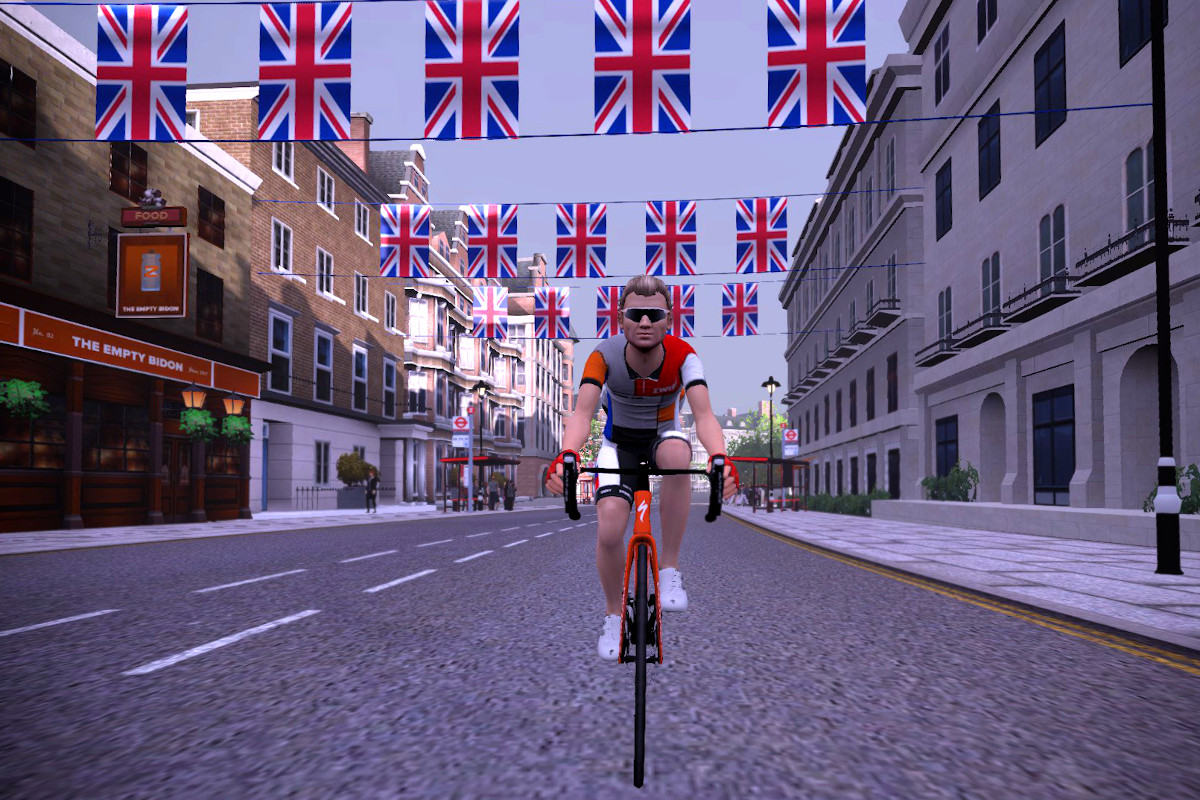
My process should now be as familiar to you as it is to me. I consulted the Zenturizer to find the Zwift routes that most closely matched the 2019 MVC ride’s 102 miles and 5,925 feet of climbing. Out of several options, I chose to undertake seven laps of the 15-mile “Greater London 8” course, which includes the short 450-foot climb of Box Hill.

Outdoor temps that ranged from 73-82º made riding much easier. After dancing away from a couple wheelsuckers, I spent the first half of the ride testing my defective Wahoo TICKR heart rate monitor, determining that it will only work if I’m sitting upright in the saddle in the “no-hands” riding position. If I was in any normal riding position — on the bar tops, brake hoods, drops, or even standing — it would give me obviously erroneous readings… if it gave any readings at all. Time to return that piece of slag and go back to Garmin.

The highlight of the second half of the ride was randomly coming across Herd team member Simon Keeling, who was doing the similar-but-not-identical century-plus PRL route. We exchanged encouraging messages then vectored off on our own again.

My legs started cramping on the last of my seven laps. This was made worse when I had to make an extra climb up the back side of Box Hill to make up some climbing I’d need to properly approximate last year’s MVC ride.

But I limped home to complete my tenth Zentury of 2020. I only realized after a friend’s comment that I’d logged no less than 96 Strava achievements on that ride, 16 of which were PRs!

In terms of lessons learned...

Doing long rides on a weekday is a big improvement, because you don’t have to worry about neighbors trying to sleep in. But if you don’t start until 10am, even a fast century is still gonna kill an entire day.

If you know you’re gonna have to do some extra climbing somewhere along the line, don’t leave it for the end of the ride, when you’re tired and cramping.

And if you want to keep some fruit on hand to munch on, either freeze it beforehand or keep it cool with some ice, because warm fruit just isn’t as palatable.

And finally… I’m getting tired of Zwift’s courses. That’s not surprising, considering I’ve ridden 4,860 miles on them over the past ten months. Zwift hasn’t implemented that many virtual roads to begin with, and it doesn’t help that only a few of them are adequate substitutes for real-world events.

And that’s not a good thing now that I’m at peak season, with three more events to mimic over the next 4-6 weeks. Plus another round of barf-o-tronic FTP tests.

But before that, a bit of rest, please?

The Akron Bicycle Club’s Absolutely Beautiful Country ride is the first major ride of 2020 that was neither cancelled, postponed, or virtualized. They asked people to register (for free) and supplied cue sheets, but provided no formal ride time, no route markings, no support vehicles, and no water stops. Basically, it was a completely unsupported ride along a published route, kind of like a brevet.

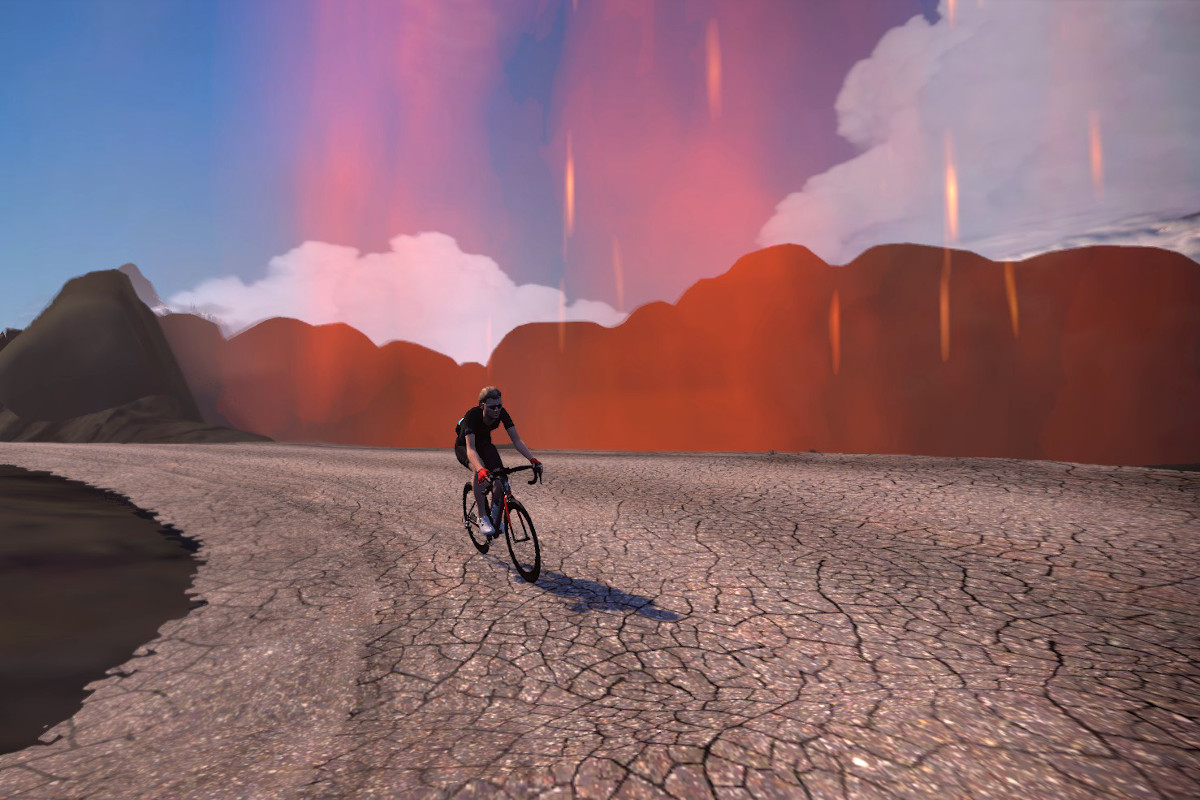
Moonlight on the Volcano

Although I’ve enjoyed riding it for the past three years, there was no way I was going to drive two hours to Akron and two hours back just to do an unsupported century, when 40 miles is the longest unsupported outdoor ride I’ve done at home (mostly due to concerns about stopping at convenience stores to refuel). In the middle of a global pandemic, it’s just not worth the added risk.

So despite there being a nominal ride, I was still going to mimic the route indoors on Zwift. As has become routine, I consulted my Zenturizer to find a course that matched last year’s ABC ride in distance and climbing.

Thankfully Pittsburgh’s longest heat wave in 25 years—eight days above 90°—broke on Saturday, when I warmed up with the 29-mile second stage of Zwift’s Etape du Tour, which was also my first look at the brand new France environment they just released.

Then Sunday morning I set out on 4.3 laps of Zwift’s Watopia Out & Back course. Each lap begins with a nice flat section in the desert, then up the reasonably challenging Volcano Climb, and back to the start via the Hill KoM Reverse.

Right from the start, I set myself an easy pace, about 150W normalized power. I spent the first three hours chatting on Discord with some fellow Herd members who were already halfway through their own century attempt.

Once they finished and signed off, the second half of my ride became more challenging. Ascending the Volcano four times was more climbing than I remember doing in the Akron ride, and my self-indulgent pace meant the ride dragged on long than necessary (though still much faster than the IRL ride due to traffic and rest stops).

Toward the end, I started incurring the usual fatigue, aches, and pains. Knowing I needed a little more climbing to reach my target, I made a short excursion into the rollers in Titans Grove, then finished off my eighth Zentury of 2020, with a spot-on 106 miles, and 33 feet more than the necessary 4,593 feet of climbing.

Right Turn, Not Left!

One of the strangest things is coming home from a century with no sensations of sun exposure. Stranger still is having eight centuries under my belt, but pretty much no tan whatsoever. As the subject line says: centuries 8, tan: 0! I need to continue—and perhaps increase—the few short outdoor rides I started doing in June, when 25% of my miles were done outside.

Beyond the pseudo ABC ride, there have been a few noteworthy developments in the past couple weeks.

I’ve already mentioned Zwift’s Etape event and new France map, which includes the iconic Mont Ventoux climb as well as nine new route badges to secure.

And our eight-day heat wave that really sapped my strength, and which will resume again on Wednesday.

Also my two year old Wahoo HRM strap broke, so I replaced it with a second-generation TICKR. Unfortunately, that hasn’t been working very well, and I’m considering swapping it out yet again.

Shimano released a 25th anniversary edition of their cycling sandals, my preferred footwear. I’ve put 60,000 miles on them, including 150-mile days, and couldn’t be happier with them, even despite the stupid tan lines they give you! I’ll try to add another pair to my collection.

And no report would be complete without mentioning my Pan-Mass Challenge fundraising. I’m currently at $1,725 for the year, which qualifies me for the official ride jersey, so you’ll see me sporting that very soon. I’m just $53 short of reaching $113,000 lifetime fundraising for the Dana-Farber Cancer Institute’s Jimmy Fund, a cause I believe in wholeheartedly. If you’d like to help out, please make a donation on my PMC profile page.

I’ve wanted a heart rate monitor (HRM) for many, many years. They’ve been the gold standard for cyclist training tools for a long time, notwithstanding the recent trend toward power meters.

However, they’re somewhat expensive, and I never felt justified in spending the money. Plus I feared it would be like the cadence sensor: useful only for a short period of time, enough to calibrate one’s own internal sense, and extreaneous thereafter.

However, prices have come down, and an HRM would have been handy indeed for my wintertime indoor trainer workouts. So I finally picked up a cheap Sigma Sport PC14 on sale at the Noshbar.

Cheap is the word. Any electrical field will cause the unit to either register a pulse of zero or over 200: a near impossibility for someone my age. So I can’t really trust it to record the max heart rate I hit during any given workout. Unfortunately, your max is what all the training heart rate zones are based off, so I’m fiddling with it to find my true max.

Here’s my initial observations. They’re based on only two days’ worth of use, so they’re highly provisional.

heart rate monitor

Resting heart rate, taken before getting out of bed in the morning, is a good indicator of general fitness. A sedentary person might have an RHR in the range of 60-80 beats per minute, while a trained cyclist would be closer to 45-55, so lower is usually better. I’ve seen a low of 51 bpm, and a sustained reading of 53, so that’s in line with my expectations. I remember taking my pulse in high school when I was bored and getting resting rates below 48.

Max heart rate is largely a function of age, and the standard formula for estimating it is to subtract your age from 220, but that will then vary based on your fitness level, with higher numbers being better. A 45 year-old’s expected values range from 164 to 186 bpm, and although I predicted I’d max out at 165, I’ve seen readings as high as 171. That’s in line with the base formula, although again that’s preliminary and more testing is required.

Using that as a base, I derived several additional numbers. My aerobic limit is around 120 bpm (70% MHR), and recovery rides should stay below 140 bpm (80% MHR). My lactate threshold should be somewhere between 140 and 155 (80-90% MHR).

The most interesting thing I’ve learned so far is that you can do easy aerobic training or you can do hard, painful interval training, but you derive very little training benefit in the middle ground between them. Below 70% MHR you’re burning mostly fat and can go all day; above 85% MHR you’re burning glycogen and building up lactic acid and need to rest and recover every few minutes; but in that grey area between 80-85% MHR, you’re working way too hard to burn any fat, but not hard enough to exercise your VO2 and ability to buffer and clear lactic acid. So that’s a dead zone you should avoid training in; for me, that area is from about 137-145 bpm. In short: go easy or go hard, but don’t go halfway.

For anyone trying to lose weight, that information is incredibly important. You’re always drilled with the value of exercise— particularly aerobic exercise—in losing weight, but there’s a huge mental trap there. Although aerobic exercise raises your heart rate, it doesn’t raise it enough for it to feel hard. Since most people think “harder is better”, they’ll often push themselves and work out in this middle ground, where they’re working hard, but not all-out. Unfortunately, at that level you’re only burning glycogen, not fat, and you’ll just crave sugar to replenish your blood and liver glucose levels. To lose weight, you have to do gentle exercise for very long periods of time, and it shouldn’t feel very difficult at all.

It’s similar to one of the problems I observe in novice cyclists. They get on a bike and mash down on the pedals at a knee-shattering 60 rpm. They think you have to work hard to make the bike go, or that you’re not exercising unless it’s hard work. It’s counterintuitive to a new rider, but selecting a very light gear that you can turn over easily is not only less effort and better aerobic exercise, but it’s also more efficient, and will save your knees, which harder efforts will damage.

So that’s the report on this year’s new toy. I’ll be curious to get more data from it over time, and particularly to see whether it provides me with useful information that will help me marshal my physical resources during longer rides.

Frequent topics