Aquaman

Aug. 16th, 2016 05:18 pm

Sunday I was up dark and early for my first Mon Valley Century ride.

Or rather, to check the radar to see if conditions were too ugly to ride. The forecast had called for day-long rain and thunderstorms as a powerful front rolled through, but at 4:20am the radar didn’t look prohibitive, and the NWS forecast language had moderated slightly.
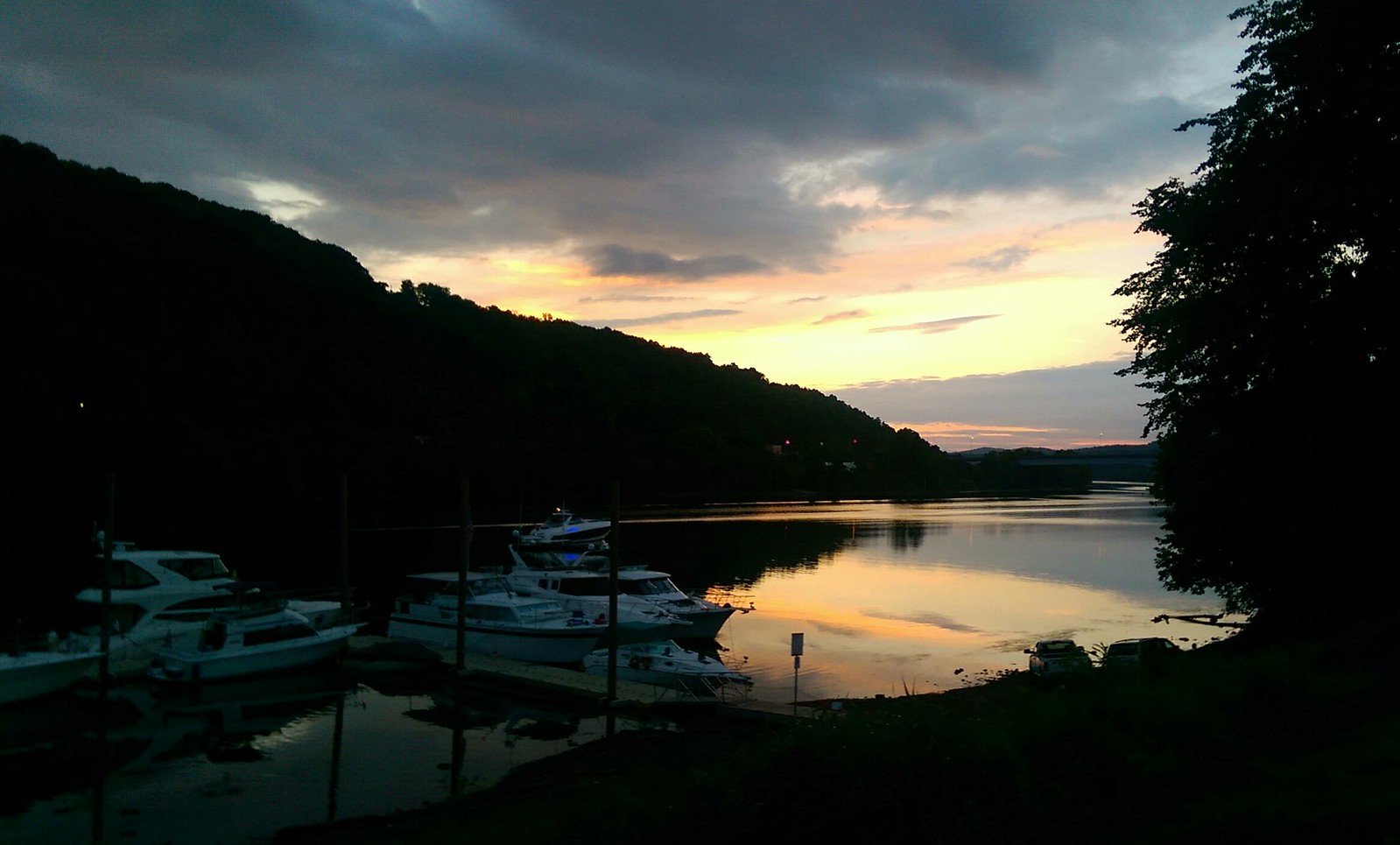
Sunrise over the Monongahela

I really don’t like missing major events on my cycling calendar, so I decided to risk it, packed up my backup bike rather than the good one, and drove down to Monongahela.

There were only a handful of riders at the Noble J. Dick Aquatorium, and after taking a picture of the sunrise over the river, I was the first to set out on the 100-mile route.

The first few miles were very fresh chip-seal, which essentially made it a gravel road. But once that section was done, it was clear sailing on empty country roads for the next 90 minutes. The first two riders caught up with me at the first rest stop, 22 miles in. So far, the weather was fine, and one of the volunteers told us that the radar looked like it would stay clear until noontime: very good news.

Having cut across country, we turned north and followed the Monongahela north, back toward the start. We all missed an intermediate water stop the organizers had moved, but a bunch of us regrouped at 10am at the lunch stop: mile 53 and first loop complete, as we were only a couple miles away from our original start line.

The next hour and a half was spent circling out on a different loop out to the rest stop at mile 72. As I got back on the road, an intermittent sprinkle began to fall, but it wasn’t enough to make things messy. I returned to the start/finish line at 12:30pm with 83 miles done.

Technically, that was the end of the ride, because the organizers had arbitrarily lopped ten miles off the start and end of the route because Bunola River Road was presumably closed.
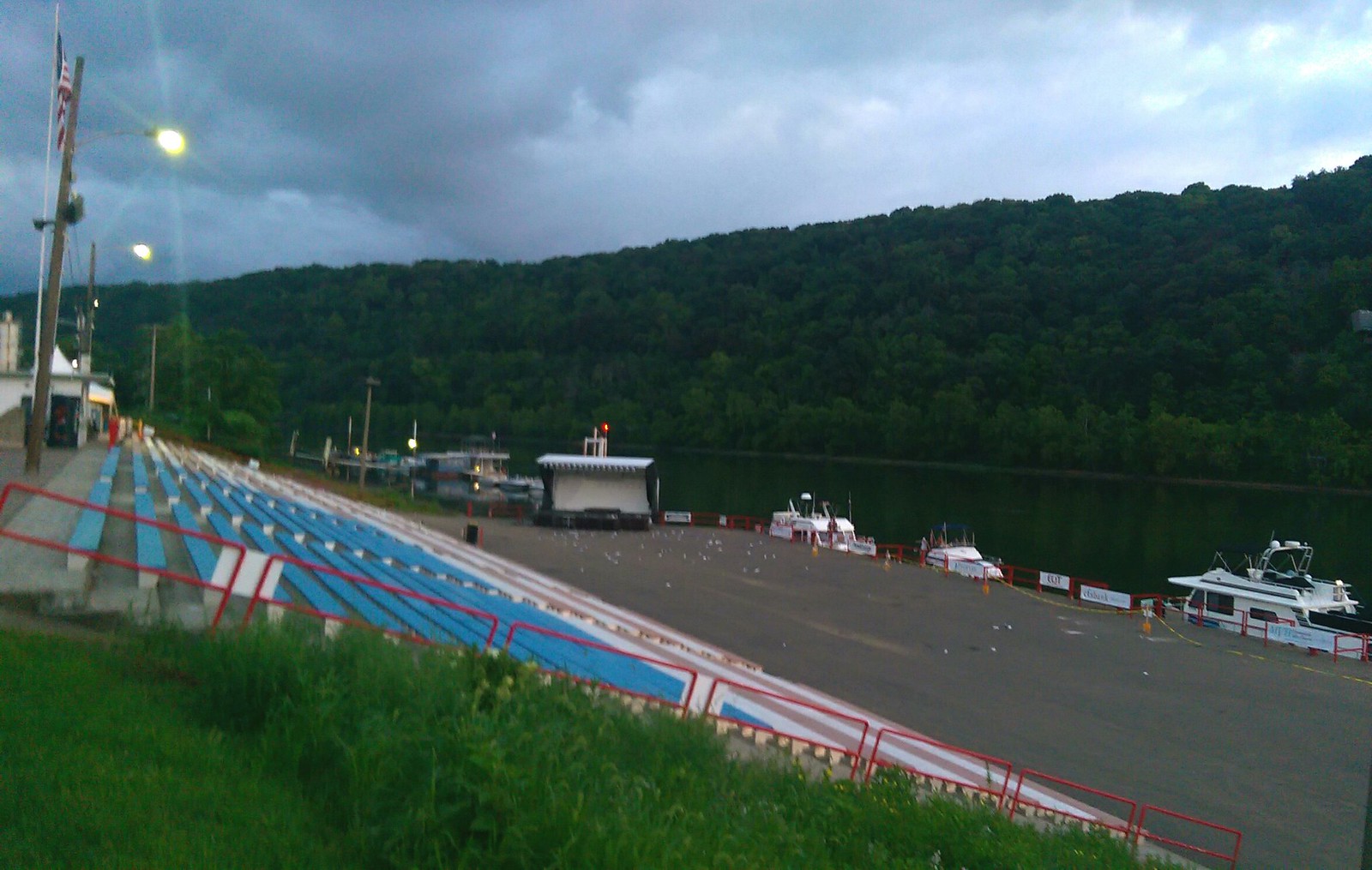
So this is what an aquatorium looks like

Knowing better, and wanting to complete a legit century, I decided to ride up Bunola Road to the old start/finish in Elizabeth and back, which would complete the full 100-mile course. While I did that, I endured one good, soaking shower, which passed but left the roads very wet. While I did hear some thunder, it wasn’t the hellfire and brimstone that the forecast had called for, and for the most part it was acceptably refreshing. Nonetheless, I was glad I rode the beater bike instead of my good one.

I completed the full course—my sixth century of the year—at 1:45pm. A seven-and-a-quarter hour century ain’t terrible, especially with 5,000 feet of climbing. I hadn’t pushed myself very hard, and it had been an overall pretty pleasant day out.

Thankfully, it turned out that I’d over-prepared for the weather we got. Although maybe I was just quick enough to escape it. Later that afternoon, a storm dumped over three inches of rain, prompting very real flash flood warnings in several of the towns I’d ridden through. So I’m actually okay with the idea of having over-prepared.

Going through those precautions gives me the opportunity to share some of the ways I prepare for riding in the rain. Hopefully this list will be useful to others—as well as my future self—when facing such conditions.

Let’s start with the most basic truth: NOTHING is going to keep you dry. NOTHING. You ARE going to get SOAKED. Are we clear on that? Okay.

One of my hard-won cycling lessons is that it only takes a cyclist a couple minutes to get soaked to the bone, and once that’s done, you can’t get any more wetter (sic). The damage is already done, so you might as well just keep pedaling and enjoy it!

Having said that, here’s how I prepare for a long, wet, ride in the rain:

  • Don’t use your good bike if you can avoid it; instead, ride a beater bike.
  • Don’t bother with a rain jacket. Lots of sports apparel companies make incredibly expensive rain jackets specifically for cyclists. The few that actually protect you from the rain also make you sweat so much—and trap it inside the garment—that you would be better off going without. Try to dress for the temperature instead.
  • If you expect rain and wet roads, a clip-on fender is great. It’ll prevent the rooster-tail from your rear tire from being flung up into following riders’ faces, and also from being flung up your anus and backside. If you expect sprinkles, an Ass Saver should be sufficient.
  • Wear a cycling cap with a brim. That’ll help keep the rain (and spray from other riders) out of your face.
  • Another thing that helps with spray is clear lenses for your sunglasses. You absolutely need eye protection under these conditions, but dark lenses impair your visibility. Clear safety glasses can be cheap and effective, but they’re prone to fogging up due to lack of ventilation.
  • Certain things must be kept waterproof: your wallet, your phone, and any food you’re carrying. For these, one or two layers of Ziploc bag is ideal. Make sure your cyclocomputer is water-resistant, too.
  • Inside that Ziploc, keep a handkerchief too. It’ll be useful for wiping off wet glasses, screens, hands, and so forth.
  • If you drove to the ride, keep a full-size bath towel in the car. You can use it to dry off, and to protect the seat on the drive home.
  • If you have the opportunity to change, obviously bring a dry set of clothes, and a bag to stuff your wet kit into.
  • Give your chain some wet lube, rather than dry lube, before setting out. It won’t perform miracles, but will stick longer. To be honest, you need to worry more about cleanup after the ride than lubing the chain before. After a wet ride, your bike is going to need a major cleaning.
  • Lower your tire pressure in the wet by a few PSI. This will enhance your grip on slippery surfaces. Also expect your braking distances to double.
  • Bear in mind that drivers have drastically limited visibility in the rain, so carry rear blinky lights, extra batteries (inside that Ziploc), and possibly a (lighted) safety vest. Take responsibility for being seen on the road.
  • I almost always wear cycling sandals, and they’re surprisingly effective in the rain. Water flows through them, unlike regular cycling shoes and socks, which absorb water, become heavy, and stay sodden for days.

While riding in the rain isn’t the best experience in the world, hopefully some of those ideas will be helpful.

Follow this link for my full 2013 Pan-Mass Challenge ride report, including writeup, photos, and GPS logs.

This is the tenth and final installment of my series of hints, tips, pointers, and advice for other Pan-Mass Challenge charity riders. These are the things I've learned during more than a decade of participating in the PMC.

Remember that the full list of posts is permanently available online at http://www.ornoth.com/bicycling/hints.php

Whether you're a first-timer or a longtime veteran, may you find these ideas useful, and I hope you have a wonderful PMC experience!

So far we've covered registration, fundraising, training, packing, and riding... All that's left is what to do once the event is over: Post-Ride.

  • Write up a ride report when you're done. Not only will it preserve your memories of the ride, but it'll be of interest to your sponsors and other riders.
  • Send a post-ride update to all your sponsors, letting them know how it went, what it was like, and that you might be asking for another donation next year...
  • Be sure to look for yourself in the official event photos, which appear on the PMC website incrementally over the weeks that follow the ride.
  • Also look for yourself in event photos posted to the pan_mass group on Flickr, and add your own photos to the collection!
  • Post your photos to Flickr, videos to YouTube, etc., and tag them PMC, panmass, or something similar so that other interested folks can find them.
  • Keep fundraising! You've got until October to chase down those people who promised a donation but haven't done so yet. Send out one final reminder as the fundraising deadline approaches.
  • To cap the year, consider attending the check presentation ceremony, which usually takes place just after Thanksgiving.
  • Around the end of the year, enjoy your copy of the annual PMC Yearbook, and share the link to the online PDF with your sponsors.
  • Turn around and start all over again with the "Registration" section, because it's time to reserve your hotel room(s) for next year's ride!

This is the next to last posting in my series of hints, tips, pointers, and advice for other Pan-Mass Challenge charity riders. These are the things I've learned during more than a decade of participating in the PMC.

The full list of posts will be compiled and permanently available online at http://www.ornoth.com/bicycling/hints.php

Whether you're a first-timer or a longtime veteran, may you find these ideas useful, and I hope you have a wonderful PMC experience!

Having just returned from the Outriders ride from Boston to Provincetown, it seems appropriate that today I'm going to talk about the second half of the PMC, which covers much of the same territory: Sunday: Bourne to Provincetown!

  • Sunday, wear whatever jersey you want. If you're riding with a team, they usually wear their team jerseys on Sunday. I usually wear the jersey from my first PMC.
  • There's no organized start on Sunday; plan to leave MMA around 5am.
  • Don't believe anyone who thinks that Cape Cod if flat. There are hills. You'll see. Especially Provincetown, Truro, and the Route 6 Service Road in Sandwich, which has rollers you'll want to shoot over, if you can.
  • There are usually ice pops at the Brewster (Nickerson State Park) water stop.
  • After you leave Wellfleet, expect a brutal headwind on Route 6 all the way to Provincetown. If there's no wind on Route 6, don't worry: you'll run into it when you turn back from Race Point. It's nice to merge in with a paceline for those segments.
  • Don't be fooled when you see the Pilgrim Monument and the "Entering Provincetown" sign. There's still several more miles as you loop out to Race Point and back into town.
  • When you make the turn at Race Point, zip up your jersey and keep your eyes peeled for the event photographers!
  • When parking in the bike line at Provincetown, sling your bike over onto the far side of the fence to avoid having it buried beneath other bikes or having to park at the way far end of the bike line. Loop your handlebars over the fence to make sure it doesn't fall down the other side!
  • If you're meeting someone in Provincetown, make sure they're on the road early. Route 6 backs up something fierce on Sunday.
  • Be warned that Provincetown has notoriously bad cell phone coverage.
  • Don't bring soap into the showers at Provincetown; they provide special biodegradable soaps, since the showers run off into the harbor.
  • You can wade in the ocean near the causeway behind the bike line in Provincetown, if you want to cool off.

Look for my tenth and final posting next week, when I share my experience on what you want to do post-ride!

This week, the rubber hits the road in my series of hints, tips, pointers, and advice for other Pan-Mass Challenge charity riders. These are the things I've learned during more than a decade of participating in the PMC.

The full list of posts will be compiled and permanently available online at http://www.ornoth.com/bicycling/hints.php

Whether you're a first-timer or a longtime veteran, may you find these ideas useful, and I hope you have a wonderful PMC experience!

I've spent the past seven weeks talking about everything you need to think about before the ride... Now let's talk about the first segment of the ride itself: Saturday: Sturbridge to Bourne!

  • Riders are asked to wear the official event jersey on Saturday.
  • Bring arm warmers for Saturday morning. It's often cold at 5am, even in August. You can strip them off later.
  • In the morning, do a couple laps around the parking lot before you line up for the start, just to check your tire pressure, brakes, and gears.
  • Unless you're a very slow rider, line up in the fast group at Sturbridge. So many people fill that group from the back that anyone in the other two groups automatically winds up at the very tail end of the ride amongst the slowest riders.
  • Don't sweat the ride route. It'll be thoroughly marked, there'll be lots of other riders, and there'll be lots of volunteers guiding the way. You shouldn't need any maps.
  • Don't sweat the hills. Yeah there are some, but if you've done hill training, you'll be fine. The miles are more strenuous than the hills.
  • Watch out for the route merge just before the Dighton lunch stop; it's really dangerous.
  • If you're curious about what your century time might be, the Wareham stop is almost exactly 100 miles from the Sturbridge start.
  • The final leg of Saturday's ride, from Wareham to Bourne, is only 8 miles. But riders are tired and it can be both congested and commercial, so be extra careful on this segment.
  • When you arrive at the finish, get your luggage and go straight to the showers, then quickly to the massage tent. Neglect this rule and you won't get any massage.
  • Even if you get a late massage appointment, you can sit in a "standby" area and take any tables that are still open after the scheduled riders for that period are accommodated.
  • You can wade in the ocean behind the dorms at MMA, if you want to cool off. Or perhaps "freeze off" is a more accurate term.
  • The tugboat dock, next to the canal, is one of the more quiet and peaceful spots to relax at MMA.
  • If you're riding with a team, official photographers take team and Living Proof portraits Saturday afternoon at MMA near the flagpole by the canal.

Next week I'll go over the second half of the ride, as we follow Sunday's route from Bourne to Provincetown.

It's June, so it's time to start getting serious about the Pan-Mass Challenge. So we get down to business in this week's posting in my series of hints, tips, pointers, and advice for other charity riders. These are the things I've learned during more than a decade of participating in the PMC.

The full list of posts will be compiled and permanently available online at http://www.ornoth.com/bicycling/hints.php

Whether you're a first-timer or a longtime veteran, may you find these ideas useful, and I hope you have a wonderful PMC experience!

Now it's time for the nitty-gritty, as I share some of the secrets I consider absolutely essential for a happy ride, and let you know what I do: During the Ride!

  • Consider involving your sponsors during the ride by posting text, photos, video, or audio to sites like Twitter, a blog, Facebook, or location-based services like FourSquare and Gowalla.
  • Getting ahead of the main pack of riders makes the ride a lot less crowded and stressful. Skipping the first water stop or taking only a short time, particularly at the lunch stop, are the best ways to make ground on other riders.
  • Start eating and drinking immediately, to stay ahead of your body's needs. Drink at least one bottle of Gatorade between each water stop.
  • Don't ride so hard that you are panting. Your stamina will last much longer if you stick to a strictly moderate pace. The less energy you expend at the start, the more you'll have left at the end.
  • If you have practiced it, draft other riders. This can save you 25 percent of your energy. Just be very careful, and let them know you're there.
  • Be businesslike at the water stops, and keep those stops brief. Finishing quickly means shorter lines for showers, massages, and food then you get to Bourne.
  • There are often volunteers giving basic massages near the medical tent at many of the water stops.
  • Enjoy the cheers of the spectators. How often do you get cheered on by crowds like that, after all?
  • Take notes about things that go especially well or poorly, so that you can mention them to the event planners when they ask for post-ride feedback. If your phone or camera has a voice recorder function, that's a great way to note things as they happen, so you don't forget.

Next week I look at everything you need to know to get from Sturbridge to Bourne!

Today may be a holiday, but there are no holidays in my ten-part weekly series of hints, tips, pointers, and advice for other Pan-Mass Challenge charity riders. These are the things I've learned during more than a decade of participating in the PMC.

The full list of posts will be compiled and permanently available online at http://www.ornoth.com/bicycling/hints.php

Whether you're a first-timer or a longtime veteran, may you find these ideas useful, and I hope you have a wonderful PMC experience!

This week I help you plan what to bring, so you don't forget something essential to your ride: Packing!

  • Make a packing list, and keep updating it after every ride, so that you have a reliable checklist of things to bring. This is just as useful for other travel and cycling events as for the PMC.
  • When packing, put things in separate bags based on where you're going to need them: e.g. one bag to bring to the Sturbridge hotel room, another for things you'll need on the bike Saturday, one with what you'll need at Bourne, on the bike Sunday, at the Provincetown finish, etc. Plastic grocery bags (doubled) work well for this purpose. Make sure they're clearly labeled, so you can grab and go!
  • The PMC has a bag drop that'll transport your bags from the start to Bourne, and then to the finish. Use it! Be sure to pack street clothes, shower supplies, and comfortable shoes! And use a distinctive, highly-visible bag that you'll be able to pick out in a huge luggage pile.
  • Because there are plenty of water stops, you actually don't have to carry much during the ride. A seat bag with basic repair and first aid kits is sufficient, plus water/Gatorade and a tiny bit of emergency food. Don't overdo it!
  • Bring a pocket camera and use it. Something small enough to fit in your cycling jersey pockets, that you can whip out and use quickly. If you're going to take pictures from the saddle, get lots of practice first, and be aware of other riders around you!
  • It's very handy to write the distances to the water stops on a piece of cloth tape on your bike's top tube. And the major hills, too. That way you'll know what's coming up next. Estimated arrival times are good, as well. And maybe something inspirational. This is what the pros do at races.
  • When preparing the food you'll carry on the bike, consider pre-unwrapping it and cutting it into bite-sized pieces for ease of use. But learn from my experience: don't put unwrapped donuts in your jersey pockets!

Next week's topic: What to do during the ride.

This week is the halfway point in my ten-part weekly series of hints, tips, pointers, and advice for other Pan-Mass Challenge charity riders. These are the things I've learned during more than a decade of participating in the PMC.

The full list of posts will be compiled and permanently available online at http://www.ornoth.com/bicycling/hints.php

Whether you're a first-timer or a longtime veteran, may you find these ideas useful, and I hope you have a wonderful PMC experience!

This week we look at the things you need to do leading up to the event: Pre-Ride Prep!

  • Bring your bike into the shop for a tune-up 1-2 months before the ride. Not last minute.
  • Avoid making any major changes to the bike or its fit in the final weeks before the ride.
  • Taper your training the week before the ride. Do at most a couple *very* easy rides, just to keep your legs loose. It's nice to start the PMC well rested, with peak fitness and replenished desire to spend time in the saddle.
  • Be sure to get plenty of sleep the days before the ride.
  • Drink lots of water in the 48 hours before the ride, right up to the start. Start the ride a bit overhydrated.
  • Clean and lube your bike and do a short, very easy shakedown cruise the day before the ride, just to make sure everything works and is ready to go.
  • While you should eat well, you really don't need to overeat before the ride. Just be sure to eat something lowfat and low-fiber the morning of the ride, preferably an hour or two before the start.
  • Some people make it a true pan-Massachusetts ride by riding from the NY border to Sturbridge on the Friday before the official ride. If you want to do this, do serious hill training, and contact one of those groups to ride with.
  • When you check in to the event, immediately run to the restroom and try on your event jersey (and shorts, if applicable) to be sure they fit (sizing can change from year to year). If you need to exchange them, you can do so right there at registration.
  • Catch the opening ceremonies Friday evening. Really. Usually Billy also gives a speech before the cameras go on-air. If you can't get into the (sweltering) auditorium, it's simulcast in an overflow tent behind the hotel, and on live television, as well.

Next week's topic: Packing.

Number four in my weekly series of hints, tips, pointers, and advice for other Pan-Mass Challenge charity riders. These are the things I've learned during more than a decade of participating in the PMC.

The full list of posts will be compiled and permanently available online at http://www.ornoth.com/bicycling/hints.php

Whether you're a first-timer or a longtime veteran, may you find these ideas useful, and I hope you have a wonderful PMC experience!

This week's tips address the most important and challenging part of the ride: Fundraising.

  • Linkedin, Facebook, Twitter, blogs, email lists: use every social networking opportunity both to get the word out and to gather names for your list of contacts.
  • Use the ride as impetus to keep in touch with old friends and reconnect with former friends. One of the side benefits of fundraising is that it encourages you to reach out to people you care about at least once a year.
  • Try to tailor your fundraising letters to each person. Don't just blast out one generic mass mailing. The more personal you make it, the more real it feels to people.
  • Give your sponsors a reason to donate: whether it's the story of someone you know fighting cancer, a personal goal you've set for yourself, or a gift that they'll earn for making a donation of a certain amount.
  • Track every interaction you have with your sponsors, and never let someone get away with saying they'd support you without coming through. Maintain a spreadsheet or database of your contacts.
  • Some people feel guilty for not making a big donation, so they decide not to give anything at all, rather than something small. Find a way to make them feel that giving a small amount is better than giving nothing at all. Setting a goal of reaching a certain number of sponsors can help in this regard.
  • After every donation, make sure you ask whether the sponsor's employer has a charitable matching gift program. That's free money!
  • Once they've made a donation, personally and promptly thank your sponsors and continue to send them periodic updates about your ride to help them feel involved.
  • Take opportunities to involve your sponsors in the ride by sending emails before and after the ride, around the fundraising deadline, and after the check presentation.

Next week's topic: Pre-Ride Prep!

This is the third post in my weekly series of hints, tips, pointers, and advice for other Pan-Mass Challenge charity riders. These are the things I've learned during more than a decade of participating in the PMC.

The full list of posts will be compiled and permanently available online at http://www.ornoth.com/bicycling/hints.php

Whether you're a first-timer or a longtime veteran, may you find these ideas useful, and I hope you have a wonderful PMC experience!

This week I address the core of your PMC prep: Training!

  • Train for the ride. You'll be much happier if you do.
  • Gradually increase your mileage until you're comfortable doing about 60 percent of the ride's distance. That'll build up your stamina sufficiently to complete the event without putting undue stress on your body.
  • Also do a few long back-to-back rides on consecutive days, to get your body used to getting back on the bike a second day in a row.
  • Pedal at low resistance and rapid cadence to save your knees. Beginners usually select a gear that's too big/hard, which can damage your knees and makes cycling more work than necessary.
  • Make sure that some of your training is on big hills, which will dramatically increase your strength. Hill repeats will provide the biggest training benefit of anything you can do.
  • Although hard training is the trigger that tells your body it needs to get stronger, remember that it can only get stronger while you're resting. Get plenty of it, and rest just as diligently as you train, if not more so. If you don't feel like a slacker on your recovery days, you're doing it wrong!
  • Begin your season with long, easy, aerobic base miles, then, once you've achieved your basic fitness level, move on to shorter, more intense hill repeats and interval training. Don't focus your training on mileage alone, because beyond a certain point more miles yield no benefit at all.
  • Don't train so much that you lose your desire to ride or your performance starts trending downward. That's called overtraining, which happens when you're not getting enough rest and letting your body recover.
  • Experiment incorporating basic stretching into your pre- and post-ride routine, especially hamstrings, calves, quads, IT band, and neck.
  • Wear sunblock. Serious sunblock. It's much easier to apply to shaved legs, by the way.
  • Practice eating and drinking on the bike, and test the foods you plan to ingest on the ride to make sure your body will tolerate them well. Don't make significant dietary changes on the day of the event!
  • Practice grabbing your water bottle with a reverse grip, with your thumb toward the bottom rather than the top. That makes it easier to squeeze the bottle and drink from the side of your mouth, so you don't have to raise your head and take your eyes off the road to drink.
  • Learn how to ride comfortably in a pack with other riders. Don't let the PMC be your first group ride. This is my most important safety tip, because the first time you ride in a big pack of mixed riders can be both dangerous and harrowing.
  • Postride stretching and self-massage are also great aids to recovery.
  • The ideal training diet is very low in fat, very high in complex carbs, and moderate in low-fat protein (most Americans get more than enough protein, so you don't need to increase it). On the bike, even simple carbs (sugars) have a role in providing quick energy. Don't be afraid of eating, because a cyclist working hard can burn over 1,000 kcal per hour.
  • The Charles River Wheelmen's seriously hilly "Climb to the Clouds" century usually happens two weeks before the PMC, and makes a great test of your readiness. If you can do CttC, the PMC will be no problem at all.

Next week's topic: Fundraising!

This is the second post in a weekly series I've begun on hints, tips, pointers, and advice for other Pan-Mass Challenge charity riders. These are the things I've learned during more than a decade of participating in the PMC.

The full list of posts will be compiled and permanently available online at http://www.ornoth.com/bicycling/hints.php

Whether you're a first-timer or a longtime veteran, may you find these ideas useful, and I hope you have a wonderful PMC experience!

This week's topic is one that everyone loves: Equipment!

  • If you're riding a hybrid or mountain bike, get skinny tires. The difference in rolling resistance is very significant.
  • Clipless pedals: they're also usually a good idea. Shimano mountain bike style cleats are recessed, so they're easier to walk in than traditional road cleats.
  • Wear padded cycling shorts. Like all of the odd things that cyclists do (well, most of the odd things), there's a good reason why everyone wears them. Without underwear.
  • Sunglasses. Use them! Riding all day in moving air dries your eyes out something fierce, and glare's no fun. And I haven't even mentioned flying insects, gravel, and branches...
  • Get a water bottle with a wide mouth, so that you can stuff ice into it as well as liquid.
  • You can buy insulated water bottles at your local bike shop. They're not going to perform miracles, but they're definitely worth the small extra cost.
  • If you have room for two bottles, make one a sports drink and one water. You can always pour the latter over your head on a really a hot day.
  • If you are prone to muscle cramps, consider bringing electrolyte pills to ingest along the way. There's no guarantee they'll work for you, but they probably can't hurt. As always, test these out on training rides before the day of the event.

Next week's topic: Training!

This is the first in a series of postings I have planned, wherein I will share hints, tips, pointers, and advice for other Pan-Mass Challenge charity riders. These are the things I've learned during more than a decade of participating in the PMC.

I will be posting one group of hints each week until I've posted all ten sections. And the full list will be permanently available online at http://www.ornoth.com/bicycling/hints.php

Whether you're a first-timer or a longtime veteran, may you find these ideas useful, and I hope you have a wonderful PMC experience!

This week's topic is something you should already be on top of: Registration and Logistics.

  • If you want to ride the traditional route from Sturbridge to Provincetown, sign up as soon as registration opens in January. It sells out very quickly.
  • During registration, if you're in doubt about which to order, opt for the official cycling jersey rather than the tee shirt. You can always buy a tee shirt later.
  • If you want to get decent rest Saturday night, plan to stay in a hotel off the MMA campus. Second choice are on-site tents. The dorms aren't very restful.
  • If you do want to stay in a hotel in Sturbridge, Bourne, or Provincetown, book your rooms a year in advance. Yes, really.
  • Expect nearly all the hotels on Cape Cod to have a two-night minimum.
  • Try to convince your friends to ride, too. It really is a much better experience when shared.
  • The usual PMC Twitter hashtag is #PMCyyyy where 'yyyy' is the current year (e.g. #PMC2011). It's interesting to monitor it to hear what other riders are up to.

Next week: Equipment!

Over the past few months, I’ve been re-reading my back catalog of cycling magazines, pulling out points that I thought were worth remembering and/or sharing. This final post contains all the stuff that didn’t fit the other categories, like travel, humor, and so forth.

  • The French-speaking Caribbean island of Guadeloupe is a great spring training cycling destination.
  • Elite pros often say that New Hampshire’s Mt. Washington is tougher than the Alpe d’Huez. It’s 7.6 miles with 2.6 miles being dirt, and an average incline of 12 percent. Long stretches are 18 percent, and it maxes out at 22 percent. Average wind speed is 35 MPH, and for decades it was also the site of the highest wind speed ever recorded on Earth. The course record is a blistering 9.6 MPH. The road is only open to cyclists on two days each year, and many makes of cars are not allowed on the mountain at all because of known weaknesses (mostly insufficient brakes).
  • Due to physiological differences, women tend to have an advantage on hill climbs, due to their leg strength and lower weight. They also excel at ultra endurance events due to their larger fat stores to power long aerobic efforts. Their lower center of gravity also helps with bike handling. Men, due to their overall strength and fast-twitch muscle fibers, typically outperform women in sprints, on the flats, in time trials and sprints.
  • When buying a new helmet or sunglasses, always test the combination, to ensure that the helmet and sunglasses fit well together and don’t interfere with one another.
  • Foam plumbing insulation, which comes pre-sliced lengthwise, is the perfect material for protecting frame tubes when packing your bike.
  • If you commute often, don’t lug your bike locks back and forth with you. Just leave them conveniently attached to the bike rack at work.
  • It’s really, really bad form to wear pro or team kit if you’re not being paid to wear it. If you are stupid enough to wear team kit, you’d damned well better be able to put the hammer down, or people will look at you as a complete poser.
  • On any ride where time matters, be sure to keep your rest breaks as short as possible. Remember this adage: “Going is faster than stopping.”
  • The cyclist’s idea of a love triangle: me, my significant other, and my bike.
  • Remember not to violate DuPont’s Law: the cool factor of Lycra is inversely proportional to the wearer’s distance from the bike.
  • Those of you who use compressed CO2 cartridges to fill your tires should remember that carbon dioxide is 52 percent heavier than air. And that’s rotating weight, which is going to slow you down.

Over the past few months, I’ve been re-reading my back catalog of cycling magazines, pulling out points that I thought were worth remembering and/or sharing. Here in part four is a collection of hard-won cycling techniques.

    In training, either go easy or go hard, but don’t spend all your time at a moderate effort like 10 BPM below your lactate threshold. While this is exactly the pace most group rides travel, you’ll wind up incurring fatigue without stressing your body enough to cause it to adapt and improve. Emphasize quality in your training sessions, not quantity.

    When riding in a group, try to stay in the front half of the pack, because riders at the back expend more energy by getting whipsawed during braking, turns, and accelerations.

    People habitually breathe very shallowly, using only 10-15 percent of their lung capacity. Train yourself to breathe deeply to more effectively power your muscles. On the bike, concentrate on full exhalations, because it’s more important to get rid of waste carbon dioxide than to take up excess oxygen.

    As you approach a climb (or a sprint), take a dozen big, deep breaths to flush all the carbon dioxide out of your system. Also, most riders’ heart rates go up unnecessarily at the mere thought of a hill, so work on mentally relaxing and welcoming such efforts, and your heart rate will not spike as readily.

    At the start of a climb, be sure to ask the people you are riding with questions which require them to give extended answers. While they’re busy talking and panting, you’ll be breathing normally and dropping them.

    When climbing, pull up on the handlebar with same hand as the foot you are using on the downstroke. That is, pull up with your right hand to give you more power while you drive your right foot downward.

    On descents, beyond a certain speed (around 28 mph) pedaling actually doesn’t provide a lot more forward momentum (maybe 5 mph max). It’s probably more efficient to get into your tuck and use the time to rest and recover from your climbing effort.

    Coasting descents are your best opportunity to relieve a weary butt by raising yourself slightly out of the saddle.

    Aerodynamically, it’s important to keep your knees and elbows turned inward or inline, rather than splayed out, where they catch a lot of wind and function like air brakes.

    Counterintuitively, having your head very low, with your chin near your bars, isn’t an aerodynamically optimal position. It actually creates more turbulence than if your head is 4-6 inches above the bar. Keep your head still and your back flat and aligned with your head rather than hunched up.

Over the past few months, I’ve been re-reading my back catalog of cycling magazines, pulling out points that I thought were worth remembering and/or sharing. Installment number three contains all kinds of crazy health and nutrition advice.

  • The average person has a resting heart rate of 60-80 beats per minute, with the average at 72. Trained cyclists' are usually lower, due to the cardiac fitness that comes with training. It is not unusual for conditioned athletes to get below 50 BPM. Elite cyclists have the lowest resting heart rates ever observed. Although I've only just started this year's training, my RHR this morning was 57 BPM.
  • If you keep wounds somewhat moist, rather than letting them dry, they are less likely to scab over and develop scars.
  • Cyclists are at high risk of repetitive stress injuries to the knees, specifically chondromalacia, osteoarthritis, IT band syndrome, and patellofemoral pain syndrome. Most of these can be prevented by proper bike fitting, spinning rather than mashing, and having an adequate training base for the workload. Icing the knee is usually beneficial, but do not ice for more than 20 minutes.
  • Endurance cycling has been linked with bone loss tending toward osteopenia and osteoporosis, since it is non-weight bearing and copious amounts of calcium can be lost through sweat. A cyclist can lose 200mg of calcium (the amount in a cup of milk) in just one hour of riding. A 7-hour century can cost a rider 1400mg, which is more than the US daily recommended intake. A cyclist training 12 hours a week loses 2440mg per week, which can add up year after year. This is compounded because dietary calcium is not readily absorbed, and kidney stones can form on an intake of as little as 2500mg per day. Absorption is improved by vitamin D and by taking calcium in gradually throughout the day. Calcium citrate is a preferred supplement to calcium carbonate. Stay far away from carbonated sodas, because the phosphoric acid leaches calcium from the bloodstream and bones.
  • It is suggested that potatoes be stored in the refrigerator, and that root vegetables like carrots and beets can be stored in the pantry.
  • A cyclist can burn in excess of 4,500 kilocalories riding a century at 15 mph. That's the caloric equivalent of four pints of Haagen Dazs ice cream.
  • Frozen concentrated orange juice usually has significantly more vitamin C per cup than the not-from-concentrate "fresh" juices. Unfrozen, both types lose 2 percent of their vitamin C per day. If you like spicy food, note that hot peppers have 350 percent more vitamin C by weight than oranges.
  • Roasted peanuts have more antioxidants than strawberries, apples, and many other fruits.
  • Your body can only process about 60g of carbohydrate per hour, so ingesting more will only lead to digestive upset and delayed flushing of the stomach.
  • Some popular junk foods fuel the body just as well as sports bars and gels. Good examples include waffles, bagels, graham crackers, vanilla wafers, salted cashews, and Payday candy bars. A quarter cup of raisins has 31g of carbohydrate, plus potassium which assists in muscle contractions. Fig Newtons are particularly good, two of them providing 22g of carb, 1g of fiber, plus potassium, iron, and calcium. Animal crackers can provide 46g of carb plus calcium. Gummi bears are easy to carry and pack 34g of carb plus protein. Pop Tarts provide 39g of carb, and Twizzlers have more carb per calorie than energy gels. Rice Krispies Treats are a great energy bar you can make at home.
  • Similarly, for recovery, sugary kids' cereals are just as good as expensive sports recovery drinks, with the same balance of 70 percent carbs and 15 percent protein. Suggested brands: Cheerios, Froot Loops, Cap'n Crunch with Crunchberries, and Frosted Flakes. Another optimal post-workout recovery drink is fat free chocolate milk.
  • The “pez” in Pez candies is short for the German word “pfefferminz”, or “peppermint”, their original flavor. Originally marketed as a health food and an aid to smoking cessation, the trademark Pez dispensers were designed to mimic cigarette lighters.

Over the past few months, I’ve been re-reading my back catalog of cycling magazines, pulling out points that I thought were worth remembering and/or sharing. This second installment contains some tricks for maintaining your bike.

  • Blue Dawn dish soap really is a high strength grease cutter, which makes it appropriate for some (but certainly not all) areas of cleaning the bike.
  • There's an apocryphal story that rubbing a bit of toothpaste on the clear plastic surface of your cyclo-computer will clear up scratches on its surface. It's worth a try, anyways.
  • Another dubious suggestion is to apply Rain-X protectant to your (sun)glasses if you're riding in the rain. While this might help keep your glasses clear, be sure to test it out before using it on plastic lenses!
  • Whenever you replace a tube or tire, if you align the tire's label with the tube's valve stem, it'll be easier for you to inspect both the tire and tube when you get your next puncture.
  • The handles of the quick release skewers in your hubs go on the left (non-drive) side of the bike. If your tires only have labels on one side, the labels go on the right (drive) side.
  • In addition to the usual items in your seat pack (spare tube, patch kit, multitool, tire levers), carry a Ziploc bag with Ibuprofin, a cleat screw, and chain replacement links/pins.
  • Consider also carrying a Presta/Schrader valve adapter. You can put this in that Ziploc, or just leave it installed on one of your valves.
  • To lubricate your shift cables, shift into the large chainring and cog, then shift all the way down without turning the cranks. This'll make it easy to remove the cable housing from its stops, so you can wipe and lube the cable before replacing it.
  • Whenever you remove your rear wheel, shift down to the smallest cog. This will make removing and replacing the wheel easier.
  • The right pedal goes on clockwise, and the left pedal counterclockwise. The left pedal and the right side of the bottom bracket are the only parts on the bike that are reverse threaded (that is, they don’t follow the “righty-tighty, lefty-loosy” rule).
  • When hand-truing a wheel, use the barrel adjusters to trim the brake blocks to give you a fixed point to eyeball your rim’s wobble, just like a truing stand.
  • Clockwise is tighter when you are looking at the spoke through the rim. Remember that on the rear wheel, drive-side spokes are more heavily tensioned than non-drive side.
  • When replacing a chain, use a bent paper clip or coathanger to keep the chain taut while you install the connecting link. That way you don’t need four hands.
  • When your chainring teeth start showing wear, you may be able to preserve them by rotating them a quarter turn on the crank, so that different parts of the ring are now at the power stroke points. This may not be feasible however with new chainrings that are designed to assist shifting.

Frequent topics