Here’s another rule of thumb I’ve developed for endurance cyclists: if you have to use your brake, you’re doing it wrong. That might sound a little silly, but it’s good science.

The only way that a bike moves is through the rider producing the force to propel it. You invest a lot of muscle energy to get the bike up to speed, and then its momentum allows you to keep it rolling along while expending just a little bit more muscle energy. When you stop pedaling and coast, the bike gradually loses momentum and will eventually come to a stop. On an ideal ride, you would only have to produce enough energy for the bike to just make it to your destination.

Since we don’t live in an ideal world, there are times when we need to use our brakes and come to a stop. For the endurance cyclist, stopping and starting is a really expensive operation.

First, the stop. For most stops, a rider uses the bike’s brake, which dissipates the energy built up in the bike’s momentum. That’s momentum that originally came from the rider’s muscle power. When the rider has used more muscle power than needed, he must use the brake to get rid of that excess momentum. Theoretically, he would have been better off expending less energy and coasting to a stop, rather than using too much of his limited muscle power and throwing the excess inertia away.

If you’re just out for a ride around the neighborhood, that’s no big deal, because you’ll never exhaust your stored muscle energy. However, if you’re an endurance rider doing a seven- or eight-hour 130-mile race, running out of energy (bonking) is a real possibility, so conserving every calorie of muscle power is critical.

Then comes starting back up again. As I indicated above, getting a bike up to speed is an investment of energy. It’s costly at first because you’re propelling both yourself and the weight of the bike; however, the investment pays off later in being able to use the bike’s momentum to keep it moving with much less effort. But every time you stop, you use an awful lot of your stored muscle energy getting back up to speed, especially when trying to do so quickly.

There are clear lessons here for cyclists. First, avoid stopping overall, because repeated stops and starts can consume a lot of energy. Second, manage your effort and try to ride in a way that doesn’t require much braking. You might even consider use of the brakes as a warning signal, a reminder that you probably expended more effort than absolutely necessary. I.e. if you have to use your brake, you’re doing it wrong.

Now, obviously the real world is a little more complicated than that. Downhills also put energy/momentum into the system that might need to be dissipated, and road design and traffic control placement usually don’t allow bicycles to gradually coast to a stop. Riders obviously need to apply a modicum of wisdom to these concepts.

But I’ve found it useful, especially on long-distance rides, to be very conscious of how much muscle power I use, which includes riding such that I can avoid using the brake as much as possible.

To the uninitiated, endurance cycling would seem exclusively about the legs. Looking at a rider, there isn’t anything else going on other than propelling the bike forward, mile after mile.

But the reality—and one of the things that draws me to it—is that long-distance cycling involves nearly every part of the body, and stresses many bodily systems to their maximum capacity.

Imagine bringing your heart rate up to 80 or 90 percent of your max and holding it there—not just for a few minutes, but for seven or eight hours. Imagine the load on your circulatory system of 50,000 extra heartbeats. Think about the demand that big muscles, hungry for oxygen, place on your lungs and respiratory system.

Cyclists' legs

Working muscles also need fuel in the form of glycogen. A cyclist quickly depletes what’s stored in the muscle tissue, then burns through the larger reserves stockpiled in the liver. After that, it’s up to the digestive system to make the carbohydrates you ingest available to your muscles as quickly as possible. And do it without making much demand on the circulatory system, which is already overtaxed.

Meanwhile, your body is trying to cool itself through perspiration, losing precious fluid and electrolytes. Here again, you dehydrate quickly, then rely on the digestive system to rapidly replace what your body loses through sweat. While sweating, the skin is also protecting you from wind, dirt, insects, gravel, and solar radiation.

While your legs are pumping to propel you forward, the rest of your muscles are working, too. Arm muscles are used to maintain your grip on the handlebars, and to pull against the bars while climbing. Your back, neck, and core muscle groups constantly adjust to maintain your balance as well as an unnatural and somewhat uncomfortable aerodynamic position. When I finish a long ride, my traps are usually in far more pain than my legs.

All your weight rests on your hands, feet, and butt, and these contact points are sometimes worked raw. And your hands are constantly working: shifting gears, braking, manipulating the bike computer, delivering food and fluid, signaling your intentions, and more. Your eyes and ears are equally busy, watching for threats, maintaining balance, and helping you navigate.

All of this input data is fed up to the brain, where it’s all coordinated: maintaining your balance, making decisions, assessing your effort level, calculating angles on descents, figuring out how to react to the immediate conditions, and at a higher level how to navigate from Point A to Point B. And it’s doing that while impeded by a very limited amount of fuel, since it relies exclusively on glycogen to function, which your muscles burn through at a prodigious rate.

I’m always taken by surprise when non-cyclists ask what I think about all day on one of my long rides. What to think about? There’s precious little time or energy or attention to spare for contemplation. In fact, on a lengthy ride, too much thinking is probably a sign that something has already gone wrong!

Even when the ride is done, your body continues working hard, repairing itself, recovering, replenishing, and building stronger muscles in response to the training load.

… Looking back at what I’ve written, even enumerating the bodily systems that cycling calls on still fails to communicate the raw intensity of those demands.

I often simply collapse on the bed for an hour or two at the end of a real hard ride; there’s precious little left over that you would call human. And ironically, that very emptying out provides a transcendent experience for the rider. A challenging ride is the crucible wherein we surpass normal human limits, and breathe the same rarified air as the greatest athletes among us.

These days, the descriptor “epic” gets thrown around pretty casually, but “epic” is a very fitting word for the ride that demands everything a cyclist has got. Every cyclist’s palmares is speckled with rides that truly are that monumental: destined to become oft-recalled personal legends. Such epic rides transform the cyclist, no matter how mundane, into an heroic figure, for having the simple audacity to test not just the strength of his legs, but all the diverse limits of his bodily endurance.

One thing amateur cyclists have in common with pros is that after a certain amount of time spent above your lactate threshold, you crack.

The human body is capable of producing prodigious amounts of power, and can sustain it over surprising lengths of time. But there’s a limit, and although you can’t see it coming, when you surpass that limit, it’s like slamming straight into a brick wall.

Maybe you’re on a fast, hilly group ride and pushing yourself as hard as you can. It’s a constant mental and physical struggle to hold the wheel in front of you. Depending on how fit you are, you can get away with that for twenty, forty, ninety minutes. But at some point your body will decide to shut down. It’s done, and so are you. You’ve cracked.

Rider down

The drop-off is surprisingly sudden and dramatic. One minute you’re working hard, at 100 percent but just hanging on to the other riders; the next minute, you can barely put any power into the pedals. You watch as your buddies disappear around the bend. It’s not just that you can’t hold their wheels anymore; you’re going backwards, only able to produce about half their speed.

You can try to recover, but no amount of soft-pedaling is going to bring you back across the precipice you fell from. You’ll have enough energy to drag yourself home, but only at a tepid grandma pace. You watch helplessly as you get passed by three year-olds on tricycles, butterflies, and the occasional roadside boulder.

You can see it just as dramatically in the pro peloton. They’re all in a pack, climbing huge mountains as if they were no big thing. A couple serious attacks and then *BAM*! You watch, wondering why one rider who was at the front suddenly and completely fell off the pace.

The problem for both amateurs and pros is that there are few (if any) clues that precede cracking. Every part of your body is already screaming because you’re pushing your absolute limit, but there’s no gauge showing how long you can sustain that effort; no “Check Engine” light to tell you that you’re on the verge of a blow-up.

There are only two things you can do to avoid cracking, and they’re both painful as hell. First, ride so hard that you crack often, and try to learn how to estimate when it’ll happen, so that you can hopefully back off before you’ve spent too much time at maximum output. And second, train like hell, so that your body can sustain redlining for increasingly longer times.

Suffering and cracking were the primary topic of one of my classic blogposts, a book review from twelve years ago, citing really eloquent passages from experienced riders Tim Krabbé, Lance somebody, and Paul Fournel. It’s titled “Be sure to really suffer out there!

As my cycling mentor Bobby Mac always said: you can go fast, or you can go long, but you can’t go fast for long.

There are only three contact points between bicycle and rider: hands on bars, feet on pedals, and butt on saddle.

No one ever says anything good about their saddle. For the vast majority, it is the seat of dissatisfaction and pain. Even experienced cyclists, once they find a saddle that works for them, do their utmost to forget all about it.

That strikes me as odd. Much of the information our brain uses to execute the complex operation of riding a bike comes to us through our hands, feet, and rear, but we try really hard to avoid thinking about what those contact points might be telling us.

swoopy road

There are interesting sensual experiences here that we overlook. The transition of weight onto our hands as we brake on a steep descent. The rhythmic juddering of the bike beneath us as we fly across a set of railroad tracks or a wooden bridge.

Many of these sensations come to us through the saddle. The up-and-down of a raised crosswalk speed bump. The change in ride texture from asphalt onto the smoothness of a painted road line, or the roughness of a coastal road that has been too long exposed to the elements.

And then there are those amazing, curvy roads that herald a flowing dance between your body and the bike, as you shift weight smoothly from left to right and left again while the road swoops back and forth. There are roads I could easily identify simply through their saddle feel: the southbound descent off Strawberry Hill, coming down South Street in Carlisle, swoopy Wilsondale in Dover, or the horrible pitted surface of Collins in Truro.

Bicycling is an intensely sensory experience, but we focus nearly all of our attention on the sights and sounds around us or the internal sensations of exertion: respiration, muscle pain, and thirst.

It’s sad that we only think about our contact points with the bicycle as sources of pain to avoid, rather than as a rich source of sensation, information, and experience. Not merely a pain in the ass, they are the physical interface between ourselves and the simple machine that allows us to travel so freely throughout—and in direct contact with—our world.

So on your next ride: instead of “saddle sores”, think “saddle soars”.

I’ve mentioned a couple times that this year I planned to visit a massage therapist after my big rides, to evaluate whether professional massage provided any discernible benefit in terms of recovery, flexibility, and muscle tightness. Now, with my season unexpectedly cut short, I guess I have the time to summarize my experience.

I had five sessions (sort of). The first one didn’t really count, as it was early season and I hadn’t ridden in several weeks. It was more just an expectation-setting and get-to-know-you session.

My first real post-ride session was three days after the hot & hard Tour d’Essex County. The result wasn’t very positive. Despite my primary interest in leg work, the masseur worked my upper body a lot, and not gently. I left with new pains in my chest, bicep, lower back, and groin, along with some unexpected bruising.

I think much of the problem was his predominant orientation toward therapeutic massage. His initial focus was on finding structural issues in my upper body and “repairing” them, rather than my explicitly-stated interest in simple muscular recovery and flexibility in my legs and glutes.

My next session was two days after Outriders… or would have been, except the masseur canceled on me. I’d been looking forward to a good workout after the extremely long 130-mile early-season ride, but so much for that!

Two days after the Mt. Washington Century was my next session. By then it was the end of July. That went well; I felt like I got more than my allotted timeslice, and my legs did feel a little looser afterward. But I can’t say it was dramatically different from what I could achieve myself.

My final session was two days after the Pan-Mass Challenge, and that was very similar: a bit more time than I expected, and reasonably good (but not dramatic) results.

Then of course after the accident there haven’t been any long rides, so I haven’t been back.

So my overall experience was mixed. While it was pleasant and somewhat helpful, it certainly didn’t provide a compelling training and recovery benefit beyond the self-massage techniques that I’ve done in previous years.

Judging from my experience at the PMC, I believe that what you get out of massage can vary very widely from MT to MT, so maybe that’s part of the equation, too.

Would I continue doing it? Sure… except for the expense. At $70 to $100 a pop, that’s a lot of cash to pay for a small benefit, especially if it’s coming out of pocket rather than covered by insurance. I’m glad I tried it, but I can’t justify the expense.

I certainly will put renewed emphasis on self-massage after rides, because I have certainly seen the benefit of postride massage. I’m just not convinced that that it’s worth paying someone else to provide that service.

Or maybe I should find a new romantic interest who might be willing to help… Nah!

When I bought my new bike, I also wanted to finally have a full premium fitting done.

Judging by the people I talk to, unless you’re a cyclist, you probably have no idea that there’s anything more to fitting a bike than making sure you can reach the pedals and the brakes, and that’s it. Well, it gets a whole lot more complex than that…

Still, it’s fair to ask why I would get my first professional fitting now. After all, I’ve ridden over 40,000 miles with no apparent issues, right?

Well, you can always improve, and there are a few minor annoyances that might be alleviated by a proper scientific fitting. For one thing, I tend to ride with my shoulders hunched up around my ears, which over long distances turns into a severe burning pain my traps. And I spend nearly all my riding time with my hands on the brake hoods, rather than down in the dropped section of the handlebars, which is much more efficient, but has been a lot less comfortable for me.

And my friend Jay’s experience was educational. Everyone who rode with him knew his setup was wacked, but he insisted it was correct for his mutant torso… until he came out of a professional fitting with a more reasonable looking setup, more power, fully functional genitalia (reportedly), and a much happier demeanor.

So it made sense to me to get a level-set to see if there were any tweaks that might improve my bike setup and my cycling form.

The problem was that my two-hour fitting was scheduled toward the end of Patriots Day: the day the Boston Marathon was bombed. That kinda blew a hole in our agenda…

I went in the next day and was told the fitter could work with me at 4pm. However, she only had an hour free, so we had to split the fitting up into two parts over separate days. The first part concentrated on basic bike fit, so that I could start riding, and I’d return a couple weeks later to do a followup and all the in-depth biomechanical stuff.

Fortunately, I’d ridden the new bike a few hours before the first fitting, so I had a good idea what I wanted changed. And I also had my old bike on hand, so that we could directly compare and measure differences between my old and new setups.

That first session mostly consisted of me talking about what kind of riding I do and how the bike currently felt, the fitter adjusting the bike toward what she thought would work best, and then me convincing her to tweak that so that it was closer to what I had grown used to on my old bike.

We pretty much agreed on saddle height, although I did learn that I tend to ride with my heel up and toes pointed down, rather than level or “ankling”. Our biggest compromise was over reach to the handlebars. My old bike had a lengthy 130mm stem and my seat was slammed back as far as it could go, and she gave me a 120mm stem and moderated my setback a little, because she thought I was too stretched out. Between that and the shallower handlebar drop on the new bike, we hoped I might feel a bit more comfortable riding in the drops, which eventually proved true.

The other main thing I brought up was my hunching my shoulders and back, which is a habit that I have real difficulty breaking. Basically, I know it’s bad, but I feel I need to pull on the bars to generate power, and that causes me to tense my shoulders. She had no real mechanical ways to correct that, so her only advice was to just stop doing it.

We combined the second half of the fitting with my normal 30-day post-purchase tune-up. That second fitting session basically consisted of the fitter asking me what I needed changed, and me saying “Nothing”. I’d expected us to do a bunch of in-depth biometrics work, but the only measurements we took were the same basic ones we had taken the first time: knee angle and knee-to-pedal. And that was pretty much all she did.

So contrary to my friends’ experiences with premium fittings, I don’t think I got much value from it: certainly very little beyond what one would get from a standard, free post-sale ride-ready fitting.

As for the 30-day tune-up, my results there were mixed, too. On the plus side, I had the shop enable multi-shift on my electronic shifters. Translation: instead of hitting the button several times to shift up or down multiple gears, I can simply hold the button down longer, and it’ll jump two or three cogs at a time. That’s a massive usability improvement for someone who rides in the city and is constantly jumping up and down the cassette while stopping and accelerating at traffic controls.

On the minus side, they charged me to attach my frame pump mount to the frame, but neglected to actually do the work! So I made them do it when I picked up the bike. (Aside: the only reason I had the shop attach it is because my bike has nonstandard-sized bottle cage bolts that wouldn’t work with the pump’s plastic mount.)

Overall this new bike shop seems informed and well-intentioned, but extremely forgetful and a little careless. I guess that means that I’ll just have to keep an eye on anything they do for me.

This week I also had my first massage appointment. This year, I’m planning on having full massages done after most of my big rides, to gauge its effectiveness in recovery and keeping my muscles from tightening up so severely over the course of the summer. We’ll see how that goes.

My first session was relatively benign. My only disappointment was that I’ve been off the bike for two and a half weeks, so I wasn’t in a position where I could judge the therapeutic and recovery value of the body work. But that’ll come shortly, and I’m looking forward to it.

The one thing the masseur did mention was that I showed symptoms of what is called “upper cross syndrome”, which basically means my body shows the hunched shoulders and other effects of spending too much time leaning forward at a desk or on the bike. And the prospect of looking like a hunched-over old lady is enough to get me looking at appropriate corrective exercises.

And in other news, I have to say I’m blown away (again!) by my PMC supporters’ amazing generosity. When my water heater blowed up (sic) on Monday, canceling a century ride I’d planned, I spent the day sending out my first 50 fundraising emails. A mere 48 hours later, they had already donated over $2,700 to the Dana-Farber Cancer Institute! I have some ridiculously awesome friends!

And a lot more fundraising to do, of course…

Some interesting stuff that shouldn’t wait for the release of my 2011 PMC ride report.

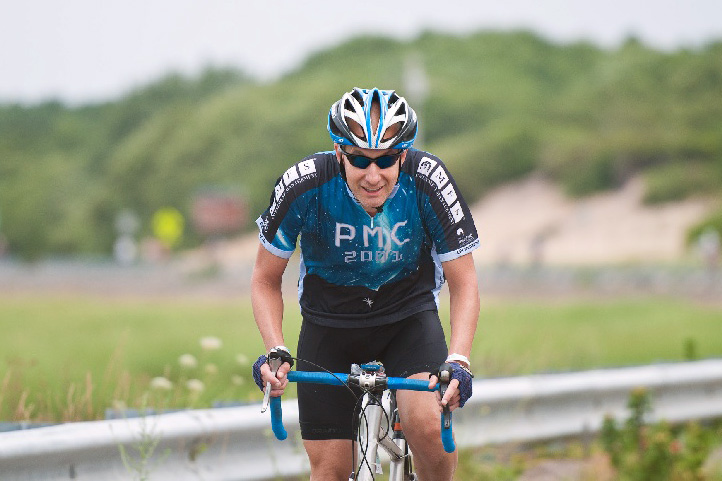
First and most importantly is that the PMC home page features a photo of me putting the hammer down during last weekend’s Pan-Mass Challenge. I was absolutely floored, because in a field of 5,200 riders it’s rare enough to have one’s picture taken, much less selected for inclusion in the post-ride photo montage!

On top of that, there are so many things about that photo that blow me away. It’s actually a good picture of me, wearing this year’s event jersey. And the jersey’s properly zipped up, a pro move that I teased my buddy Noah about a couple weeks ago. It’s a picture of intensity, with a pained grimace on the guy behind me. I’m down in the drops, leading a paceline, both of which are somewhat rare events. I didn’t even think I’d seen any event photographers on the course! If you look carefully, you’ll notice that it’s the biggest photo in the whole collage, and I’m given more prominent placement and a larger picture than Lance Armstrong and Senator John Kerry! And damn if I don’t have nice legs, too!

So yeah, when my buddy Dave Long pointed that out, I pretty much flipped my shit. Huge moment of pride, excitement, and amusement. Hopefully I’ll be able to obtain the original.

Next items are a couple of new purchases.

The first is a replacement rim for my rear wheel. Two days before the PMC, I found cracks in the rim of the Ksyrium SL that I run. So at the last second, I went to Back Bay Bikes and one of the mechanics let me borrow one of his (personal) wheels to ride the PMC with. I guess that deserves a paragraph in and of itself.

But a few days ago I got my rebuilt Ksyrium back. You might remember that I had a warranty replacement of that wheel two years ago. While they would have done a second replacement, the wheel was two months out of warranty, so I had to foot the bill to repair it. But now she’s back and hopefully will last. I wish I knew why I’m so tough on rear wheels, tho; I’ve destroyed two Ultegra and two Ksyrium SL rear wheels.

I also received the new Shimano cycling sandals I’d ordered. I’ve used two identical pairs of sandals since I started riding back in 2000, and I wore them into the ground because they don’t make that model anymore. However, one of them literally fell apart after this year’s Climb to the Clouds, so I ordered a pair of Shimano’s current model: SH-SD66.

Any time you change anything related to the contact points between you and the bike—hands, shoes, or seat—you risk screwing things up. I’ve only taken a couple rides, but so far they feel good. The most noticeable change is that the soles are stiffer, which is good, since I could feel exactly where the cleat was on my old sandals. Of course, it remains to be seen whether that stiffness is permanent or just a factor of the shoes being new, but I’m hopeful enough to retire the old ones and order a second pair to keep in rotation.

Final item is an interesting article about what it takes to be a pro cyclist, and how integral suffering is to cycling, whether one be a pro or just a neighborhood speedster. You might be interested in the whole article, but here are a couple choice citations that resonated with me:

Everything about cycling is contained in that gesture, including its reigning truism: to race bicycles is to drink greedily from a bottomless chalice of agony. The sport and its heroes are only knowable, and then just barely, once you come to understand that suffering is cycling’s currency. And what that currency buys is the occasional—the very, very occasional—moment of exquisite glory.

The first thing you notice about professional cyclists is that, with few exceptions, they appear to live their internal lives in a heavily padlocked tomb of mental anguish. They are at once astonishingly young and improbably ancient, a result of the fact that they are paid for their agony. They are modern-day ascetics, working in the open-air monastery of the mountains of Europe, with helmets as tonsures, spandex as robes.

There is thus a detachment in their manner that suggests the real world—our world—exists to them only as storybook legend, trapped as they are in another realm, with no corollaries, no points of contact, no common ground. They experience their lives through the tiny aperture of cycling; the aperture is so small because the light is so fierce. They have felt and done things on the farthest shore of the possible.

The reward for being the best isn’t that one takes *less* pain; rather that one is able to absorb *more*. The nature of this process is revealed at the precise instant that we come to know ourselves completely: we learn how far we can push ourselves, and the true mettle of our character. But that knowledge isn’t properly intelligible, nor is it transferable. To mangle Laurie Anderson’s aphorism, writing about cycling’s meta-state is like dancing about architecture. It is a private knowledge, forged in pain’s stables, and belongs to men who are not served by articulating it.

There’s no outward sign that [the cyclist] is one of the best athletes on earth. If you came across him shopping for a Billy bookcase at IKEA, you’d assume he had just returned from an island survival challenge, which he lost. Badly.

With nearly fifty international victories in a sport where body mass is a primary disadvantage, and his name enshrined forever in everyone’s minds as THE WORLD’S GREATEST ATHLETE™, you’d think Lance Armstrong would be one svelte dude.

Not so much. In fact, my body-mass index (BMI) is actually much lower than Lance’s.

At 165 pounds, Lance’s racing weight is exactly the same as my trained weight. Since I’ve got six inches of height over him, my BMI (a simple calculation based on weight divided by height) of 20.1 is significantly lower than his middle-of-the-road 23.7. At his height (5’10”), Lance would have to lose another 25 pounds to have a BMI as low as mine, tipping the scales at a mere 140 pounds!

And before his bout with cancer, Lance was listed as weighing 185, which puts his pre-cancer BMI at a stunningly flabby 26.5 at a time when he earned about 20 percent of his race wins…

Sure, all this probably says something about the shortcomings of BMI as a measure of fitness, but I’m not about to stop telling people that my BMI is 25 pounds “leaner” than Lance Armstrong’s!

Over the past few months, I’ve been re-reading my back catalog of cycling magazines, pulling out points that I thought were worth remembering and/or sharing. Here in part four is a collection of hard-won cycling techniques.

    In training, either go easy or go hard, but don’t spend all your time at a moderate effort like 10 BPM below your lactate threshold. While this is exactly the pace most group rides travel, you’ll wind up incurring fatigue without stressing your body enough to cause it to adapt and improve. Emphasize quality in your training sessions, not quantity.

    When riding in a group, try to stay in the front half of the pack, because riders at the back expend more energy by getting whipsawed during braking, turns, and accelerations.

    People habitually breathe very shallowly, using only 10-15 percent of their lung capacity. Train yourself to breathe deeply to more effectively power your muscles. On the bike, concentrate on full exhalations, because it’s more important to get rid of waste carbon dioxide than to take up excess oxygen.

    As you approach a climb (or a sprint), take a dozen big, deep breaths to flush all the carbon dioxide out of your system. Also, most riders’ heart rates go up unnecessarily at the mere thought of a hill, so work on mentally relaxing and welcoming such efforts, and your heart rate will not spike as readily.

    At the start of a climb, be sure to ask the people you are riding with questions which require them to give extended answers. While they’re busy talking and panting, you’ll be breathing normally and dropping them.

    When climbing, pull up on the handlebar with same hand as the foot you are using on the downstroke. That is, pull up with your right hand to give you more power while you drive your right foot downward.

    On descents, beyond a certain speed (around 28 mph) pedaling actually doesn’t provide a lot more forward momentum (maybe 5 mph max). It’s probably more efficient to get into your tuck and use the time to rest and recover from your climbing effort.

    Coasting descents are your best opportunity to relieve a weary butt by raising yourself slightly out of the saddle.

    Aerodynamically, it’s important to keep your knees and elbows turned inward or inline, rather than splayed out, where they catch a lot of wind and function like air brakes.

    Counterintuitively, having your head very low, with your chin near your bars, isn’t an aerodynamically optimal position. It actually creates more turbulence than if your head is 4-6 inches above the bar. Keep your head still and your back flat and aligned with your head rather than hunched up.

Over the past few months, I’ve been re-reading my back catalog of cycling magazines, pulling out points that I thought were worth remembering and/or sharing. Installment number three contains all kinds of crazy health and nutrition advice.

  • The average person has a resting heart rate of 60-80 beats per minute, with the average at 72. Trained cyclists' are usually lower, due to the cardiac fitness that comes with training. It is not unusual for conditioned athletes to get below 50 BPM. Elite cyclists have the lowest resting heart rates ever observed. Although I've only just started this year's training, my RHR this morning was 57 BPM.
  • If you keep wounds somewhat moist, rather than letting them dry, they are less likely to scab over and develop scars.
  • Cyclists are at high risk of repetitive stress injuries to the knees, specifically chondromalacia, osteoarthritis, IT band syndrome, and patellofemoral pain syndrome. Most of these can be prevented by proper bike fitting, spinning rather than mashing, and having an adequate training base for the workload. Icing the knee is usually beneficial, but do not ice for more than 20 minutes.
  • Endurance cycling has been linked with bone loss tending toward osteopenia and osteoporosis, since it is non-weight bearing and copious amounts of calcium can be lost through sweat. A cyclist can lose 200mg of calcium (the amount in a cup of milk) in just one hour of riding. A 7-hour century can cost a rider 1400mg, which is more than the US daily recommended intake. A cyclist training 12 hours a week loses 2440mg per week, which can add up year after year. This is compounded because dietary calcium is not readily absorbed, and kidney stones can form on an intake of as little as 2500mg per day. Absorption is improved by vitamin D and by taking calcium in gradually throughout the day. Calcium citrate is a preferred supplement to calcium carbonate. Stay far away from carbonated sodas, because the phosphoric acid leaches calcium from the bloodstream and bones.
  • It is suggested that potatoes be stored in the refrigerator, and that root vegetables like carrots and beets can be stored in the pantry.
  • A cyclist can burn in excess of 4,500 kilocalories riding a century at 15 mph. That's the caloric equivalent of four pints of Haagen Dazs ice cream.
  • Frozen concentrated orange juice usually has significantly more vitamin C per cup than the not-from-concentrate "fresh" juices. Unfrozen, both types lose 2 percent of their vitamin C per day. If you like spicy food, note that hot peppers have 350 percent more vitamin C by weight than oranges.
  • Roasted peanuts have more antioxidants than strawberries, apples, and many other fruits.
  • Your body can only process about 60g of carbohydrate per hour, so ingesting more will only lead to digestive upset and delayed flushing of the stomach.
  • Some popular junk foods fuel the body just as well as sports bars and gels. Good examples include waffles, bagels, graham crackers, vanilla wafers, salted cashews, and Payday candy bars. A quarter cup of raisins has 31g of carbohydrate, plus potassium which assists in muscle contractions. Fig Newtons are particularly good, two of them providing 22g of carb, 1g of fiber, plus potassium, iron, and calcium. Animal crackers can provide 46g of carb plus calcium. Gummi bears are easy to carry and pack 34g of carb plus protein. Pop Tarts provide 39g of carb, and Twizzlers have more carb per calorie than energy gels. Rice Krispies Treats are a great energy bar you can make at home.
  • Similarly, for recovery, sugary kids' cereals are just as good as expensive sports recovery drinks, with the same balance of 70 percent carbs and 15 percent protein. Suggested brands: Cheerios, Froot Loops, Cap'n Crunch with Crunchberries, and Frosted Flakes. Another optimal post-workout recovery drink is fat free chocolate milk.
  • The “pez” in Pez candies is short for the German word “pfefferminz”, or “peppermint”, their original flavor. Originally marketed as a health food and an aid to smoking cessation, the trademark Pez dispensers were designed to mimic cigarette lighters.

This time of year, five weeks before my annual PMC ride, my reading habits usually turn to cycling titles. Many deal with training, technique, and nutrition—more on that in a subsequent post—but a few address the indescribable essential nature of cycling. Paul Fournel’s “Need for the Bike” and Tim Krabbé’s “The Rider” are two outstanding, enduring classics of that genre. There aren’t many others.

So I was very excited to come across a book called “Open Your Heart with Bicycling” at the BPL the other day. The volume was subtitled “Mastering Life through Love of the Road”, and a pull quote offered the definition, “To become aware of the inspiration that a sport or hobby, such as bicycling, brings to your entire life”. The back cover talked about the author’s years as a Benedictine monk and further time spent at a Buddhist college.

With that kind of a lead-in, I suspected I’d found another example of that rare breed of book that manages to capture that essential experience of cycling, full of the elusive insights that are almost impossible to relate to anyone but another cyclist.

I was misled. “Open Your Heart” would be more appropriately named, “A Very Basic Beginners Overview of Cycling”. It’s really a book for the neophyte, save for the nonsequitorial chapter on how to open your own bike shop. Sadly, there’s more philosophy in a single chapter of Fournel or Krabbé than can be found in the entirety of “Open Your Heart”.

So why am I writing about it? Well, there are three points I want to make/save/share from the exercise.

The first is confirmation of my theory that the “runner’s high” is extreme glycogen depletion and the resulting impaired brain function. I first articulated this idea six years ago in this post on my regular blog. Here’s the relevant quote from OYHwB (bolds are mine):

I have to eat; there is no question that I must eat after a long ride. […] I am perfectly content eating alone, particularly when my blood sugar is low as a result of very strenuous exercise. I am a grouch when I have not eaten properly. I eat what is necessary to stabilize and improve my disposition and only then am I allowed to be with other people! I have made more verbal blunders in this condition than I have ever made while drinking.

I think that illustrates my point very nicely.

The second item of note is the one bit of philosophy that I was able to glean from the book. It derives from the following passage:

But that’s how my real spiritual journey begins: with a world-class bicycle, a dream, and the haunting realization that no matter what the hucksters on television say, not every dream comes true. You can’t have it all, but you *can* have what you truly desire. I needed to learn this lesson, and I discovered the simpler pursuits like cycling gave me exactly what I desired. Not achieving boyhood dreams has been the least of my worries, and the joy that I experience on a daily basis began when I understood that as a young adult.

While the author doesn’t say it, he’s dancing around an interesting truth: that real happiness doesn’t come from fleeting experiences, but from simple things that one can derive joy from every day of one’s life. That could be something simple that is available every day, such as enjoying the sun in a clear blue sky, or the wind in the trees, or one’s favorite companions, or it could be satisfaction derived from a memory one can always revisit, such as helping a friend or donating time or money to humanitarian causes. But the idea is to base one’s sense of joy on things that aren’t transient, that don’t need to be reinforced every few days, weeks, or months.

Finally, the book caused me to reflect on what happens during a long ride. If you asked me what my mind was up to during those six- or eight-hour jaunts, I’d have to admit that it’s not doing much! While some of it might be off pondering things, most of the time I’m fully occupied making the moment-by-moment observations and actions that are required to operate a bike on a public way.

In that sense, it’s very zen: there is no “me” there, there’s just the riding: when riding, just ride. It’s a time when the joys and demands of the road supersede the usual preoccupation with one’s personal storyline; for a while, you forget yourself. Which thought, in turn, got me thinking about a famous passage from Sōtō Zen founder Master Dōgen’s “Genjōkōan”:

To forget the self is to be enlightened by all things of the universe. To be enlightened by all things of the universe is to cast off the body and mind of the self as well as those of others. Even the traces of enlightenment are wiped out, and life with traceless enlightenment goes on forever and ever.

Such is the ride.

Of course, it’s also on the bike that thoughts like this often come along:

Seeing an object in a backyard with a rounded cover: Is that a baby carriage, or is it a barbecue grill? Wait! Why can’t it be both? A combination baby carriage and barbecue grill! Why hasn’t anyone ever thought of that? Brilliant!

Frequent topics