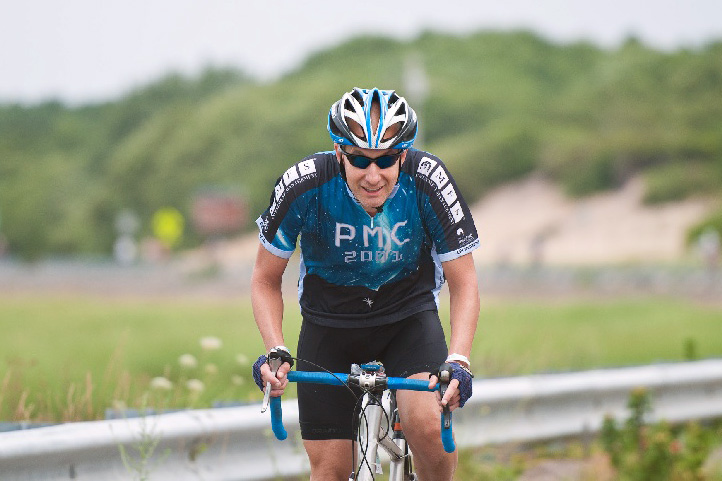
I was 35 years old when I started my adult cycling career. In those early years, my rapidly-growing cycling fitness more than compensated for any loss of overall fitness that came as I aged.

As the years passed, my cycling fitness reached a stable plateau, while the effects of aging slowly but consistently gained momentum. But I wasn’t worried; throughout my forties I could easily keep up with riders ten years younger.

But when I turned 50, I noticed it took increasingly more effort to keep up with the kids. And now that I’m 60 years old, I have to admit that I’m simply not keeping up with them anymore, and never will again, no matter how hard I train.

So in case you’re on that same career path, here’s a few observations about my experience as an aging cyclist.

It’s easiest to see in the numbers. It wasn’t as linear as the “220 minus age” formula implies, but my max heart rate has dropped significantly over the past 15 years, from 175+ down to 160. And the inevitable loss of muscle mass has been reflected in my FTP and other measurements of power output like sprinting duration and max power.

The media always invokes the idea that we need more recovery time after hard efforts as we age. For me, that manifests mostly in my ability to do repeated bursts of high-intensity effort within a ride. I don’t feel I need more recovery time between rides; if I need more time for anything after a hard ride, it’s for my motivation to recover! And of course the standard prescription for maintaining fitness as we age is to continue doing severely painful intensity workouts. Ugh!

One generalization I can confirm is that as I’ve aged, my sleep cycle has become shorter and less refreshing. Gotta start embracing the nap, although they’ve always left me feeling nauseous afterward.

Another change is that I’m less willing to tolerate bad weather. I’m good with heat, but I’m kind of done thinking that riding in the cold is any fun. Doubly so for rain, and the annoying cleanup routine that follows a wet ride. Yes, it can be done; no, I don’t think it’s worth it anymore.

But once you’re out on the road on a nice day, what does riding “over the hill” feel like? It feels like having one of those days where you’re not performing at your best… every single day! Whether it’s heavy legs or lack of aerobic fitness, it always feels as if there’s something limiting me. There aren’t many of those strong days when you’re at peak fitness and everything comes effortlessly.

Instead of looking forward to hills as a place to attack your group, you begin to fear them as places where you’ll fall behind the group. And they drop you more frequently on those climbs… and on the flats… and on descents. You still participate in group rides, but you wind up isolated and riding by yourself much of the time.

You get discouraged on group rides, because you’re the last person to each rest stop, which means you always get the least rest before the group sets out again, despite being the person who needs recovery the most. So you give up on the group and spend more time doing solo rides.

That’s what it’s like. I’ve had an undeniable drop-off in physiological performance due to aging. But at the same time, psychologically I’m just less willing to tolerate the suffering inherent in high-intensity, maximal efforts. To keep up with other riders, I have to spend more and more of my time riding at my limit, and it’s harder and harder to marshal the motivation to spend long hours riding at that limit.

While I was slowly getting older, I spent 25 amazing years near the front of the pack. Now that I’m 60 years old, that’s simply no longer a possibility. It’s time to set ego aside and get used to being one of the slower riders that other people have to wait for. It’s either that, or ride solo, which is something I’ve always done quite a lot of.

While I may not be the strongest cyclist in the pack any more, I still have the advantage of being significantly healthier than my sedentary age-group peers. And I still have as much passion for cycling as I’ve ever had. The bottom line is that I need to accept my reduced capabilities, adjust my goals to match them, find groups that will tolerate them, and just ride on.

May the road before you be a long, enjoyable one!

In March, when I was in Kuala Lumpur (heheh!) I scoped out a local bookstore’s manga, Buddhism, and cycling sections. In the latter, I discovered the intriguingly-titled Into the Suffersphere: Cycling and the Art of Pain. Which I set aside because it was pricey in Malaysian ringits. However, I later requested it from Amazon.

The book covers three predominant topics. The first is professional bike racing and cycling culture. The second—which derives from cycling—is suffering: its manifestation and methods of coping, and the doping that pervades the sport. That gives way to the third topic: the philosophical relationship between man and his suffering, seen through the lens of (of all things) Theravada Buddhism.

You might think “Orny, this is the perfect book for you!” And to some degree you’re right, although I’ve long since become disgusted and given up following the perpetual circus of lying and cheating that calls itself “competitive cycling”. So the book gets a cool review from me in that respect.

Then there’s the theme, or lack thereof. Taken one way, the book is a series of anecdotes and observations related to those three main topics; however, it never supplies the reader with an overall thesis, argument, or conclusion. OTOH, from a less goal-oriented point of view, it’s a wildly eclectic and engaging jaunt through a storehouse of seemingly random and improbable connections and associations.

The only way I can communicate this breadth is by listing out some of the people the author cites and things he refers to. I’ll start with the most pertinent to the topic, and proceed to the more eclectic.

Addressing cycling, the author references the Strava social network whose name is the Swedish word for “striving”, and its infamous Suffer Score metric (which was recently replaced by the completely useless “Relative Effort”, as I mentioned toward the end of my previous blogpost). He mentions Team Sky’s focus on “marginal gains” and Chris Froome’s perpetual glassy-eyed stare at the power data on his bike computer. He mentions Graeme Obree’s singleminded attempts at the hour record, and Jens Voigt’s famous “Shut up legs!” quote. Cycling’s most infamous drug busts, including Operacion Puerto. Tim Krabbe’s semi-autobiographical novel “The Rider”, and a short piece by Alfred Jarry with the stunning title: “The Crucifixion Considered as an Uphill Bicycle Race”. Consideration is given to concepts as contemporary as MAMILs and “The Rules” according to the ludicrously pretentious Velominati.

In terms of Buddhism, the author’s knowledge is broad and detailed, but that’s not surprising given that he is a longtime resident of Chiang Mai, Thailand. He describes the phenomenon of “monkey mind” and the modern preoccupation with mindfulness, from Thich Nhat Hanh to Jon Kabat-Zinn’s completely secular MBSR. He mentions Theravada, dhamma, the Four Divine Messengers, the Middle Way, the Four Noble Truths, the Noble Eightfold Path, Right Effort and Right Concentration, dukkha and sukha, the Wheel of the Dharma, samsara and nirvana, jhana, impermanence, non-attachment, and the Buddha’s final instruction upon his parinirvana to strive diligently.

Moving gradually further afield, he cites several philosophers, ranging from Nietzsche to John Stuart Mill, the Dalai Lama, Malcolm Gladwell, the Roman stoics, Alan Watts, Karl Marx, Albert Camus, Terry Pratchett, and the Black Knight’s “It’s only a scratch” sketch from Monty Python and the Holy Grail.

Also of interest to me were his geographical references, which included his homeland of Thailand, Malaysia’s Tour de Langkawi race, Cambodia, Phuket, Singapore, and the classic Thai phrases “farang” and “mai ben rai”.

Being an English expat, he must also enjoy his football, because he also references superstar Lionel Messi and makes fun of the soccer world’s most infamous ear-biting racist asshole, Luis Suarez.

In terms of random tidbits that struck a chord with me, he uses “klicks” as shorthand for “kilometers”. Mentions “postural hypotension”: fainting upon getting up too fast. Finds women in yoga pants a distraction from meditation. As a jew, he goes to great lengths to relate how uncommon cycling is amongst his tribe. And he rails a bit against society’s ridicule of anything undertaken by middle-aged men (I’ll have more to say about that soon in a post on my main blog).

As you can see, he covers an awful lot of ground, and much of it does resonate with me. I guess I’d be more enthusiastic about it if I didn’t take pervasive doping in sport as seriously as I do; instead, focusing on something I find so pathetic evokes a sense of depression in me.

Still, it’s an entertaining read and a good enough book overall. For most people, it’d be better to request from a library than purchase outright… but few libraries will stock something this specialized and esoteric.

While there’s a lot more that the author could have said about it, I’m glad to see anything that covers the interface between cycling, suffering, and philosophy (and specifically Buddhism).

I wasn’t planning on repeating last year’s Akron Bike ClubAbsolutely Beautiful Country” century. It was a really nice ride, but it’s a two-hour drive from Pittsburgh, which makes for a lot of driving on top of a 100-mile bike ride.

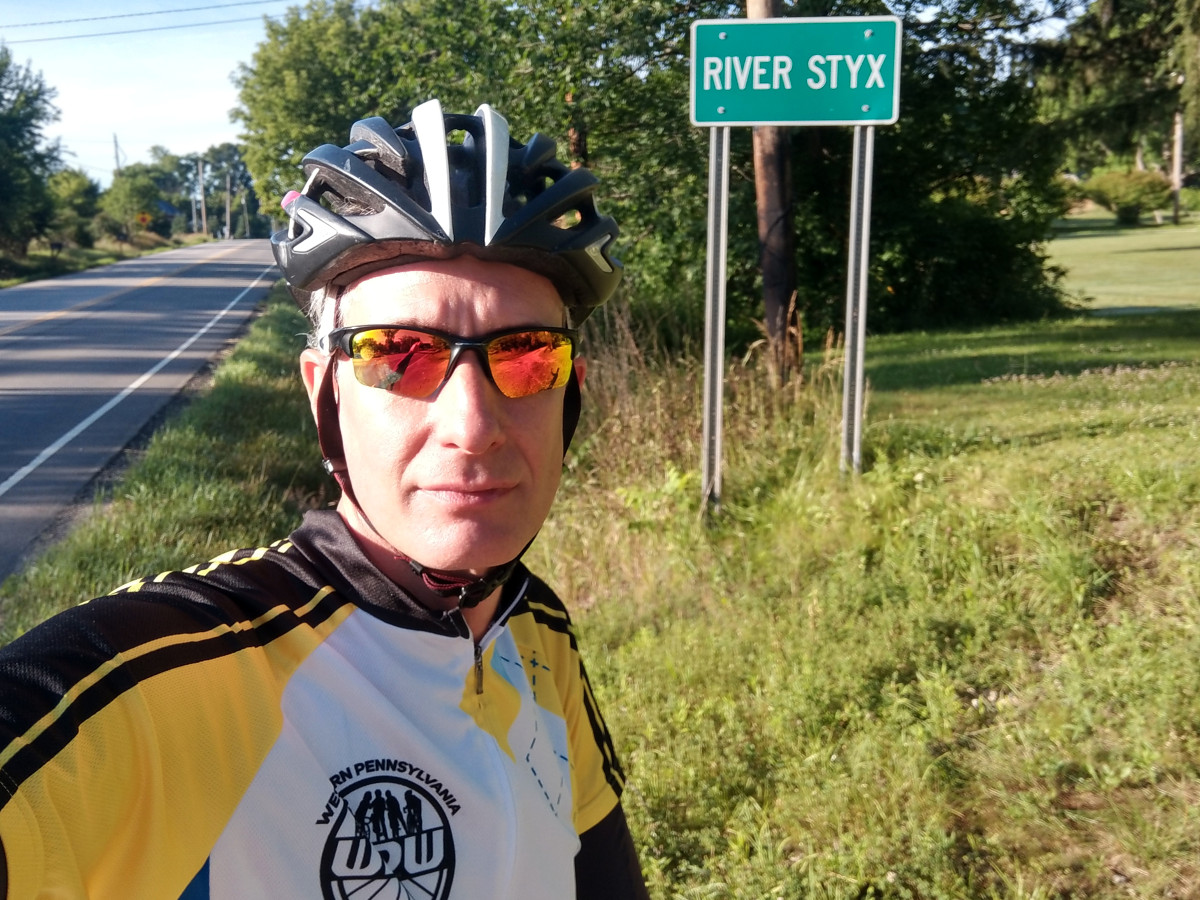
Selfies on the River Styx

Selfies on the River Styx

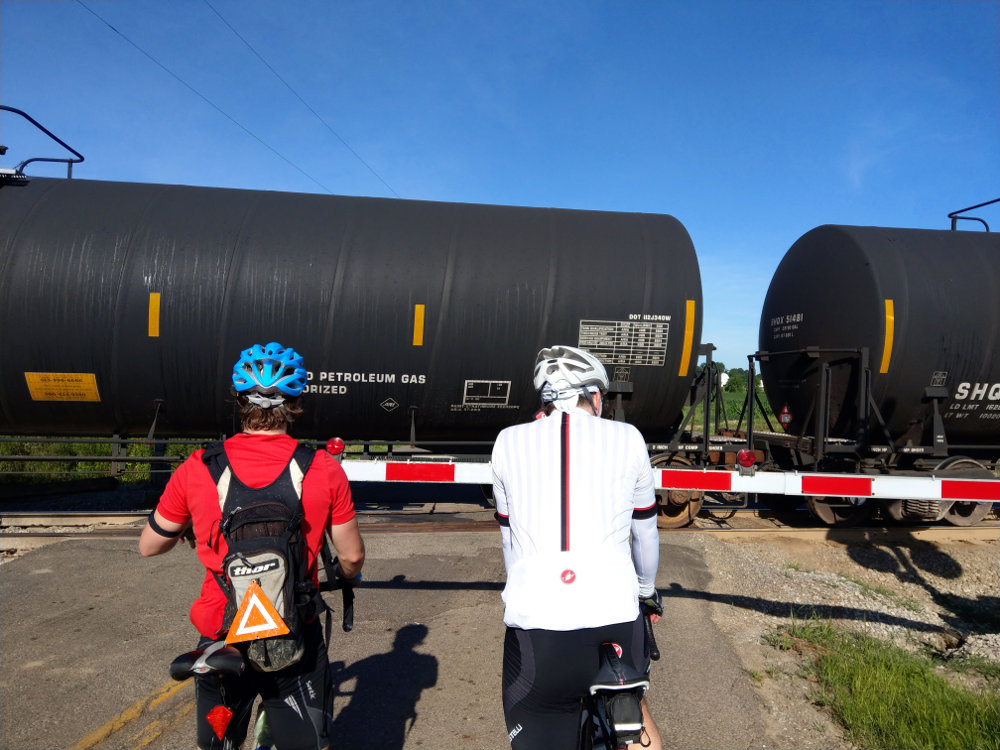
Level Crossing

Level crossing delay

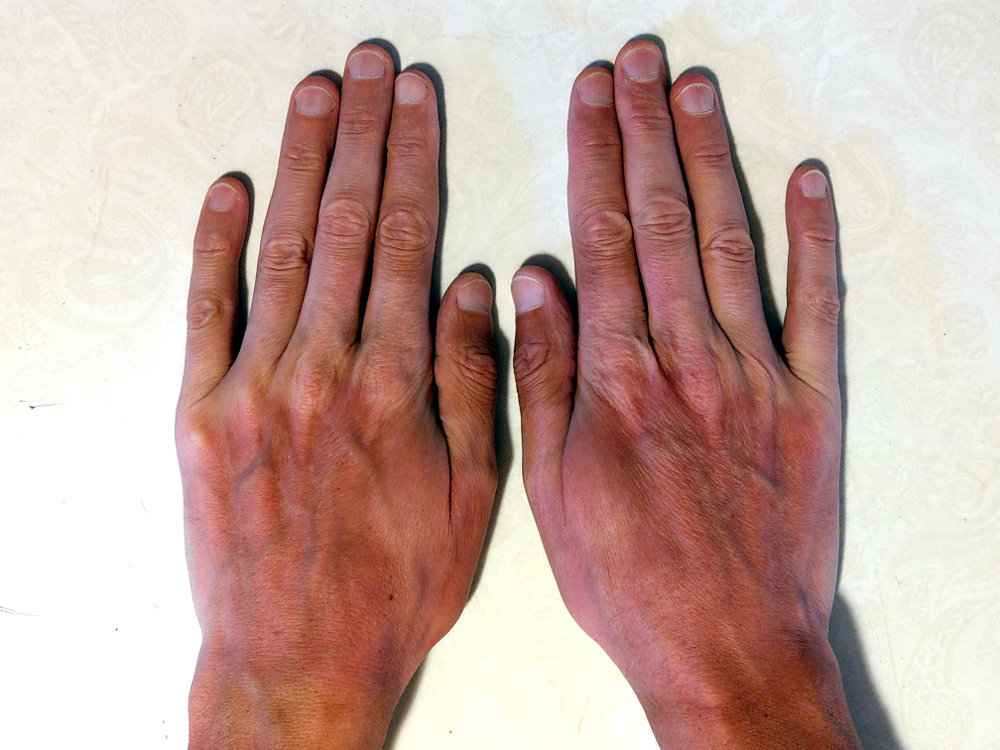
It Burns

Sunburned hands

However, having spent much of the first half of this year away from home, I was really under-trained and in desperate need of fitness before all the big summer rides. And with Inna still out of town, there was no one to inconvenience.

But the biggest reason to go was the weather. A week-long heat wave broke on Friday, leaving us with a delightfully temperate weekend. Sunny and less humid, with little wind, it was perfect weather for a long ride, so…

I got up at 3:45am Sunday “morning” and was on the road by 4:30, headed back to the city that gave us the Kent State massacre, Devo, and Chrissie Hynde.

During the drive, I noticed that almost all of Ohio’s roads are straight north-south or straight east-west, with very little variance. It made me wonder why they didn’t just name their cities by map coordinates. So if Cincinnati was called “A12” and Columbus was called “F5”, then you’d know that to get from one to the other you’d have to drive 5 units east and 7 units north. Seems like it would be a lot more efficient in a place like Ohio, since—with no diagonals—that’s just the way the roads work anyways.

Kitting up in the Copley High School parking lot, I discovered a packing mistake: the pair of cycling glove’s I’d brought were both right hands. The guy parked next to me offered to loan me a pair, but I demurred. Going bare-handed wouldn’t be any major discomfort, I thought. No big deal… If anything, it might hide or even out some of my characteristic cyclist’s tan lines.

At ten-to-seven I was in the saddle, dropping lots of riders in a desire to work up some body heat to ward off the morning coolth. Eighteen miles later, I stopped to get a selfie in front of the sign for the village of River Styx. It’s probably not an auspicious thing, crossing the River Styx with 82 miles still to ride…

Speaking of stopping, about 35 miles in I caught up with a couple riders who were stopped at a level crossing while a big freight train rolled by. Fortunately, the end (of the train) was near, and I was only delayed about three minutes.

About one-third done, I was already experiencing some physical difficulties. I was obviously undertrained and not ready for the distance, even on a flattish course like this, and by the end of the day my legs were cramping up. My knees were complaining loudly, thanks to inflammation picked up while on my recent meditation retreat. I was also having difficulty swallowing due to an undiagnosed throat irritation. The day eventually heated up, and on the last, 15-mile segment, I was so blown that I had to stop for a brief roadside rest before finishing.

This was countered by the excellent work done by the organizers at the rest stops. Twelve miles in, riders were offered donuts. At the halfway point, small sandwiches piled high with cold cuts and cheese. At Mile 70, the Dalton Dari-ette offered free ice cream! And all the stops had ice, which for me is always key.

I finally rolled back into the high school at 2:15pm. I had enjoyed the Ohio countryside and the beautiful day, but I was glad the suffering was finally over, and happily looking forward to getting into an air conditioned car for the drive back to Pittsburgh.

Pulling the bike out of the car trunk at home, I noticed that the plastic mounting tab for my Di2 electronic shifting junction box had broken. That’s an annoyance, since I’d just purchased and installed a new mounting bracket for it.

But more troublesome—though less costly—were the implications of spending seven hours in the July sun without gloves. The rest of my body has long-since adapted to sun exposure, such that I didn’t suffer any ill effects of going completely without sunblock; however, my hands have always been shielded by gloves, and the sensitive skin on the back of them isn’t seasoned to strong sunlight and got thoroughly sunburned. Lesson learned!

Nonetheless, I’m glad I went, and (mostly) had a good time. There aren’t many century rides to choose from here in Pittsburgh, and I’m happy to participate in and support those few that remain.

But whether I’m ready and willing to undertake another century happening weekend… We’ll see how well I recover!

Some interesting stuff that shouldn’t wait for the release of my 2011 PMC ride report.

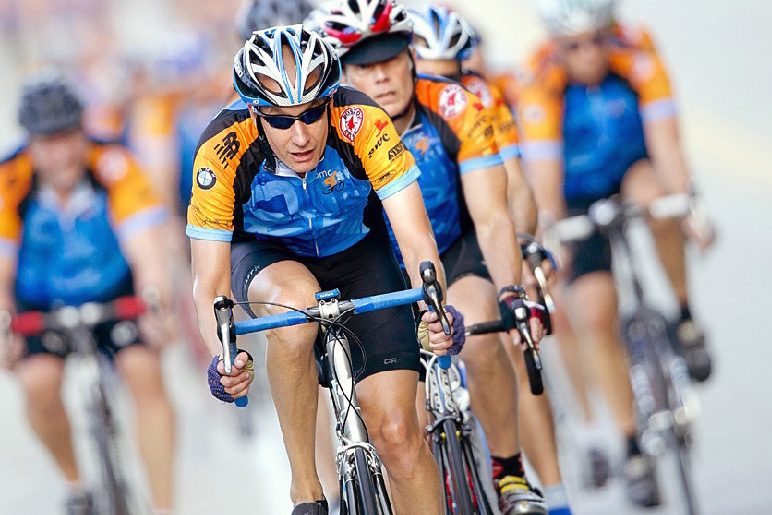
First and most importantly is that the PMC home page features a photo of me putting the hammer down during last weekend’s Pan-Mass Challenge. I was absolutely floored, because in a field of 5,200 riders it’s rare enough to have one’s picture taken, much less selected for inclusion in the post-ride photo montage!

On top of that, there are so many things about that photo that blow me away. It’s actually a good picture of me, wearing this year’s event jersey. And the jersey’s properly zipped up, a pro move that I teased my buddy Noah about a couple weeks ago. It’s a picture of intensity, with a pained grimace on the guy behind me. I’m down in the drops, leading a paceline, both of which are somewhat rare events. I didn’t even think I’d seen any event photographers on the course! If you look carefully, you’ll notice that it’s the biggest photo in the whole collage, and I’m given more prominent placement and a larger picture than Lance Armstrong and Senator John Kerry! And damn if I don’t have nice legs, too!

So yeah, when my buddy Dave Long pointed that out, I pretty much flipped my shit. Huge moment of pride, excitement, and amusement. Hopefully I’ll be able to obtain the original.

Next items are a couple of new purchases.

The first is a replacement rim for my rear wheel. Two days before the PMC, I found cracks in the rim of the Ksyrium SL that I run. So at the last second, I went to Back Bay Bikes and one of the mechanics let me borrow one of his (personal) wheels to ride the PMC with. I guess that deserves a paragraph in and of itself.

But a few days ago I got my rebuilt Ksyrium back. You might remember that I had a warranty replacement of that wheel two years ago. While they would have done a second replacement, the wheel was two months out of warranty, so I had to foot the bill to repair it. But now she’s back and hopefully will last. I wish I knew why I’m so tough on rear wheels, tho; I’ve destroyed two Ultegra and two Ksyrium SL rear wheels.

I also received the new Shimano cycling sandals I’d ordered. I’ve used two identical pairs of sandals since I started riding back in 2000, and I wore them into the ground because they don’t make that model anymore. However, one of them literally fell apart after this year’s Climb to the Clouds, so I ordered a pair of Shimano’s current model: SH-SD66.

Any time you change anything related to the contact points between you and the bike—hands, shoes, or seat—you risk screwing things up. I’ve only taken a couple rides, but so far they feel good. The most noticeable change is that the soles are stiffer, which is good, since I could feel exactly where the cleat was on my old sandals. Of course, it remains to be seen whether that stiffness is permanent or just a factor of the shoes being new, but I’m hopeful enough to retire the old ones and order a second pair to keep in rotation.

Final item is an interesting article about what it takes to be a pro cyclist, and how integral suffering is to cycling, whether one be a pro or just a neighborhood speedster. You might be interested in the whole article, but here are a couple choice citations that resonated with me:

Everything about cycling is contained in that gesture, including its reigning truism: to race bicycles is to drink greedily from a bottomless chalice of agony. The sport and its heroes are only knowable, and then just barely, once you come to understand that suffering is cycling’s currency. And what that currency buys is the occasional—the very, very occasional—moment of exquisite glory.

The first thing you notice about professional cyclists is that, with few exceptions, they appear to live their internal lives in a heavily padlocked tomb of mental anguish. They are at once astonishingly young and improbably ancient, a result of the fact that they are paid for their agony. They are modern-day ascetics, working in the open-air monastery of the mountains of Europe, with helmets as tonsures, spandex as robes.

There is thus a detachment in their manner that suggests the real world—our world—exists to them only as storybook legend, trapped as they are in another realm, with no corollaries, no points of contact, no common ground. They experience their lives through the tiny aperture of cycling; the aperture is so small because the light is so fierce. They have felt and done things on the farthest shore of the possible.

The reward for being the best isn’t that one takes *less* pain; rather that one is able to absorb *more*. The nature of this process is revealed at the precise instant that we come to know ourselves completely: we learn how far we can push ourselves, and the true mettle of our character. But that knowledge isn’t properly intelligible, nor is it transferable. To mangle Laurie Anderson’s aphorism, writing about cycling’s meta-state is like dancing about architecture. It is a private knowledge, forged in pain’s stables, and belongs to men who are not served by articulating it.

There’s no outward sign that [the cyclist] is one of the best athletes on earth. If you came across him shopping for a Billy bookcase at IKEA, you’d assume he had just returned from an island survival challenge, which he lost. Badly.

Pain. The bicycle is a pain machine.

I really didn’t know much about pain before I climbed back onto a bike in 2000 and started training for my first Pan-Mass Challenge. But the endurance athlete’s mantra of “no pain, no gain” quickly proved its verity beyond question.

It’s a strange thing: training. The whole idea is to push yourself, to stress your body so much that it triggers short-term adaptations to handle the ever-larger challenges you give it.

That is the proverbial house of pain where the athlete lives, learning to value, even to relish it. There’s a very real reason the training videos I spin to are marketed as “The Sufferfest”: riders come to identify pain with improvement.

Group rides are especially notorious, where everyone tries to push everyone else to work harder, go farther and faster. Tim Krabbé sums it up nicely in “The Rider”, his novelization of a typical bike race: “Pain, commonly seen in my circles as a signal to stop doing something, has ceased being that to me ever since [I bought my first bike].” I relate to that like some hard-won, hidden truth. And maybe it is.

From a Buddhist standpoint, I think the bike is a great place to practice with pain, to play with separating the physical experience of pain from the mental reaction that demands that we make it stop. Unless it kills you or does permanent damage, all pain is endurable. Every steep hill you climb, every time you take a pull at the front, every time you go long: those are all opportunities to see just how far you can push your pain threshold, as well as how long you can sustain it.

On my PMC rider page, I wrote, “On the road, riding 200 miles takes stamina, strength of will, and the ability to overcome pain. Those attributes are demanded in much greater quantities from cancer victims and their families.

Cancer victims are suddenly thrust into this same arena of having to deal with pain, both physical and emotional. It’s something I wouldn’t wish upon anyone.

But in a strange parallel to the training cycle, going through the pain of cancer treatment can make an individual immensely strong, especially emotionally. If you’ve been through chemo, radiation, and a life-threatening disease, your sense of the scale of what you can endure increases exponentially, and the other little trials of daily life seem downright trivial in comparison.

In that sense, cancer is a crucible that teaches people the true value of life and every moment that comprises it. I’ve heard such stories again and again; I just wish that they didn’t come at such a terrible cost.

Yes, cycling can be painful. I have ridden over 26,000 miles, many of them at or near the limit of my endurance. I’ve biked 150 miles in a single 12-hour day in the saddle, climbed the slopes of Mt. Hood, pushed myself to reach 47 miles per hour, and done more hard and/or long training rides than I could count.

But I am truly in awe of the strength, stamina, and resistance to pain that cancer patients young and old demonstrate every day. The temporary “good pain” of cycling seems silly in comparison. Theirs is the true “Sufferfest”, and I can only do this one small thing to bring about a future where such heroics are no longer necessary.

My PMC mantra is this: Through this little pain, hopefully everyone will gain.

Of course, it’s also on the bike that thoughts like this often come along:

Seeing an object in a backyard with a rounded cover: Is that a baby carriage, or is it a barbecue grill? Wait! Why can’t it be both? A combination baby carriage and barbecue grill! Why hasn’t anyone ever thought of that? Brilliant!

Frequent topics