![[personal profile]](https://www.dreamwidth.org/img/silk/identity/user.png)
Pedal to the Medal
Apr. 8th, 2022 04:44 pmMeasuring power is the gold standard of performance management on the bike. I’ve waited years for the industry to provide a pedal-based power meter that is accurate, uses mountain bike-style SPD cleats, is reasonably easy to use, and “affordable”.
In 2018 I bought a Wahoo Kickr Core indoor trainer, which allowed me to finally measure my power output over the winter. But when I took the bike off the trainer for the summer, I had to give up measuring power, and go back to estimating power (and thus fitness and fatigue) indirectly based on heart rate data.

However, after over a decade of waiting, last month I opened my wallet and acquired a set of Garmin Rally XC200 power meter pedals. Here’s some background and insight into how it’s been for me so far…
Why pedal-based? These days, you can throw a power meter on a bike in several places: pedals, crankarms, chainring spider, rear hub… A pedal-based system made sense for me because it’s the easiest to install, and the easiest to move from one bike to another. And unlike a hub or indoor trainer, it measures your power output earlier in the process, because some power is lost to friction and inefficiency in the drive train (as we’ll see in detail below).
Why the Garmin ones? One other option, the SRM X-Power, was about the same price, but they have a bad rep with pedals, and just didn’t seem able to manufacture them very quickly.
The only other option would be to buy a pair of non-SPD Favero Assioma pedals, rip out the internals, and plug that into a pair of Favero SPD pedal bodies. That would have been a couple hundred bucks cheaper, but would have voided their warranty, which is meaningful on a nearly $1,000 purchase.
Another argument in favor of the Garmins is that they have 2 to 4 times better battery life than the others.
A lot of this gets covered in exhaustive detail by the incomparable DC Rainmaker in his exhaustive Garmin Rally review from last year, as well as this year’s power meter pedal buyer’s guide.
Some miscellaneous notes: All these pedal-based units are double-sided (a necessary convenience), and also transmit your cadence to your bike computer, eliminating the need for a separate cadence monitor.
Like the Assiomas, the Garmin power meter is housed in the pedal spindle, and can be moved between pedal bodies of different styles. So if I ever decided to switch from SPD pedals to SPD-SL or Look Keo style cleats, I could just buy some empty pedal bodies and plug the power meter spindle right in.
Also, although the Garmins were very expensive, I got a tasty $240 discount thanks to REI’s spring members’ sale. Plus forthcoming reward bucks that could be applied to a new Garmin bike computer, if they were to ever release a new model…
Some usage notes: You need to keep a couple things in mind in addition to your battery life. One is that you need to let the unit acclimate to the outdoor temperature in order to get accurate readings, and that can take about ten minutes if you store and ride your bike in very different temperatures. And then you also need to do a zero-offset calibration about 10 or 15 minutes into every ride. It’s a bit of a bother, but it’s much better than we used to do with older power meters.
One big difference is the weight of the pedals. These pedals weigh 443g; they are replacing my current pedals, which weigh in at 306g. Although I’ll also be removing my dedicated cadence sensor from the bike, which is an additional 10g.
So what data do I get? I’ve already mentioned power (in Watts) and cadence, but there’s a shitton more. You get the power balance between your left and right legs. You get how much time you rode seated versus standing. You get measurements of how much power you produce at all points throughout the pedaling circle (even if that’s not of any practical value to anyone). You get measurements of whether your power is being delivered at the center of the pedal, or off to one side, which might indicate a bit of a fitting problem. And all of these are logged second-by-second for later analysis.
Can this get any geekier? I’m glad you asked!
So one of the biggest questions to ask of any power meter is its accuracy. The first units claimed to be accurate to ±5%, and up til now I’ve been assuming my Kickr is performing up to its ±2% claim. Most power meters these days (including my pedals) advertise ±1% accuracy, but how do I know? Well, let’s compare them against one another!
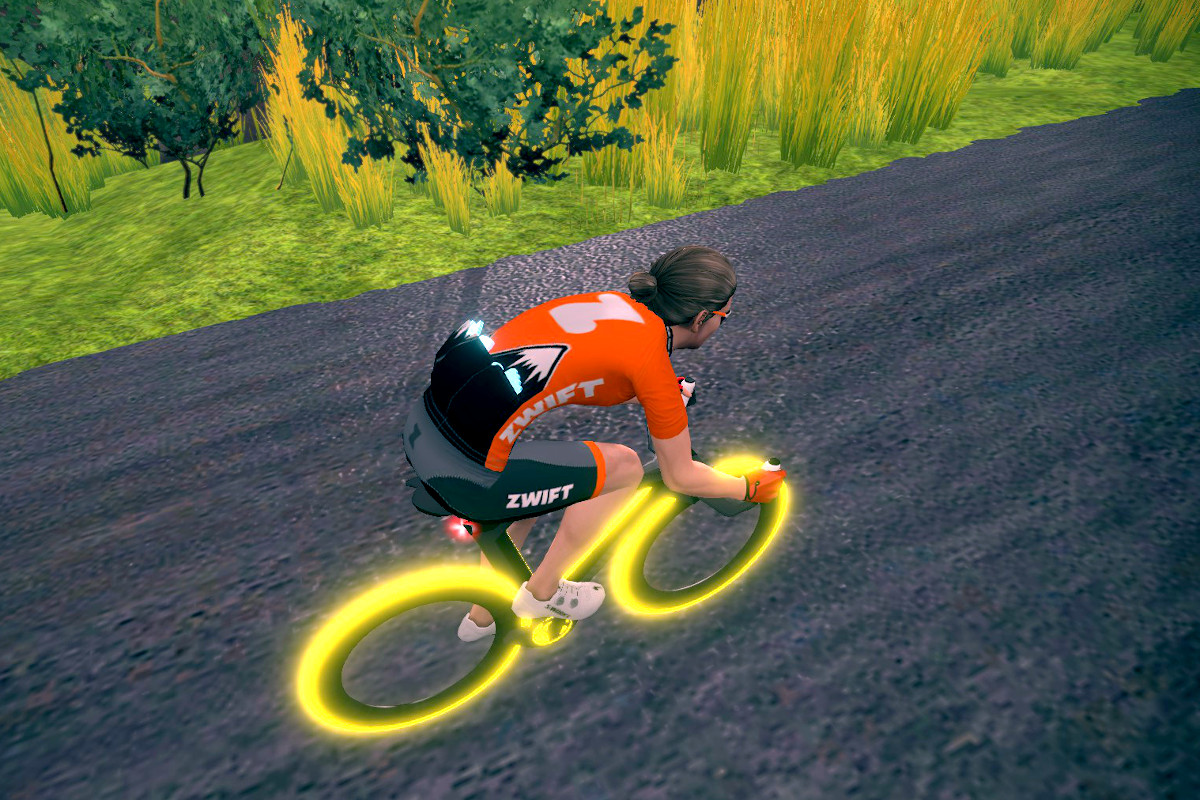
I’m going to look at two indoor trainer rides. The first is a March 31th 50-minute ride of Zwift’s Tour of Watopia Stage 3 on the hilly Downtown Titans route. The second, longer ride is ToW Stage 2’s flatter Watopia’s Waistband route on April 2th.
For each ride, I simultaneously recorded the power data coming from my Wahoo Kickr Core, and also that coming from my Garmin Rally XC200 pedals. So if things are working correctly, the measurements coming from each ride should be almost identical.
First, the numbers: As expected, cadence was virtually identical between the pedals and the crank-mounted dedicated cadence sensor (I did not take cadence from the Kickr, as trainers aren’t reliable for cadence data).
In contrast, the pedals registered an average power that was 2.7 to 4.1% higher than the trainer. Similarly, average weighted power came in 3.0 to 4.5% higher. Does that mean one power meter is slightly off, and how do we know which one?
No, everything’s fine. That small difference is eminently explainable by that thing I mentioned way back in paragraph four: power numbers coming from a trainer will be lower due to drive train losses that occur due to friction and flexion somewhere between the pedals, crankarms, chainrings, chain, cogset, and trainer. So they’ll naturally report a little lower numbers than pedals, which measure power transfer much earlier in the process. That would easily explain the 2.7 to 4.5% variation I saw.
But interestingly, when you look at maximum power (e.g. sprinting), the difference between the pedals and trainer falls to 0.6 to 1.0%. I haven’t got a good explanation for that yet.
But that’s all just summary data, and averages aren’t a great way to validate data over time. Much more revealing (and interesting) is the second-by-second detailed data. For that, we need some charts!
Next, the charts: So let’s compare the power data for each ride in the DC Rainmaker Analyzer Tool, overlaying the numbers for each ride from our two data sources to see how closely they match up. In all these charts, the red line is my Kickr Core trainer’s data, and the Garmin pedals are in green, and hopefully those lines will be almost identical.
First, let’s look at the power charts for the whole duration of both rides.


It’s a little easier to see on the first chart, since it’s less busy, but in general the numbers reported by my pedals and my trainer line up really well, with the pedals giving slightly higher numbers, as expected.
Remember tho that the first chart is 50 minutes long, and the second is 90 minutes. So although things look pretty good (yay!), this is at an extremely coarse level. For a better comparison, we really need to zoom in a little closer. Let’s find a couple representative chunks in the 7- to 10-minute range.


And there you go. Aside from the pedals’ slightly higher readings, the ups and downs of the charts are almost identical, close enough that the difference could easily be put down by the devices’ different sampling rates. No dropouts, no crazy spikes, or big differences between the curves.
In addition to a simple time-series comparison, there’s another way athletes look at power that might confirm our conclusion. For a sprinter, your overall power doesn’t matter so much as the maximum power you can put out and sustain over five, ten, maybe thirty seconds. So the critical power curve shows the maximum power you sustained over a particular duration. Obviously, the human body can generate a lot of power in short bursts, but can only sustain a more moderate power over durations measured in minutes and hours.
Unfortunately, as I’ve noted before, I’m keeping an eye on some cardiac issues and my chainrings are so worn that I can’t really sprint without dropping my chain, so my numbers are very pedestrian. Still, we can still draw some conclusions from my critical power curves for those two rides.


And this perfectly confirms everything we’ve seen so far. At just about every duration, the pedals consistently read 3 to 5% higher than the trainer, as expected. The only variance is at durations shorter than 15 seconds, where the devices’ sampling rates might impact the numbers.
So my overall conclusion is that I can definitely rely on these pedals to produce accurate power data that is very consistent with my indoor trainer, keeping drive train losses in mind.
Unless you’re a cyclist, it’s hard to convey how exciting and interesting it is to finally have a power meter on the bike year-round. At the big-picture level, this means my power data will finally be consistent between indoor and outdoor seasons, thus giving me more reliable fitness and fatigue numbers.
This means I can not only monitor my fitness and fatigue month-by-month and year-over-year, but also precisely quantify and properly pace my level of effort and reserves on a minute-by-minute basis during an individual ride of whatever duration.