A week at a Tuscan villa is a cyclist’s dream vacation: scenic rolling hills, sunny Mediterranean weather, and—in May—the chance to visit the Giro d’Italia, one of the three European Grand Tours at the elite level of professional cycling. When the opportunity arose, I leapt at the chance.

Although the trip was ostensibly to join Inna and her kin for a family reunion, cycling was my main motivation and goal. Since this is my cycling blog, that’s the scope of this post; you can read about the non-cycling aspects in my overall trip blogpost on my main blog.
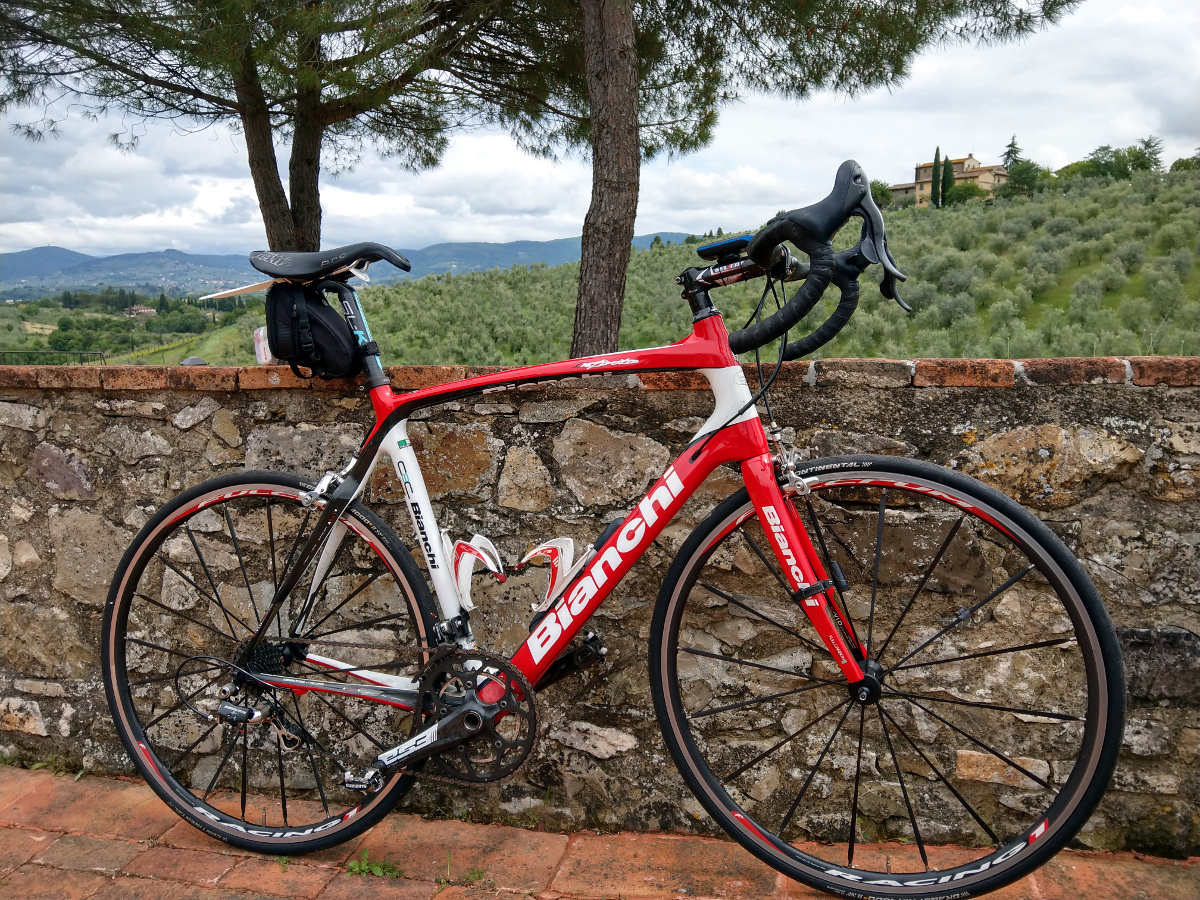
Rental Bianchi

My rental Bianchi at our villa

While the countryside was amazing, my rental bike, the weather, and my schedule all fell short of my aspirations and expectations, so I came home disappointed. Here are the details that add up to my overall underwhelming experience.

After arriving at our attractive villa late Saturday night, on Monday I drove to the Chianti Bike shop in the nearby village of Falciani. The proprietor claimed to have not received the email I’d sent requesting a week-long rental, but he spoke enough English that we communicated, and he set me up with a serviceable Bianchi Infinito.

Although Google Maps routed me along the intriguingly-named Via Ho Chi Minh in Impruneta, I drove home safely and added the various accoutrements I’d brought from home to the bike, such as my saddle bag, GPS cyclo-computer, and so forth.

The weather was cold and cloudy, with isolated rain, but between showers I set out for a quick six-mile shakedown cruise: from our villa in the village of Mezzomonte (Italian for “Half a Mountain”) down to the bottom of our ridge, then up and down another hill before climbing back up to our villa from the opposite direction I’d descended.

Having Campagnolo shifters, which work differently than my Shimano ones, the bike took a bit of getting used to. But that was nothing compared to the non-compact gearing. Whereas I’m used to riding with a lowest gear of 34x28 (32 gear-inches), the rental only went down to 39x25 (41 gear-inches). In real terms, that means its easiest gear was 28 percent harder than what I’m used to. It’s as if you took my regular bike and removed the two easiest gears.

That wouldn’t be a problem on flat terrain, but Tuscany (much like Pittsburgh) is full of short, stupidly steep hills. After a screaming, swooping descent down off our high ridge toward the town of Grassina, I made a side turn onto the little hill I wanted to climb, up to a hilltop church. With no gears sufficient for the ascent, I had to stop along the way to let my legs recover; and I never stop on climbs (thanks to the miracle of modern gearing)!

After topping that climb, flying back down to the valley, and dragging myself back up the ridge to our villa, I’d climbed over 1,000 feet in less than six miles, and was really feeling the effort, especially in the right calf I’d injured last month. Between the stupid hills and the cold, wet weather, I was already wondering who in their right mind would call Tuscany a cycling paradise!

The weather remained cold and unsettled Tuesday, and I stayed at the villa because Inna had stayed home that day, rather than sightseeing.

Wednesday morning I woke to yet more rain. Still, having spent $200 to rent a bike, I set out between storms on what looked like a simple 20-mile route downloaded from Chianti Bike’s website.

Having driven it a couple times, the road from the villa to the nearest town of Impruneta was becoming familiar, but once there, the shape of the ride became decidedly pear-esque. At first, I missed a side turn and went off track; but after backtracking, I discovered that the official route took me the wrong way up a one-way street, before it later simply rejoined the main street I’d already wrong-turned onto! That’s dumb.

Crossing the Greve

Crossing the Greve

Il Ferrone Detour

Il Ferrone Detour

As I hit a short descent into the village of Ferrone, the rain promptly started to pour again, so I pulled off and stood forlornly underneath a strip-mall overhang for 15 minutes, waiting for it to pass.

Setting out again, things got even worse. I promptly missed another turn and had to double back. After crossing the river Greve, the side road immediately turned to gravel, which at first seemed interesting, in that I’d be experiencing the same gravel roads as the nearby “Strade Bianchi” professional bike race. But it wasn’t gravel so much as deep, wet, sucking mud.

I tried climbing the side hill next to a farm before realizing I was off course and doubling back. Then I plowed through what looked like a sodden logging road and forded a stream before realizing I was again off course and backtracking. On my third try, the correct “road” looked even less-used than my previous two mistakes. With me and the bike covered in mud, I angrily decided to abort the off-road bullshit, give up on the bike shop’s route, and just set off on my own. At least then I could stick to the pavement!

So I pulled over and tried to plan an ad hoc course that would hit the same major towns as the bike shop’s route. I decided to stick to the strada provinciali: the primary roads. They were busier, with more motor vehicles passing at higher speeds, but at least they were paved!

I followed SP3 back to Ferrone, then through Falciani—recognizing the Chianti Bike shop as I passed by. Then SP2 up to Tavarnuzze, which I also recognized from the previous evening’s grocery trip. Despite the wet conditions, I flew on these smooth primary roads, which were also much flatter, congenially following the river valley rather than billy-goating up and down over steep ridges.

By then I was feeling confident enough to consider rejoining the original bike route I’d downloaded, which cut across Tavarnuzze by taking a small street over a steep hill. But in a continuation of the day’s extemporaneous nature, I was turned away by a road closure!

Back on the provincial road out of Tavarnuzze, I endured a long (but thankfully not steep) climb up SP69 through Bagnolo back to Impruneta, which was all familiar from the previous afternoon’s drive. Then SP70 back to Mezzomonte and our villa. 22 miles, and thankfully less climbing than I’d feared (1,700 feet).

If you noticed that I haven’t talked about the Giro d’Italia yet, it wasn’t because I hadn’t thought about it. If I was going to do it, Thursday would have been the day I visited the Giro. Out of all 21 stages, Thursday’s stage 12 from Osimo to Imola was the closest to Florence.

However, Imola would have required an uncomfortable and indirect two-hour drive each way, across the Apennines, and hours of standing along the roadside, waiting. It would have been a full-day committment.

At the exact same time as the riders finished in Imola, online registration opened for a difficult-to-get-into meditation retreat that I was set on attending.

Plus, Thursday was my last chance to get a meaningful ride in. So after missing my chance to see the Tour de Langkawi in Malaysia two months ago, I chose to forego my chance to see the Giro when it passed so close.
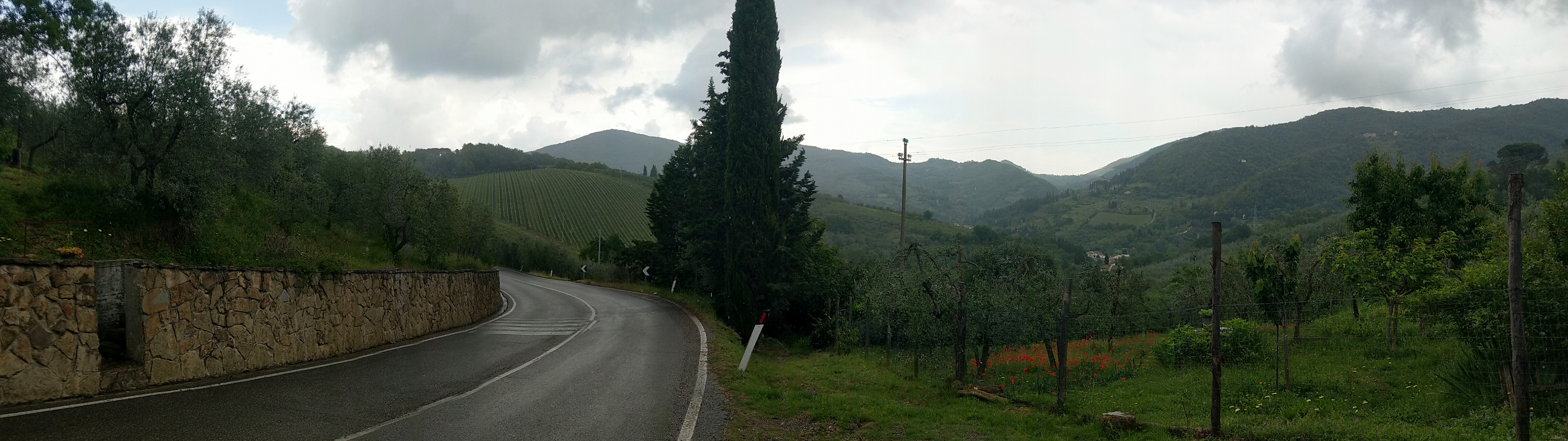
San Polo In Chianti Pano

A wet panorama in San Polo In Chianti

Because I needed to be back by 3pm to register for the retreat, I could only manage another short morning ride. I fabricated my own route into the Chianti region and set off, again defying the continued cold, wet weather.

I followed my Monday route down off the ridge and into Grassina, where it immediately started to pour. Despite my misery, I picked up SP56 and headed south through Capanuccia, San Bartolomeo a Quarate, and down into San Polo In Chianti. Then SP119 west to Strada In Chianti, north through the town on SR222 before hitting SP69 into Impruneta from the southeast, and the now comfortable SP70 back to Mezzomonte and the villa.

At just 20 miles and 1,750 feet, in wet conditions, it was a disappointing end to my riding in Tuscany.

On Friday I loaded the bike into the car and brought it back to the shop, picking up a set of red handlebar-end plugs as my only cycling souvenir to bring home from Italy.
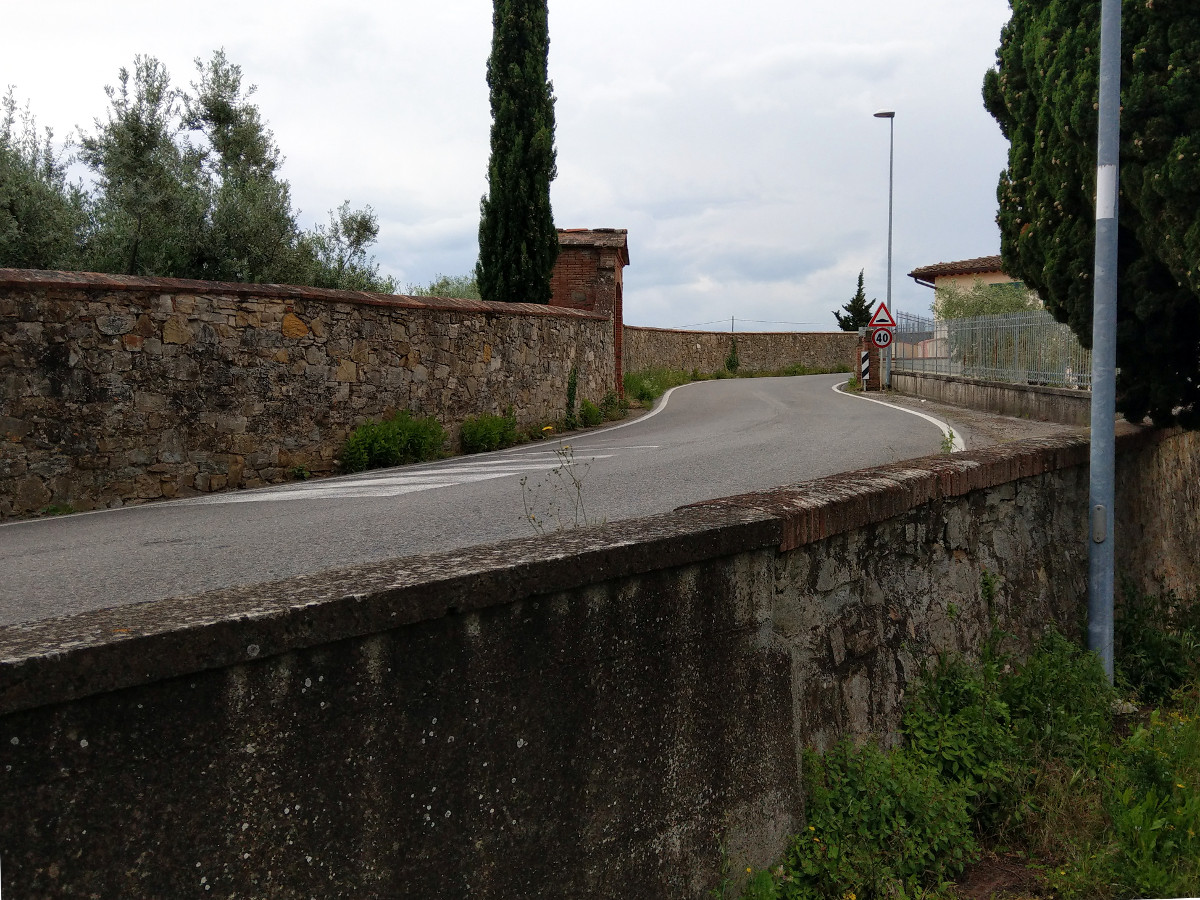
Impruneta Swoops

SP70 swoops through Impruneta

From a cycling standpoint, it was a disappointing trip. I’d anticipated long, sunny days spent exploring the countryside, admiring gorgeous views, quaint villages, and quiet roads. Instead, I missed the Giro and only managed 50 miles spread out over three very short rides, all of which were cold, wet, and miserable.

With better weather, I would obviously feel differently. The landscape is scenic and breathtaking. The roads are narrow and swooping, providing endless variety and revealing new photo opportunities every couple hundred meters. The drivers mostly didn’t cause me any problems, and certainly were less belligerent toward cyclists than in the US.

Those were all nice things that I appreciated. I have a feeling that Tuscany would be a wonderful place to ride on a nice day, with better equipment. But the absence of sun for my entire visit literally overshadowed my enjoyment of the region.

In the end, I was glad to go back home to Pittsburgh, where—despite its shitty roads and aggressive drivers—it’s sunny and warm at least some of the time.

Okay, I’ve put about 800 miles on the new bike, including two centuries and one epictacular 130-mile ride yesterday (more on that shortly); it’s time for the full-blown review.

When I set out on this (bike-buying) journey last fall, I knew it would be difficult to find a bike that would live up to my experience with my old steed, the Plastic Bullet. It served me very well, and I put 22,000 miles on it. So the bar was already set very high for the new bike.

For that reason, and because I wound up buying the exact same model, I won’t say that the R2 is a radical improvement. The geometry is almost identical, and even the curb weight is the nearly same as the old bike (the 2.5-ounce difference being about the weight of $3 in quarters).

That might sound underwhelming, but for me, finding a bike that can live up to the legacy of the Plastic Bullet (PB) is a really awesome thing. And I’m doubly appreciative of that, given the large spectrum of poorly-suited bikes that I test-rode! So despite it not being a quantum improvement, I’m absolutely and unreservedly delighted with the R2.

Although I make it sound like it’s just the same as my old bike, it’s really not. Aside from being sleek, shiny, and new, it’s no less than seven model years newer, with all the improvements and refinements that implies. I really think it rides noticeably better than the PB.

One change is that Specialized has tuned the bike a lot by altering the tube shapes. The beefier chain stays make the drive train stiffer, the thinner seat stays are more flexible to ease road feel, and the head tube (which is disproportionately large in my 61cm size) is less ugly/noticeable than before because the tubes arc and gracefully ease together where they join.

They also flattened the top tube like a squashed cylinder. That might not sound important, but it’s an unexpected convenience when stopped, when I (like many riders) will sit on the top tube. However, the lesser top tube height makes it a more difficult place to affix a name decal!

The handlebars are likewise flattened on top, providing a more ergonomic place for one’s hands. And of course the Roubaix’s classic polymer “Zertz” vibration-dampening inserts improved over the years, as well.

One of the more noticeable differences is that the R2 uses internal cable routing. That gives the bike a cleaner, refined look, but sometimes confuses me, because when I used to work on the PB on a repair stand, I’d stop a rotating rear wheel by reaching up to the top tube and yanking on the exposed brake cable that ran alongside it; no exposed cables on the R2!

A major difference that worried me initially was the move from a triple chainring to a compact double, and the consequent loss of top- and bottom-end gears. Of course, I never think about needing either an easier or harder gear during regular daily riding, but I have noticed it on hilly rides, where my old triple gave me both easier gears for steep climbs and higher top-end gears for faster descents. So far that hasn’t been a show-stopper for me, but we’ll just have to see how it goes. I expect mountainous rides will be more challenging than they used to be.

I was also concerned about the shifting reliability of the compact double (they tend to be balky because of the large difference in size between the large and small chainrings), but that has been admirably handled by the electronic brain drivetrain.

Which brings up the biggest, most obvious difference with the new bike: the Di2 electronic shifting, which I’ve pretty thoroughly described in a previous post. I can’t say it has been 100 percent flawless, but it’s definitely close (much closer than old-school mechanical shifters), and in the long run I’ll be very happy that I spent the extra money.

I recently toggled its software flag for multi-shift, which lets me swap two or three gears with one long button click. That makes it a lot easier to navigate urban streets, with all the stopping and starting you have to do in town, and has perfectly addressed the only complaint I had about my bike’s electronic brain. I’m only 60 days in, but Di2 has been a daily delight.

And there’s always the cool factor of the sound of electric servo motors moving the derailleurs into a new position. During my first group ride on the new bike, after one front chainring shift my buddy Joe called up to me from behind, “Dude… Are you a robot???”

Damned right! I’m a macheen!

So while you might not have noticed much enthusiasm in my comments to date, I’m absolutely delighted with the new bike. I went into the process with extremely high requirements, and R2-Di2 has surpassed even those expectations. I was looking for the best bike on the planet, and I’m very happy to say that I think I found it.

Ride on! Right, R2?

(Photo essay still forthcoming…)

So as I was saying, after a very short acceptance test ride, I bought my new bike last Monday.

Of course, it rained Tuesday. And Wednesday. And Thursday and Friday and Saturday, too. But finally it cleared up last night, and stayed clear for half the day today, which was enough to get a 61-mile shakedown cruise in with the Quad Cycles folks.

Mind you, it wasn’t exactly ideal weather for a ride. After all that rain, there’s been a lot of flooding. But worse than that, the wind was blowing at a sustained 30 mph, with gusts up to 50 mph! Not only did that make biking difficult to begin with, but it also brought down a ton of wet leaves, wet pine needles, and whole branches of trees. It was a bit of an obstacle course out there.

But this post isn’t about the weather, but about the bike. For those who care, it’s a 61cm 2006 Specialized Roubaix Expert Triple. That means a couple things.

First, it’s a Roubaix. They’re designed for long distance riding, and are especially designed to handle rough roads. I have to say that even at 120psi, where you’d feel the road painfully on most bikes, the Roubaix rode like buttah, but without feeling like you were riding in an Oldsmobile. Responsive, but compliant.

Second, it’s 61cm. Bike stores don’t carry *anything* in 61cm. That’s Jolly Green Giant size. So it was going to be a special order right from the start, which meant I was probably going to pay list for it. But the sizing feels great; it’s the only bike out of all the ones I test rode that actually feels comfortable and natural, where I wasn’t constantly conscious of the bike’s fit. It just feels right.

Third, it’s a 2006. I rode a couple 2005 Roubaixs, but they didn’t knock my socks off, so I took a couple extra weeks and waited for the 2006s to come out. Well, actually, I snuck a few looks at the 2006 line on some UK sites, since they were released there earlier than in the US… But eventually they were released in the US. The differences are noteworthy: a different wheelset, carbon fiber cranks, a more attractive paint job, and—most importantly—the newer 10-speed Shimano Ultegra group instead of the old 9-speeds that they had on the ’05s. Of course, since I ordered the bike as soon as it was available, that’s another reason why I wound up having to pay list for it.

And the triple. A lot of riders think having three chainrings is wimpy, and that the few ounces of weight savings is significant. They’re cracked. First, I’m used to my hybrid and its mountain bike gearing, which ranges from 29-108 gear inches. In other words, it’s got crazy low gears. And I do a lot of mountain climbing, so I need low gears. The Roubaix double—same price, by the way—only goes down to 36 gear inches, while the trip goes all the way down to 30, almost as low a gear as my hybrid had! Second, I’m rapidly becoming an old man, and I stopped falling prey to the brainless machismo thing more’n a decade ago. I need those low gears. The third reason might surprise some people: the triple has a much higher high gear than the double! The latter tops out at fairly moderate 112 gear inches; the triple has a high gear that reaches all the way up to 120 gear inches. So not only do I get a much easier low gear, but I also get a much bigger high gear!

Now, the bike is all carbon fiber: frame, forks, cranks, even the seatpost! Hence its nickname of “Plastic Bullet”. When you tap the frame with your fingernails, instead of a metallic ping, it sounds like you’re tapping a plastic cup. But it’s light, and it climbs like a gazelle.

The one big change from the hybrid is my saddle height. The guys at the bike shop set me up with the saddle a full inch higher than I had it set on the hybrid, which is an immense change to my pedaling stroke. I can’t say it’s better yet, but I’ll give it a shot for a while and see how it works out. I will say that my chafe points moved, but that’s probably just a situational thing. So far the saddle is working out very well, which was another one of my big concerns moving to a road bike.

So how did it ride? Well, it’s smooth, sleek, and strong. I really feared moving from a fairly mooshy ride to a tighter frame, but the Roubaix really eats up the ground shock. It really was a pleasure to ride.

The one overriding thing I felt was that I had a lot more power at my disposal than I ever had on the hybrid. I don’t feel like I’m riding at my limit most of the time; at any point I could jump, with a lot more high-end speed than I had before. It’s a really nice feeling of power.

Of course, it comes at a bit of a price, and the price is my vanity slash ego slash machismo. Because the bike’s so much more capable, it really shows my weaknesses more. When I’m on, I can jump and ride with the best of ’em, but if I’m tired or blown, there’s no jump in me at all. So training’s going to be even more important, so that I can call up that additional capacity whenever I need it. But that feeling of power is really nice…

The only other thing I need to mention is that I also outfitted the Plastic Bullet with a new cyclometer that I’ve been lusting after for at least two or three years: the Ciclomaster CM434. It’s outta control geekery. It goes way beyond the usual trip miles, total miles, average and max speeds, and riding time. It’s got (are you ready for this?) current altitude and incline percent; max altitude and incline; total height climbed and descended; current, max, and min temperature; and current, average, and max watts output.

So that’s the ride report for the big shakedown cruise. Ironically, it is exactly five years and one day since I took the Devinci hybrid out for its 50-mile maiden voyage out to Framingham and back.

Oh, I suppose I should mention that the Devinci will live on as my commuter bike. There’s no way I’ll be leaving the Plastic Bullet chained up in any public place, and the Devinci will do good service in the rain and snow. Soon it’ll sprout fenders and panniers and all the accoutrements of a true workhorse. We’ve had some wonderful times, but after five years and sixteen thousand miles, I think it’s happy to relinquish its days of hard riding and long miles.

Happy day! Hopefully the weekends will continue to be tolerable weather, because I’d really like to take the Roubaix down to Great Blue Hill and give it a real serious climb to chew on…

Frequent topics